Few restaurant launches create debate before most people have even taken a single bite.
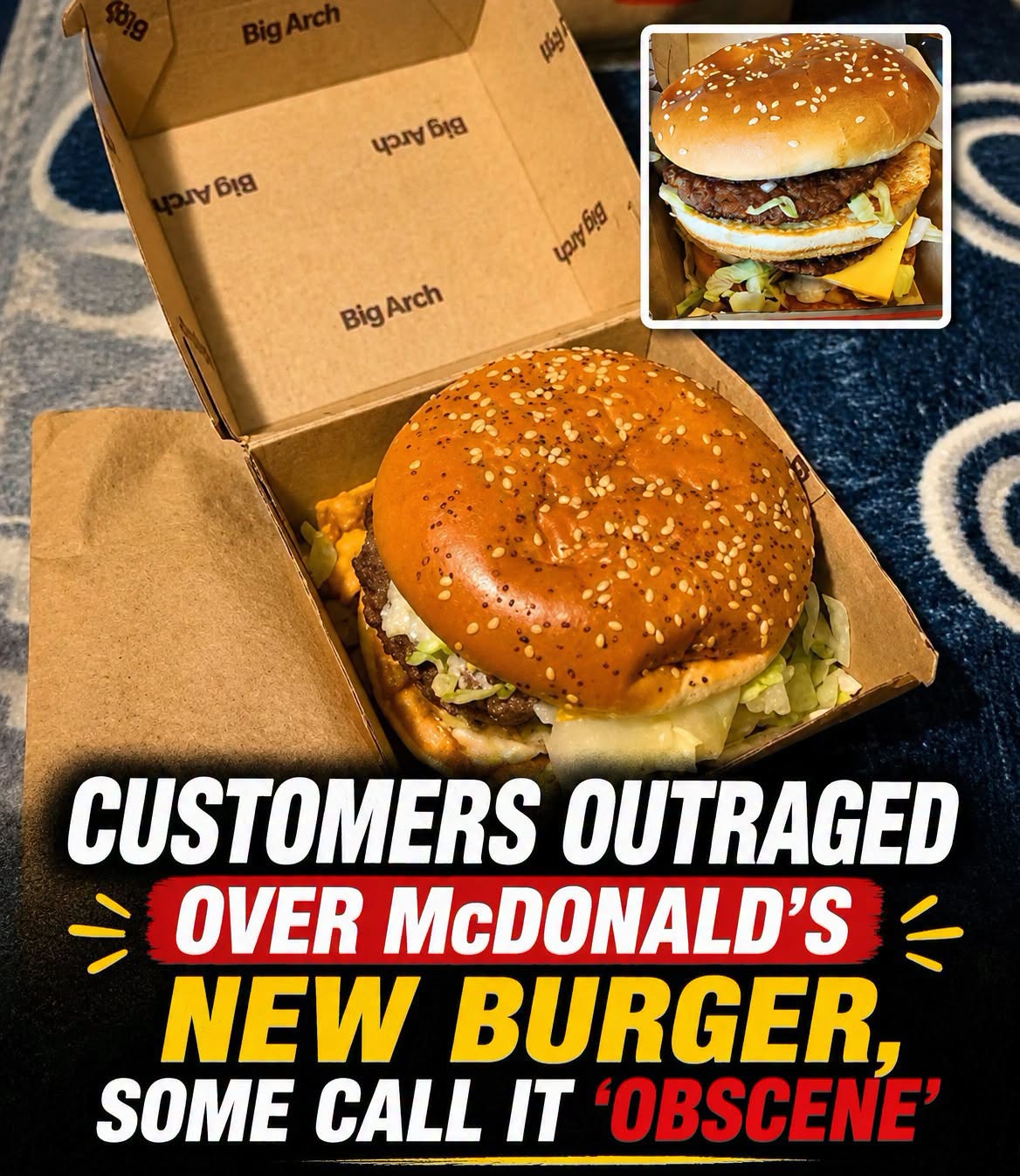
Yet that is exactly what happened when McDonald’s introduced the Double Big Mac to customers in the United States. Before the sandwich reached many trays, social media was already overflowing with reactions. Some customers celebrated its arrival as the ultimate fast-food indulgence, while others questioned whether the oversized burger represented everything that has gone wrong with modern eating habits.
The conversation quickly spread far beyond the restaurant itself.
Some called the burger exciting.
Others described it as excessive.
A few even labeled it “obscene.”
What could possibly inspire such dramatically different reactions?
The answer lies in what the Double Big Mac actually represents.
At first glance, the concept is remarkably simple.
Take one of the world’s most recognizable burgers and make it bigger.
Instead of the traditional two all-beef patties found in the classic Big Mac, the Double Big Mac features four beef patties stacked between the familiar three-piece sesame seed bun. The sandwich still includes shredded lettuce, pickles, onions, slices of processed cheese, and the famous Big Mac sauce that has become synonymous with the brand for generations.
Nothing about the recipe is revolutionary.
The ingredients remain largely unchanged.
The proportions, however, tell a different story.
For longtime fans of the original Big Mac, the larger version feels like a celebration of everything they already enjoy.
More beef.
More flavor.
More of the familiar experience they grew up with.
Many customers immediately embraced the oversized sandwich as the kind of limited-time treat meant to be enjoyed occasionally rather than analyzed endlessly.
To them, fast food has never been about perfection.
It has always been about comfort.
A familiar wrapper.
A recognizable taste.
A meal that reminds them of road trips, childhood birthdays, late-night cravings, or quick lunches during busy workdays.
The Double Big Mac simply amplifies that nostalgia.
But not everyone sees it that way.
Critics argue that the larger sandwich symbolizes a culture already struggling with portion sizes.
The United States has long faced conversations surrounding obesity, chronic disease, nutrition, and rising healthcare costs.
Against that backdrop, introducing an even larger version of one of the country’s most famous burgers inevitably raises questions.
Some wonder whether restaurants should continue encouraging increasingly oversized meals.
Others ask whether consumers truly need larger portions when many already struggle with maintaining balanced diets.
For these observers, the burger becomes something much bigger than lunch.
It becomes a cultural symbol.
The nutritional information also enters the discussion.
The Double Big Mac contains substantially more calories than the traditional version, primarily because of its additional beef patties.
Protein increases.
Fat increases.
Sodium rises as well.
Nutrition experts often remind consumers that no single food determines overall health.
Instead, long-term eating patterns matter most.
An occasional indulgence rarely defines someone’s lifestyle.
Problems arise when high-calorie meals become everyday habits without sufficient balance from fruits, vegetables, whole grains, and physical activity.
Many dietitians emphasize moderation rather than elimination.
From that perspective, a Double Big Mac is not inherently “good” or “bad.”
It simply represents one meal choice among many.
Understanding its nutritional content allows consumers to make informed decisions based on their own dietary needs and preferences.
Price has also become part of the conversation.
Depending on location, customers have reported paying significantly more for the Double Big Mac than for the original sandwich.
In an era when inflation continues affecting grocery bills and restaurant menus alike, many people question whether the larger burger offers enough additional value to justify its cost.
Some happily pay for the extra meat.
Others believe the price pushes fast food beyond what many families can comfortably afford.
Economic pressures only intensify these debates.
For some households, fast food remains an occasional convenience.
For others, rising prices mean eating out has become increasingly rare.
Every menu item now competes not only with other restaurant options but also with the cost of preparing meals at home.
The Double Big Mac therefore enters an environment where every purchase feels more carefully considered than it might have just a few years ago.
Interestingly, the sandwich itself is not entirely new.
Before arriving in the United States, the Double Big Mac had already appeared in several international markets, where it generated similarly mixed reactions.
Some countries welcomed it enthusiastically.
Others treated it as an amusing novelty.
Its international history demonstrates that conversations surrounding portion size extend well beyond American borders.
Wherever it appears, people seem equally fascinated by the question of just how large a familiar favorite should become.
The debate also reflects broader changes in consumer expectations.
Today’s customers often expect restaurants to provide both indulgent options and healthier alternatives simultaneously.
Many fast-food chains now offer salads, fruit, grilled items, lower-calorie beverages, and customizable meals alongside traditional burgers and fries.
Consumers increasingly seek choice rather than rigid definitions of what restaurants should serve.
Some visit specifically for indulgence.
Others prioritize convenience.
Still others focus on affordability.
A single menu must somehow satisfy all of them.
That balancing act has become increasingly difficult.
Social media has amplified every opinion surrounding the Double Big Mac.
Photos comparing it with the original Big Mac circulate constantly.
Some users celebrate the impressive stack of beef.
Others post humorous comparisons, suggesting the sandwich belongs more in a food challenge than an ordinary lunch.
The internet rarely rewards moderation.
Extreme reactions spread fastest.
One dramatic photograph or strongly worded opinion often reaches millions before quieter perspectives receive attention.
As a result, products like the Double Big Mac quickly become cultural talking points.
People who never intended to order one still find themselves discussing it.
Some eventually buy it simply to discover whether the online excitement matches reality.
Curiosity alone becomes powerful marketing.
For McDonald’s, limited-time menu items have long served exactly this purpose.
They generate conversation.
They encourage repeat visits.
They give customers something new without permanently replacing beloved classics.
Whether someone loves or dislikes the Double Big Mac, they are still talking about McDonald’s.
From a business perspective, that visibility carries enormous value.
Ultimately, the Double Big Mac represents different things to different people.
For one customer, it is an occasional guilty pleasure.
For another, it symbolizes excess.
Some see nostalgia.
Others see changing food culture.
Some celebrate freedom of choice.
Others question where reasonable portion sizes should end.
Perhaps that explains why the sandwich has generated so much attention.
It is not merely four beef patties layered inside a sesame seed bun.
It has become a conversation about personal responsibility, consumer choice, corporate marketing, nutrition, affordability, and the role fast food plays in modern life.
The burger itself remains unchanged regardless of those opinions.
It simply sits on the tray, waiting to be judged one bite at a time.
Whether customers embrace it enthusiastically or decide the original Big Mac remains the better choice, one thing is certain.
Few limited-time fast-food items have managed to spark quite as much discussion before becoming part of so many lunch orders.
Sometimes the biggest thing on the menu is not the sandwich itself.
It is the conversation surrounding it.