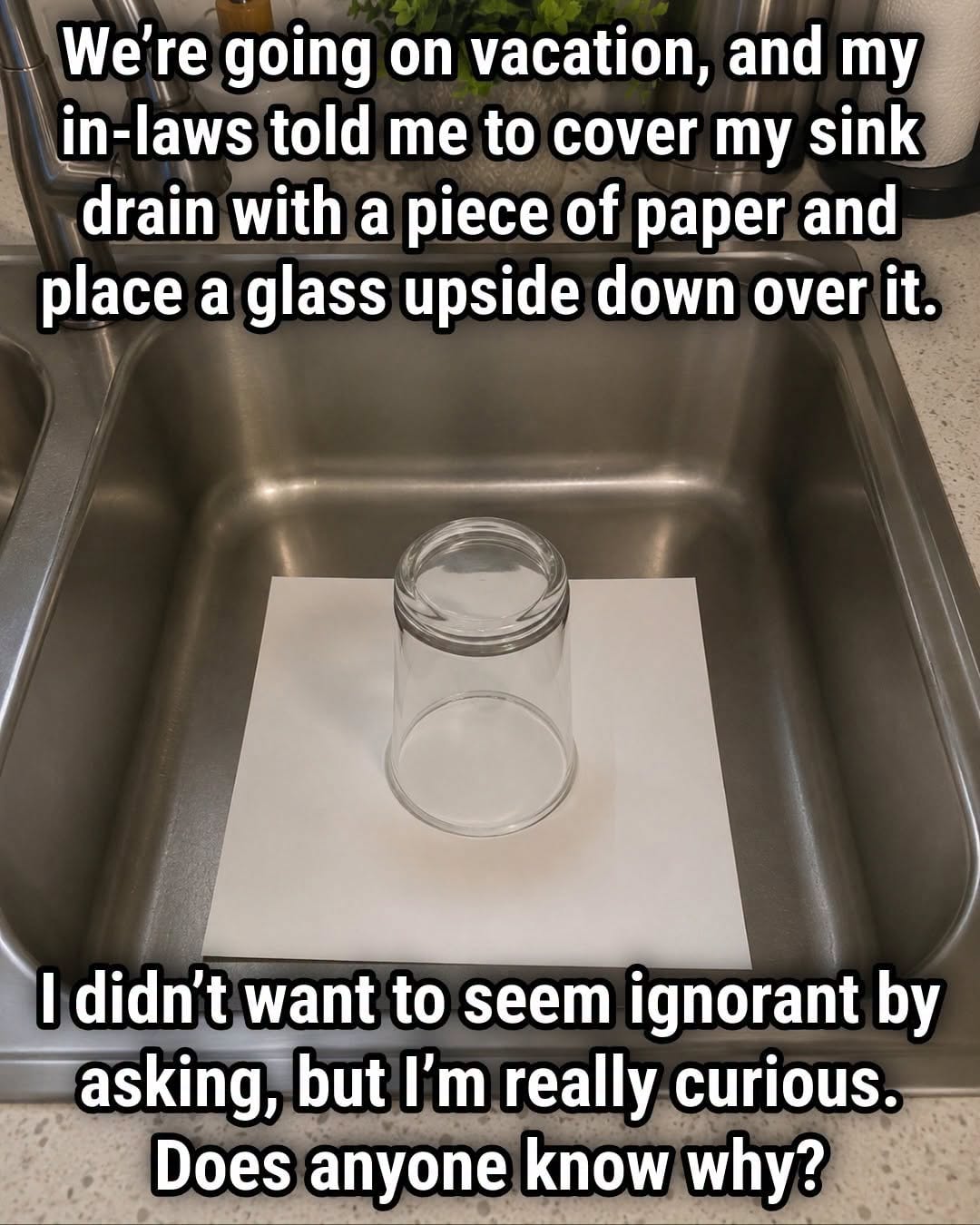
If you spend enough time online before a vacation, you’re almost guaranteed to stumble across unusual home-preparation hacks. One of the latest viral tricks suggests placing a sheet of paper over your sink drain and covering it with an upside-down glass before leaving town.
According to thousands of social media posts, this simple setup supposedly keeps foul sewer odors out of your home while also preventing insects from crawling up through the drain.
At first glance, the idea seems oddly convincing.
After all, drains are connected to the plumbing system beneath your home, so covering them appears like a reasonable way to stop unpleasant smells or unwanted pests from making an appearance while you’re away.
But does the hack actually work?
The answer is more complicated than a simple yes or no.
Interestingly, the viral trick is based on a real plumbing principle. The problem isn’t the science behind it it’s the way the solution has been presented.
To understand why, it helps to know what is happening underneath every sink, bathtub, shower, and floor drain in your home.
Hidden beneath those fixtures is a curved section of pipe known as a P-trap.
Most homeowners have heard the term before, but many don’t realize just how important this small piece of plumbing actually is.
The curved shape of the pipe isn’t designed to catch dropped jewelry or lost objects.
Its primary purpose is to hold water.
That standing water creates an invisible seal between your home and the larger sewer system outside.
As long as water remains inside the P-trap, unpleasant sewer gases cannot travel back into your home. The water barrier also discourages insects and other pests from entering through the plumbing system.
It’s one of the simplest and most effective features in modern plumbing.
However, that protection depends entirely on one thing.
The water has to stay there.
If a drain sits unused long enough, the water inside the P-trap slowly evaporates.
Once the trap dries out, the protective seal disappears.
Without that barrier, sewer odors can enter the home, and in some situations, insects may also find an easier path inside.
This is the real plumbing issue that inspired the viral vacation hack.
People understand that unused drains can eventually lose their water seal, so they look for ways to slow evaporation while they’re away.
In theory, covering the drain makes sense.
The problem is that the paper-and-glass method simply isn’t reliable.
An upside-down drinking glass resting on top of a sheet of paper rarely forms an airtight seal.
Even a tiny gap allows air to circulate.
The paper itself may become damp from humidity, curl around the edges, or shift position over time.
A slight vibration or accidental bump before leaving could even move the entire setup.
Instead of protecting your home, the arrangement often becomes little more than decoration.
The idea isn’t completely wrong.
It’s just incomplete.
Fortunately, there are much better ways to accomplish the same goal.
Before leaving on an extended trip, plumbers recommend starting with the simplest step of all.
Run water through every drain in your home.
Turn on each sink for ten to twenty seconds.
Run water in showers and bathtubs.
Flush every toilet.
Don’t forget laundry room drains or basement floor drains if your home has them.
Doing this refills every P-trap with fresh water, restoring the protective seal exactly as it was designed to function.
For shorter vacations lasting a few days—or even a week or two—this step alone is usually enough.
In most homes, P-traps hold their water for several weeks before evaporation becomes a concern.
However, some situations cause water to disappear more quickly.
Homes in extremely dry climates.
Properties exposed to constant airflow.
Unused guest bathrooms.
Basement floor drains.
Laundry standpipes.
Very warm indoor temperatures.
These conditions can speed up evaporation considerably.
If you’re planning to be away for several weeks or longer, adding another layer of protection becomes worthwhile.
Rather than balancing glasses over paper, plumbers recommend sealing the drain properly.
Many sinks already include built-in drain stoppers.
Simply closing them provides a much better seal than an upside-down glass.
Rubber sink plugs also work extremely well because they’re designed specifically for this purpose.
Reusable silicone drain covers are another inexpensive option that creates a tighter barrier while remaining easy to remove when you return home.
Even plastic wrap secured with painter’s tape can provide a temporary seal if necessary.
The objective isn’t complicated.
You simply want to reduce airflow over the drain opening.
Less airflow means slower evaporation.
Some experienced plumbers even recommend an additional trick for homeowners leaving for especially long trips.
After filling the drain with water, pour a small amount of mineral oil into the drain.
Just a tablespoon is usually enough.
Because mineral oil floats on top of water, it creates an additional layer that dramatically slows evaporation inside the P-trap.
It’s important, however, to use mineral oil rather than cooking oil.
Cooking oils can become rancid over time and may contribute to buildup inside pipes.
Mineral oil remains stable and is commonly recommended for this exact purpose.
Preparing your plumbing before vacation doesn’t stop with drains.
Many professionals suggest cleaning the garbage disposal before leaving.
Food particles left behind can produce unpleasant odors while the home sits empty.
Taking a few minutes to rinse and freshen the disposal prevents surprises when you return.
If you’re traveling during winter in colder regions, checking exposed pipes for proper insulation is also a smart precaution.
Frozen pipes remain one of the most expensive plumbing emergencies homeowners face.
Some people also choose to shut off the home’s main water supply before leaving.
While this step isn’t always necessary, it offers extra protection against unexpected leaks or burst pipes that could otherwise continue flowing unnoticed for days.
Ultimately, the viral sink hack became popular because it was built around a genuine plumbing concept.
People recognized that unused drains can dry out and searched for an easy solution.
Unfortunately, the simplified version circulating online leaves out the details that actually matter.
The real protection comes from maintaining the water inside the P-trap and minimizing evaporation—not from balancing household objects over the drain.
As with many internet hacks, the idea contains just enough truth to sound convincing.
But when practical experience meets social media simplicity, professionals usually recommend a more dependable approach.
Before your next vacation, skip the paper and upside-down glass.
Instead, refill every drain with fresh water, seal them properly if you’ll be gone for an extended period, consider adding a small amount of mineral oil for extra protection, and enjoy your trip knowing your home’s plumbing is protected the way it was actually designed to be.