
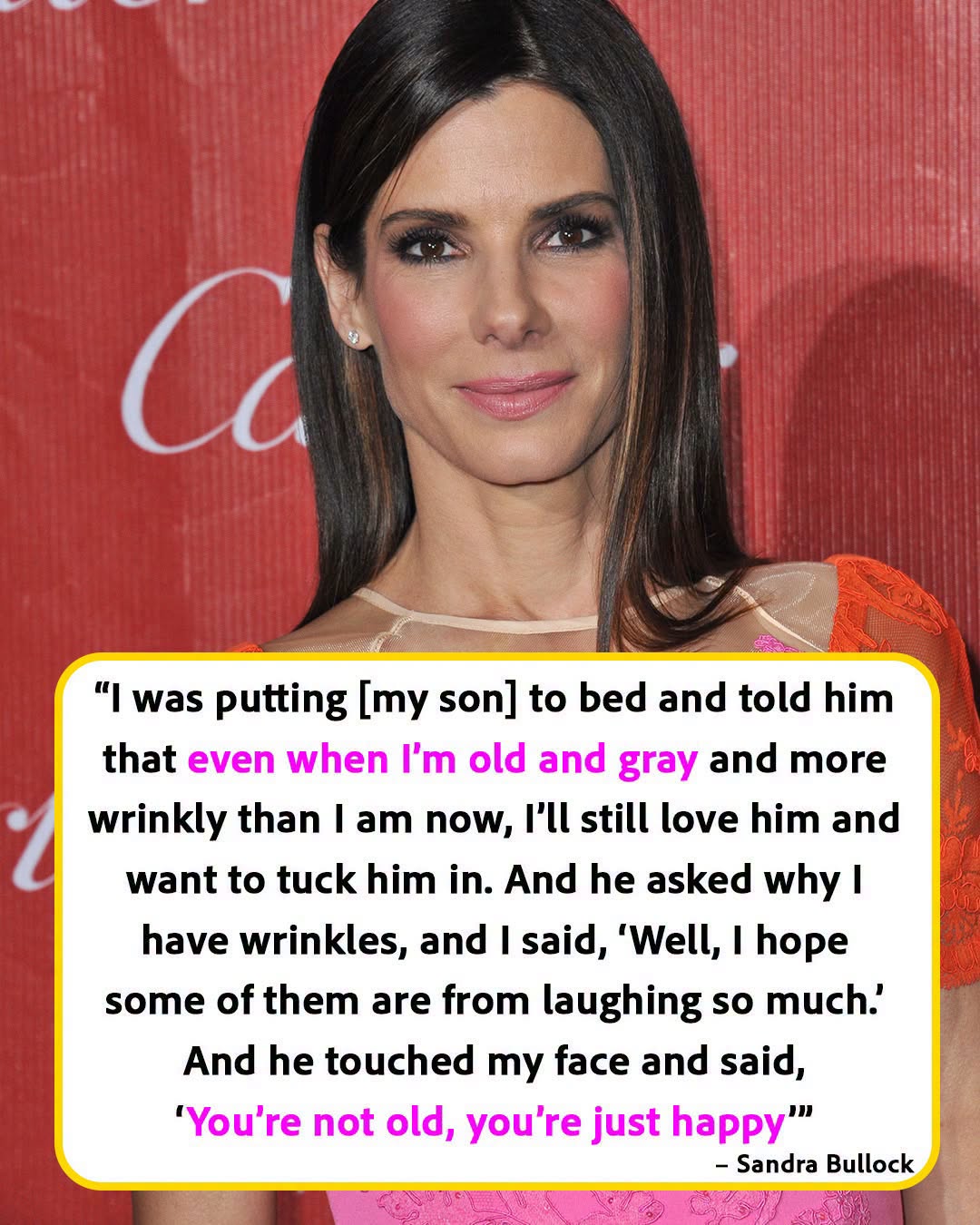
At 61, Sandra Bullock isn’t trying to outrun time.
She isn’t pretending aging doesn’t exist.
She isn’t chasing the impossible goal of looking exactly as she did thirty years ago.
Instead, she has embraced something many people spend their entire lives searching for.
Peace.
The Academy Award-winning actress, known for unforgettable performances in films like Speed, While You Were Sleeping, Miss Congeniality, The Blind Side, and Gravity, has spent decades in the spotlight.
To millions of fans, she appeared confident, funny, successful, and effortlessly composed.
But behind the cameras, Bullock admits she spent much of her younger life battling something far less visible.
Constant worry.
She now looks back on those years with remarkable honesty.
If she could sit down with her younger self today, she knows exactly what she would say.
Stop worrying so much.
It sounds simple.
Almost too simple.
Yet she believes countless hours of her life disappeared beneath endless cycles of anxiety over things that either never happened or never truly mattered.
Like many people, Bullock found herself trapped inside an exhausting pattern of “what if.”
What if she made the wrong decision?
What if people judged her?
What if she failed?
What if she disappointed someone?
The questions never seemed to end.
Even during periods when her career was thriving, uncertainty remained a constant companion.
Success didn’t silence self-doubt.
It simply changed its shape.
Instead of celebrating achievements, she often focused on possible mistakes.
Instead of enjoying the present, her thoughts drifted toward future problems that might never arrive.
Looking back now, she realizes how much energy disappeared into imagined scenarios.
Some worries were undeniably important.
Others seem almost humorous in hindsight.
She has joked about questioning everything.
Her work.
Her parenting.
Her decisions.
Even whether she had remembered to clean up after her dogs before guests arrived.
At the time, however, none of those concerns felt small.
Each carried genuine emotional weight.
That is one of anxiety’s greatest tricks.
It convinces us that every uncertainty deserves immediate attention.
Every decision feels enormous.
Every possible mistake becomes catastrophic.
Over time, those accumulated worries quietly consume moments that can never be recovered.
Bullock recognizes that now.
She describes those years with compassion rather than regret.
She understands why she worried.
She simply wishes she had trusted herself sooner.
Then her life changed forever.
Her son, Louis, arrived.
Motherhood transformed far more than her daily routine.
It transformed her perspective.
Like many new parents, Bullock discovered that raising a child introduced entirely new responsibilities.
There were schedules to manage.
Health to protect.
Dreams to nurture.
Unexpected challenges appeared almost daily.
Ironically, despite having more reasons to worry than ever before, something inside her began changing.
Her priorities shifted.
Instead of allowing every anxious thought to dominate her attention, she gradually learned to pause.
She began asking herself a simple question.
What truly matters right now?
That question became surprisingly powerful.
Rather than spiraling endlessly through hypothetical disasters, she focused on what actually needed her attention in the present moment.
Was her son safe?
Was he loved?
Was she doing her best?
If the answer was yes, many other worries suddenly lost their power.
Motherhood didn’t magically erase anxiety.
Bullock has never claimed that.
She still experiences uncertainty.
She still has difficult days.
The difference lies in how she responds.
Fear no longer controls every decision.
Instead, she views it differently.
Rather than treating fear as an immovable wall blocking progress, she now sees it as something closer to a warning light.
Sometimes fear contains valuable information.
It encourages caution.
Preparation.
Reflection.
Other times, it simply creates unnecessary noise.
Learning to distinguish between those two experiences became one of life’s greatest lessons.
That wisdom extends beyond parenting.
It influences how she approaches work, relationships, and aging itself.
Bullock has spoken openly about accepting the passage of time.
Rather than fighting every gray hair or every wrinkle, she increasingly values what each passing year has given her.
Experience.
Perspective.
Confidence.
Self-acceptance.
Those qualities cannot be purchased.
They arrive only through living.
In an entertainment industry often obsessed with youth, Bullock’s attitude feels refreshingly honest.
Hollywood has long rewarded impossible standards.
Actors frequently face pressure to remain forever young.
Appearances become headlines.
Aging becomes something to conceal.
Bullock has gradually stepped away from that mindset.
She understands that physical changes are inevitable.
More importantly, she no longer believes they define her worth.
That shift represents a freedom many people spend decades pursuing.
Her fans have noticed the difference.
Interviews reveal someone increasingly comfortable speaking honestly about life’s imperfections.
She doesn’t present herself as someone who has solved every problem.
Instead, she shares the ongoing process of learning.
That authenticity resonates because it reflects ordinary human experience.
Everyone worries.
Everyone questions themselves.
Everyone occasionally wishes they had handled certain moments differently.
Bullock’s willingness to admit those feelings makes her advice surprisingly universal.
She isn’t offering complicated self-help formulas.
She isn’t claiming happiness requires perfection.
Instead, her message centers on presence.
The present moment deserves more attention than imagined futures.
That lesson became especially meaningful after motherhood.
Being fully present for Louis required slowing down mentally.
Children naturally pull adults back into the present.
They ask immediate questions.
Need immediate comfort.
Celebrate immediate joys.
Watching her son grow encouraged Bullock to experience life alongside him rather than mentally racing ahead toward future concerns.
Without fully intending to, she discovered something unexpected.
By becoming more present for her child, she also became more present for herself.
The life she had spent years chasing wasn’t hidden somewhere in the future.
It had been unfolding quietly around her all along.
She simply hadn’t always noticed it.
Today, Bullock continues prioritizing family over constant public attention.
She has intentionally stepped back from relentless filming schedules, choosing instead to spend more time with the people who matter most.
That decision reflects the same values she now speaks about so openly.
Success means little if there is no time to experience the life it creates.
Looking back across her remarkable career, Bullock certainly appreciates the awards, iconic films, and worldwide recognition.
Yet those accomplishments are no longer the only measures of a meaningful life.
She now values ordinary moments just as deeply.
Conversations.
Family dinners.
Quiet mornings.
Simple laughter.
The small experiences anxiety once distracted her from have become life’s greatest rewards.
If she could speak to the younger woman constantly questioning every decision, her advice would probably sound surprisingly gentle.
Trust yourself.
Stop trying to control every possible outcome.
Most of the things keeping you awake at night will never happen.
And the ones that do will usually prove far less frightening than you imagined.
Life doesn’t become easier because worry disappears.
It becomes richer because attention returns to where it belongs.
Sandra Bullock hasn’t discovered the secret to avoiding fear.
She has discovered something far more valuable.
Fear doesn’t have to dictate how life is lived.
Sometimes the greatest transformation isn’t changing your circumstances.
It’s finally allowing yourself to fully experience the beautiful life that has been waiting patiently in front of you all along.