It was one of those ordinary afternoons when I decided to tackle a chore I had been putting off for weeks.
My son was out with friends, and I figured it was the perfect time to straighten up his room. I wasn’t snooping for anything. I simply wanted to pick up the laundry, dust the shelves, and make enough space on the floor so I wouldn’t step on another pair of sneakers.
As I wiped down his desk, something small caught my eye.
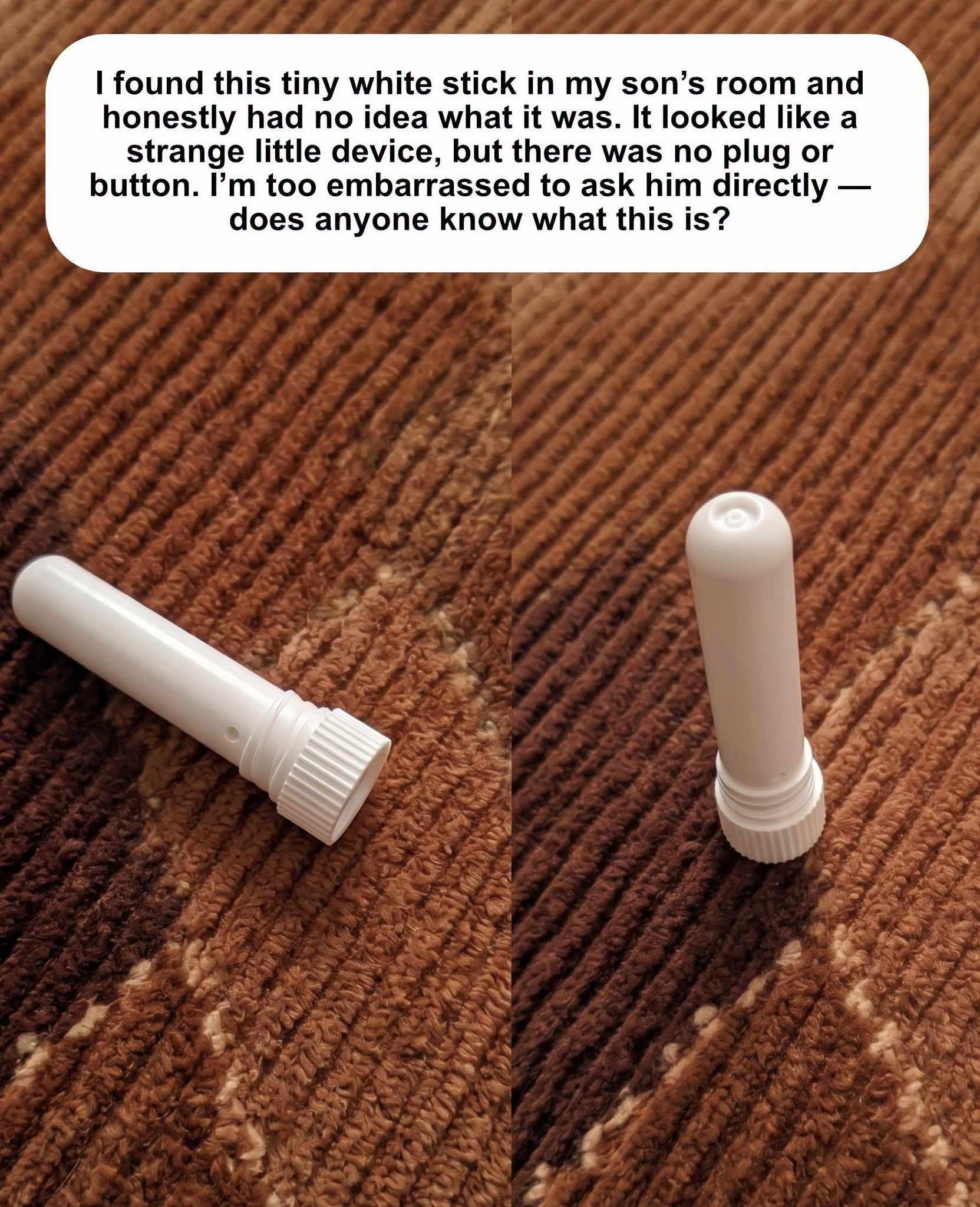
Tucked beside a stack of books was a tiny white plastic stick.
It wasn’t much bigger than my finger.
At first glance, it looked too unusual to ignore.
It had a simple design with a few tiny openings near one end, and it didn’t resemble anything I recognized immediately.
I picked it up and turned it over in my hand.
There were no flashing lights.
No screen.
No obvious labels.
Just a small white object that seemed strangely out of place.
The longer I looked at it, the more questions I had.
Almost instantly, my imagination took over.
Could it be some kind of vaping device?
A piece of expensive technology?
A hidden camera?
Some strange gadget teenagers use that adults have never even heard of?
The possibilities seemed endless.
And, unfortunately, most of the ones I imagined were not good.
I considered asking my son the moment he got home.
But then I hesitated.
What if I was completely wrong?
What if I embarrassed him over something perfectly innocent?
Teenagers already have enough reasons to think their parents don’t understand them.
I didn’t want to become another story he laughed about with his friends.
So instead of confronting him, I decided to investigate on my own.
I searched online.
I typed every description I could think of.
“Small white plastic stick.”
“Tiny white device with holes.”
“White tube found in bedroom.”
The internet, as usual, was anything but helpful.
Some websites suggested medical products.
Others insisted it could be electronic.
A few discussions immediately jumped to vaping.
Several people confidently identified completely different objects.
Every answer only made me more confused.
The more I searched, the more convinced I became that I had discovered something mysterious.
I even found myself comparing pictures late into the evening, zooming in on tiny details, trying to convince myself that one image matched the object sitting on my kitchen table.
It became almost ridiculous.
One tiny plastic stick had completely hijacked my thoughts.
The next morning, I looked at it again with fresh eyes.
It still looked unfamiliar.
It still raised questions.
But something inside me finally said what I probably should have realized from the beginning.
Maybe I should simply ask.
Before I had the chance, though, I stumbled across one final discussion online.
Someone had posted a photograph of an object that looked almost identical.
Within seconds, dozens of replies appeared beneath it.
“It’s just a nasal inhaler.”
“Looks like a Vicks inhaler.”
“I keep one in my purse.”
“I carry one every allergy season.”
I stared at the screen.
Then I looked at the object again.
Suddenly everything made sense.
The tiny openings weren’t hiding electronics.
They weren’t part of a secret recording device.
They weren’t ventilation holes for a vape.
They were simply designed to allow menthol vapors to pass through.
The mystery object was nothing more than a portable nasal inhaler used to relieve congestion from colds, allergies, or sinus discomfort.
That was it.
No hidden meaning.
No secret habit.
No dangerous discovery.
Just an inexpensive little product that has existed for decades.
The more I read, the more ordinary it became.
People carry them everywhere.
They end up in backpacks.
Car glove compartments.
Jacket pockets.
Desk drawers.
Bedside tables.
For many people, they are as common as lip balm or tissues.
I couldn’t help laughing.
Not because the object was funny.
Because of everything my own imagination had built around it.
In less than twenty-four hours, I had quietly convinced myself that I was solving some enormous mystery.
The reality couldn’t have been more ordinary.
That experience stayed with me long after I learned what the object actually was.
I realized the little white stick had never really been the story.
The real story was how quickly my mind filled empty spaces with fear.
As parents, we spend years trying to protect our children.
We notice small changes.
We worry about things they don’t even think about.
Sometimes that instinct serves us well.
Sometimes it helps us recognize genuine problems before they become serious.
But other times, worry quietly grows into assumptions.
We start writing stories before we’ve gathered any facts.
A forgotten object becomes suspicious.
A closed bedroom door feels mysterious.
A simple misunderstanding turns into silent anxiety.
Parenting teenagers can feel like balancing on a tightrope.
You want to trust them.
You also want to protect them.
Those two instincts often pull in opposite directions.
It’s easy to let imagination take control when communication feels awkward.
Looking back, I realized how close I came to creating unnecessary tension over something completely harmless.
If I had stormed into his room demanding answers, I probably would have embarrassed both of us.
Instead, the experience reminded me of something much more valuable.
Sometimes the simplest explanation really is the correct one.
And sometimes the best solution isn’t hours of internet research or endless speculation.
Sometimes it’s just having an honest conversation.
That tiny white stick eventually went back where I found it.
Not because it mattered anymore.
But because it reminded me of an important lesson.
Parenting isn’t just about noticing unusual things.
It’s about resisting the urge to let fear answer questions before your child has the chance to.
This time, the mystery turned out to be nothing more than a pocket-sized nasal inhaler.
But the bigger discovery had nothing to do with the object itself.
It was realizing how easily worry can create problems that never actually existed and how often trust begins with simply asking before assuming.