Cleaning out my grandmother’s dresser was supposed to be a simple task.
The drawers held exactly what everyone expected.
Old photographs.
Yellowed recipe cards.
Handwritten birthday letters.
Buttons collected over decades.
Loose spools of thread.
Tiny boxes whose contents only she could explain.
Every object seemed to tell a story.
Some brought laughter.
Others stirred quiet sadness.
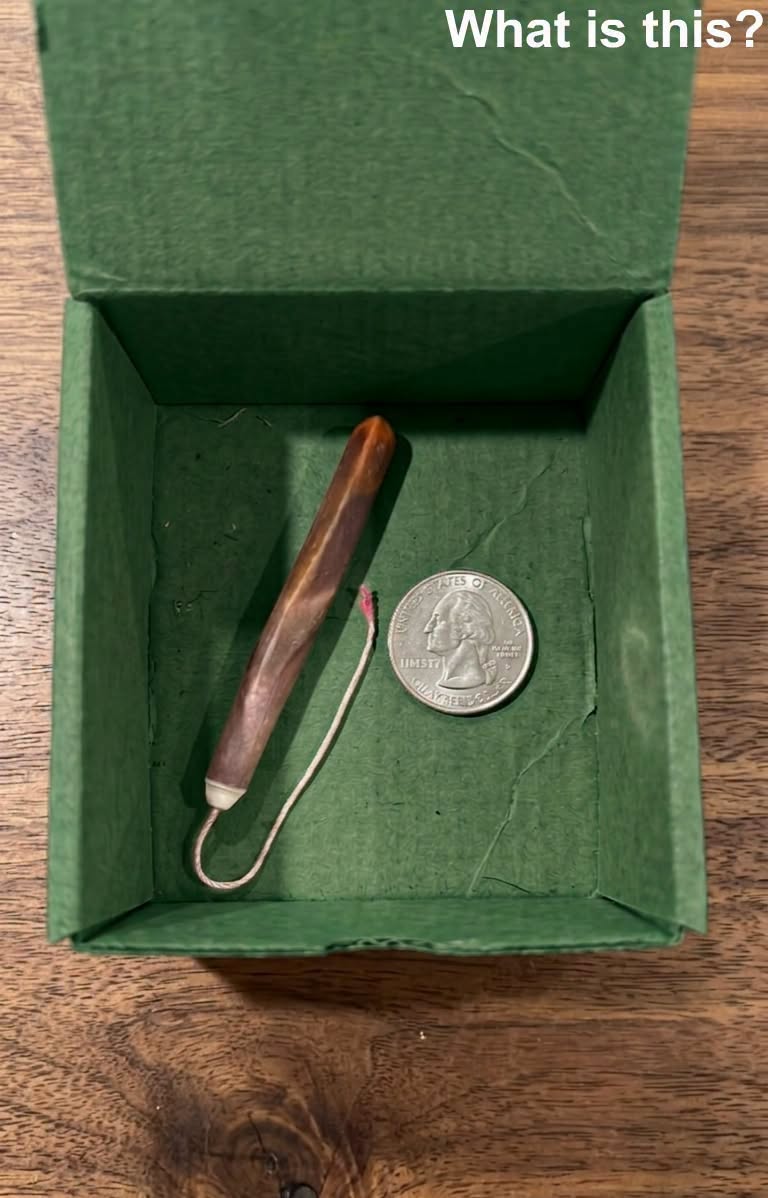
Then, tucked into the back corner of one forgotten drawer, I found something that immediately stopped me.
It was long.
Thin.
Made of polished metal.
One end narrowed into a sharp point, while the opposite end widened into a small handle worn smooth by years of use.
It looked deliberate.
Important.
But completely unfamiliar.
I turned it over in my hands several times.
There were no labels.
No instructions.
Nothing to reveal its purpose.
The longer I examined it, the more mysterious it became.
At first, I assumed it belonged with her sewing supplies.
After all, the drawer contained thread, needles, measuring tape, and dozens of other sewing notions.
Yet this object seemed different.
It didn’t resemble any sewing tool I had ever seen.
Its sharp tip made it look almost surgical.
For a moment, my imagination began filling in the missing pieces.
I found myself replaying memories from childhood.
I could still picture my grandmother sitting beside the living room window every afternoon.
Sunlight streamed across the floor while her old sewing machine hummed steadily.
She worked with remarkable concentration.
Her hands moved confidently across fabric, guiding each stitch with effortless precision.
Occasionally, she paused to adjust thread or inspect a seam before continuing.
As children, we rarely appreciated what she was doing.
To us, she was simply sewing.
Only years later did I realize she wasn’t merely repairing clothes.
She was creating them.
School uniforms.
Curtains.
Pillowcases.
Aprons.
Halloween costumes.
Holiday tablecloths.
Countless garments our family wore had passed beneath those patient hands.
Yet despite watching her sew so many times, I couldn’t remember seeing this strange metal tool.
That absence made it seem even more mysterious.
Had she hidden it intentionally?
Did it serve another purpose entirely?
The possibilities became increasingly imaginative.
Perhaps she had once worked in a profession we never knew about.
Maybe it belonged to her mother before her.
Could it have been connected to some forgotten family tradition?
The mind has an extraordinary ability to invent stories whenever facts are missing.
The unfamiliar object slowly transformed into something almost mythical.
Every unanswered question seemed to invite another.
I showed it to several family members.
Everyone had a different theory.
One cousin thought it looked like an antique ice pick.
Another suggested it might have belonged to an old medical kit.
Someone else guessed it was part of a knitting set.
None of the explanations felt convincing.
The mystery continued growing.
Eventually, curiosity won.
I searched through vintage sewing guides, old photographs, and collections of antique household tools.
Hours passed before I finally found a matching image.
The answer was surprisingly simple.
The mysterious object was a vintage sewing stiletto.
Not a weapon.
Not a medical instrument.
Not a forgotten family secret.
Just one of the most useful tools an experienced seamstress could own.
The discovery completely changed how I looked at it.
A sewing stiletto isn’t used for cutting.
Instead, it serves as an extension of the sewer’s hand.
Its pointed tip allows delicate fabric to be guided safely beneath the sewing machine needle without placing fingers dangerously close.
It helps press tiny corners into perfect shape.
It opens stubborn seams.
It positions narrow folds with remarkable accuracy.
It keeps fabric perfectly aligned during difficult stitches.
Professional tailors and experienced sewists often consider it indispensable.
Suddenly, dozens of childhood memories made sense.
I remembered how confidently my grandmother worked with difficult fabrics.
I remembered the precision of every collar, cuff, pocket, and hem.
That little metal tool had quietly contributed to thousands of careful decisions I had never even noticed.
The object itself hadn’t changed.
Only my understanding had.
What initially appeared intimidating now seemed graceful.
Its pointed design wasn’t meant for danger.
It existed purely to improve craftsmanship.
That realization carried unexpected emotion.
As children, we often notice only finished results.
We admire the completed dress.
The repaired jacket.
The perfectly fitting shirt.
Rarely do we appreciate the countless small tools and techniques hidden behind those accomplishments.
Every skilled craft contains invisible details.
The sewing stiletto represented one of them.
My grandmother probably reached for it hundreds, perhaps thousands, of times throughout her life.
Its smooth handle reflected years of steady use.
Each tiny scratch marked another afternoon spent creating something useful for someone she loved.
She never spoke about the tool.
She never explained its purpose.
She simply used it.
Quietly.
Efficiently.
Without expecting recognition.
That realization felt surprisingly profound.
So much of her life had followed the same pattern.
She rarely sought attention.
She solved problems before anyone noticed them.
She repaired torn clothing without complaint.
She shortened pants.
Replaced buttons.
Patched blankets.
Altered dresses.
Hemmed curtains.
Countless acts of care unfolded almost invisibly.
The sewing stiletto became a symbol of that quiet devotion.
It represented work that mattered deeply while often going completely unnoticed.
Perhaps that’s true of many meaningful lives.
The greatest acts of love frequently leave behind no headlines.
No applause.
Only subtle evidence scattered throughout everyday life.
A carefully mended shirt.
A warm quilt.
A child’s Halloween costume.
A favorite tablecloth brought out every holiday.
Years later, families remember the comfort those things provided without always recognizing the patience required to create them.
That small metal tool now sits safely among our family’s keepsakes.
Not because it is valuable in any financial sense.
Antique sewing stilettos can certainly interest collectors, but its importance to us has nothing to do with rarity.
It matters because it belonged to her.
Because it reminds us of afternoons filled with quiet concentration.
Because it reminds us that extraordinary love often appears in ordinary forms.
Every time I see it now, I think less about mystery and more about craftsmanship.
Less about hidden secrets and more about steady dedication.
I picture sunlight falling across fabric.
The soft rhythm of an old sewing machine.
Patient hands guiding cloth one careful stitch at a time.
Sometimes the most meaningful discoveries aren’t the ones that uncover dramatic family secrets.
Sometimes they simply help us understand someone we loved a little more deeply.
A strange object hidden inside an old dresser became exactly that.
Not evidence of an unknown life.
Not proof of forgotten adventures.
Instead, it became a quiet reminder that behind every carefully sewn garment was a woman whose patience, precision, and love touched our family in ways we only fully understood after she was gone.