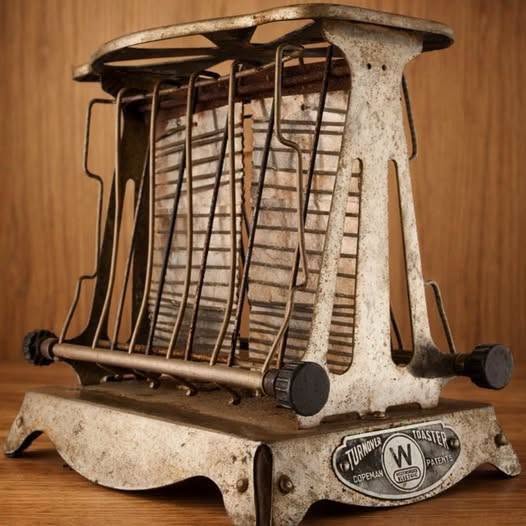
At first glance, it looks more like a strange science experiment than a kitchen appliance.
It has exposed metal wires, an unusual frame, and no obvious buttons or digital display. There are no sleek plastic panels, no glowing touchscreens, and certainly none of the convenience modern kitchens have taught us to expect.
Ask someone under the age of 40 what it is, and chances are they’ll stare at it in complete confusion.
Some guess it’s a miniature clothes dryer.
Others think it’s an antique heater or even a laboratory device.
Very few arrive at the correct answer.
Yet nearly a century ago, this mysterious machine occupied a place of honor in millions of homes.
Every morning, families gathered around it.
Children watched it carefully.
Parents relied on it.
And breakfast wasn’t quite complete until it had done its job.
The object is an early electric turnover toaster, one of the most fascinating household inventions of the early twentieth century.
While modern toasters hide their heating elements safely inside polished metal shells, these early versions displayed everything openly.
Glowing electrical coils sat completely exposed.
Slices of bread rested against metal racks only inches away from the heating elements.
When switched on, the wires slowly turned bright orange as electricity flowed through them.
The transformation itself felt almost magical.
For many families, electricity was still relatively new.
Watching invisible power suddenly become visible through glowing metal created a sense of wonder that is difficult to imagine today.
But using one of these early toasters required something modern appliances rarely demand.
Attention.
Unlike today’s automatic models that quietly pop toast out when finished, early turnover toasters expected users to participate in the entire process.
You couldn’t simply insert bread and walk away.
If you did, breakfast would quickly become charcoal.
Instead, people stood nearby, carefully observing the bread as it slowly browned.
There were no timers.
No automatic sensors.
No programmed settings.
Everything depended on human judgment.
When one side reached the perfect golden color, the user manually flipped each slice to toast the opposite side.
That single movement gave the appliance its name.
Turnover toaster.
It may sound inconvenient today.
Yet for many families of the 1920s and 1930s, the process became part of the morning routine.
Breakfast unfolded at a slower pace.
Parents prepared coffee.
Children packed school bags.
Conversations filled the kitchen.
Someone always kept one eye on the toaster.
Rather than an interruption, it became a shared ritual.
Every perfectly toasted slice represented patience rather than automation.
These early electric toasters also represented something much larger than breakfast.
They symbolized a dramatic transformation taking place across society.
For generations, preparing toast meant working over open flames, cast-iron stoves, or wood-burning fireplaces.
Smoke blackened ceilings.
Ash accumulated constantly.
Cooking demanded continuous effort.
Then electricity entered the home.
Little by little, familiar routines began changing.
Lights replaced oil lamps.
Electric irons replaced heavy cast iron heated over fire.
Vacuum cleaners reduced exhausting manual labor.
And simple appliances like the turnover toaster introduced families to a cleaner, more predictable way of cooking.
The toaster itself became one of the earliest household symbols of modern living.
Owning electric appliances suggested progress.
Visitors admired them.
Neighbors discussed them.
Children grew up believing electricity represented the future.
Looking back today, one feature immediately captures attention.
The exposed heating coils.
Modern safety standards make such designs almost unimaginable.
Today, electrical heating elements remain carefully enclosed behind insulated materials.
Consumers rarely see the mechanisms operating inside.
The early toaster, however, proudly displayed every component.
Nothing was hidden.
You watched electricity create heat in real time.
The engineering remained fully visible.
From today’s perspective, the design appears risky.
Accidental burns were certainly possible.
Curious children needed supervision.
Kitchen accidents occasionally occurred.
Yet during the early decades of household electrification, this openness reflected confidence rather than carelessness.
Manufacturers wanted consumers to witness the remarkable technology working before their eyes.
It reinforced trust.
People could literally see the electricity doing its job.
As engineering advanced, toaster technology evolved rapidly.
Manufacturers introduced enclosed heating chambers.
Automatic timers followed.
Then spring-loaded mechanisms.
Eventually, the familiar pop-up toaster emerged.
Suddenly, breakfast required almost no attention.
Insert bread.
Push the lever.
Walk away.
Moments later, perfectly toasted slices appeared automatically.
The old turnover toaster gradually disappeared from everyday kitchens.
Most were discarded.
Others found their way into attics, garages, or family basements.
Many eventually became scrap metal during wartime recycling campaigns.
As decades passed, surviving examples became increasingly rare.
Today, collectors actively search for them.
Vintage appliance enthusiasts appreciate not only their unusual appearance but also what they represent historically.
Museums frequently include early electric toasters in exhibits exploring twentieth-century domestic life.
To historians, they tell an important story.
Not merely about toast.
About technological change.
Household appliances often receive little historical attention because they seem so ordinary.
Yet they quietly reshape everyday life more than many famous inventions.
The turnover toaster shortened morning routines.
It reduced reliance on open flames.
It introduced families to dependable electric cooking.
Small changes accumulated into major social transformation.
Women managing households benefited from growing convenience.
Children experienced cleaner kitchens.
Families gradually embraced electric living without fully realizing they were participating in one of history’s greatest technological revolutions.
There is also something undeniably charming about these early machines.
Modern appliances prioritize speed, efficiency, and invisibility.
Most perform their tasks silently behind polished surfaces.
The turnover toaster did the opposite.
It invited participation.
You watched it.
Listened to it.
Judged the bread yourself.
Success depended partly on experience.
Each slice reflected your own timing.
In many ways, the toaster encouraged mindfulness long before that word became fashionable.
Rather than rushing through breakfast, people naturally slowed down.
The simple act of making toast became an activity instead of a background process.
Perhaps that’s one reason these vintage appliances continue capturing people’s imagination.
They remind us that progress once unfolded more slowly.
Each invention felt remarkable because families experienced its benefits directly.
Electricity itself remained exciting.
Every glowing wire hinted at possibilities still waiting to arrive.
Today’s kitchens contain appliances early homeowners could scarcely imagine.
Smart refrigerators order groceries automatically.
Coffee makers connect to smartphones.
Ovens recognize food using artificial intelligence.
Yet every one of those innovations traces part of its history back to humble inventions like the turnover toaster.
Without these early experiments, modern convenience would not exist.
The mysterious metal device sitting quietly in antique stores or museum displays is therefore much more than an outdated kitchen gadget.
It represents optimism.
Innovation.
Curiosity.
It marks the moment when electricity stopped being a scientific marvel and became part of ordinary family life.
What once seemed revolutionary eventually became routine.
And that simple machine, patiently browning bread one side at a time, helped usher millions of households into the modern age.
The next time someone shows you that unusual vintage appliance with its exposed coils and curious metal frame, you’ll know exactly what you’re looking at.
Not just an old toaster.
A remarkable piece of everyday history that transformed breakfast and quietly helped transform the world.