Modern weddings have become far more than simple celebrations of love.
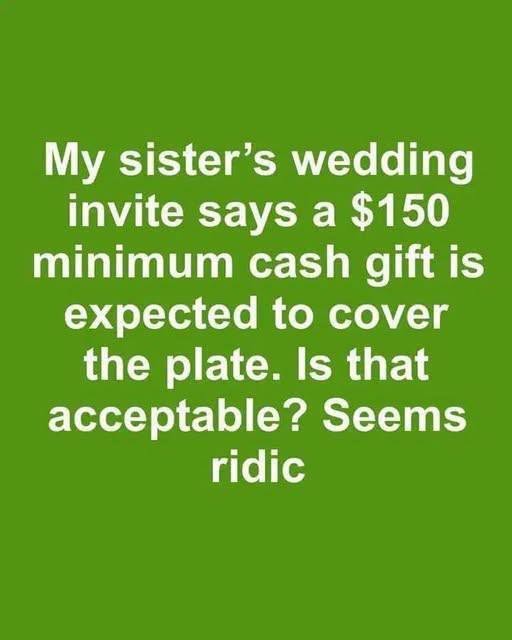
They are productions, financial commitments, emotional milestones, and sometimes even public statements about identity, values, and family expectations. In this evolving landscape, one question has sparked growing debate among couples and guests alike: is it acceptable to ask wedding guests for a minimum cash gift?
For some, the idea feels practical, even refreshingly honest.
Weddings today are expensive on nearly every level. Venues, catering, photography, entertainment, floral arrangements, and décor can quickly add up to staggering totals. Couples often spend months, sometimes years, saving to host a single evening that brings together their closest friends and family. In this context, cash gifts are no longer seen as impersonal—they are viewed as functional support that helps offset the cost of an event designed for shared enjoyment.
Supporters of the idea argue that clarity removes confusion.
Instead of guessing what to buy from a registry or worrying about duplicates, guests can contribute directly in a way that helps the couple begin their new life. From this perspective, asking for a suggested or minimum cash gift is not about pressure, but about transparency. It acknowledges the financial reality behind modern celebrations and shifts expectations into the open.
Some couples also feel that contribution-based thinking is fair.
Guests are invited to enjoy an entire experience: a carefully curated venue, a full meal, drinks, music, photography, and hours of entertainment. For hosts who are already stretching their finances to accommodate loved ones, a suggested contribution feels like a way of balancing generosity on both sides. It is not framed as a demand, but as an expression of shared participation in a meaningful life event.
However, for many guests, the request feels far more complicated.
What may be intended as clarity can easily be interpreted as obligation. When a minimum amount is mentioned, even indirectly, some guests feel as though their attendance is being measured against their financial contribution. The emotional tone of a wedding, which is meant to be warm and inclusive, can suddenly feel transactional.
Critics of minimum cash gift expectations argue that weddings should never come with a price tag attached to attendance.
They point out that guests already contribute in many ways that are not financial. Travel expenses, accommodation, clothing, time off work, and childcare arrangements can all represent significant personal costs. For some individuals or families, even a modest cash gift may be difficult to afford, especially when multiple weddings occur within a short period.
The pressure, even when unspoken, can be stressful.
A suggested amount like $150 or more may seem reasonable to some households, but entirely unrealistic to others. This creates an uncomfortable divide between what is socially expected and what is financially possible. Guests who cannot meet the expectation may feel embarrassed, while others may feel judged regardless of what they contribute.
Psychologists often note that money and social relationships are deeply intertwined with emotion.
Gifts are not simply economic exchanges; they are symbolic gestures of care, respect, and connection. When a monetary expectation is introduced, it can unintentionally shift the emotional meaning of the event. Instead of focusing on the celebration itself, guests may become preoccupied with whether their contribution is enough.
This is where much of the modern tension lies.
Weddings are deeply emotional events meant to celebrate unity, love, and shared history. Yet they also exist within a financial reality that cannot be ignored. Couples want to honor their relationships and include as many loved ones as possible, but they also face rising costs that make large gatherings increasingly difficult.
As a result, expectations around gifting have become more visible, more discussed, and more controversial.
Some couples try to address the issue by being explicit in their invitations or wedding websites, while others avoid the topic entirely in fear of appearing inappropriate. There is no universal rule, and cultural traditions vary widely. In some communities, cash gifts are standard and openly discussed. In others, even the suggestion of a monetary expectation is considered impolite.
The lack of consistency only deepens the confusion.
Guests are left to interpret signals that are often subtle or ambiguous, while couples try to balance honesty with etiquette. What one group sees as practical communication, another may see as social pressure.
Despite the disagreement, many people on both sides share a common desire: to avoid awkwardness and preserve the joy of the occasion.
This is where compromise becomes essential.
Many etiquette experts suggest that couples focus on wording that emphasizes gratitude rather than obligation. Phrases that highlight appreciation for attendance and optional contributions tend to feel more welcoming than direct minimum amounts. The tone of communication can significantly influence how the message is received.
Similarly, guests are encouraged to give within their means without comparison or guilt.
A wedding gift, whether large or small, is not a measure of affection or respect. It is simply one expression among many ways of celebrating a couple’s milestone. Presence, support, and emotional connection often carry more meaning than any monetary value.
At its core, the debate reflects a larger shift in how modern society views celebrations and financial transparency.
As costs rise and traditions evolve, couples and guests are navigating new expectations without clear guidelines. The tension between honesty and etiquette, practicality and sensitivity, continues to shape how weddings are planned and experienced.
In the end, the healthiest approach may be the simplest one.
Couples planning within their means, focusing on gratitude rather than expectation, and guests giving what they can comfortably afford without pressure or comparison. When financial concerns are handled with care and communication remains respectful, the celebration itself returns to what it was always meant to be.
A moment of connection.
A shared memory.
And a reminder that the true value of a wedding cannot be measured in dollars, but in the people who come together to witness it.