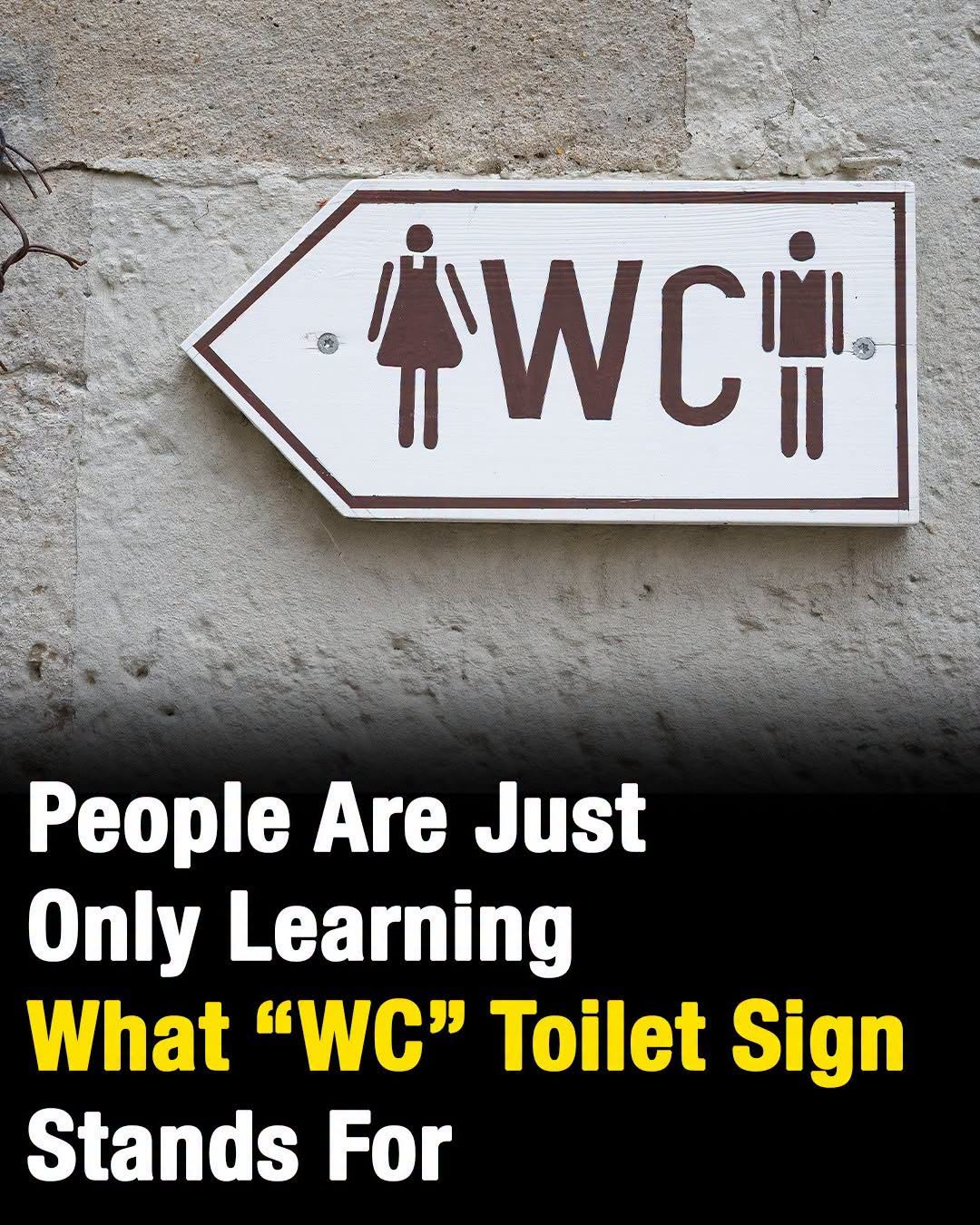
You have probably seen the letters countless times.
They appear on airport doors, hotel hallways, train stations, restaurants, museums, and public buildings all over the world. Two simple letters placed beside a small symbol of a toilet seem so familiar that most people never stop to question them.
WC.
For many travelers, those letters are simply a universal sign pointing toward the nearest restroom. Yet countless people admit they have no idea what WC actually means or why it appears in so many places.
The answer turns out to be surprisingly old, slightly confusing, and deeply connected to the history of modern plumbing.
Even after learning the meaning, many people still find the term strange.
After all, what exactly is a water closet?
The discussion surrounding bathroom names became especially popular online when a couple shared a humorous video questioning the different names people use for the same room.
One person asked why Canadians often call it a washroom.
Another wondered why Americans call it a restroom when nobody actually rests there.
Someone else mentioned the word bathroom, even though many public bathrooms do not contain bathtubs.
Then another person introduced the mysterious term WC.
Suddenly, thousands of people found themselves asking the same question.
What does it actually mean?
The letters WC stand for water closet.
Today, the phrase sounds unusual, but more than a century ago it made perfect sense.
To understand why, it helps to travel back to a time before indoor plumbing became common.
During much of the nineteenth century, most homes did not contain indoor toilets. Many families relied on outdoor facilities, outhouses, or separate structures away from the main living area. Indoor bathing spaces existed in some homes, especially among wealthier families, but toilets were often located elsewhere.
When indoor plumbing gradually became more widespread, one of the great innovations was the installation of a flushing toilet connected directly to water pipes.
Because these early toilets were often placed inside small enclosed rooms or closets, they became known as water closets.
The name described exactly what the room contained.
A small closet.
With water.
Over time, homes began incorporating these rooms into larger bathing spaces. Eventually, the toilet and bathtub often shared the same room, creating what many people now call the bathroom.
Yet the original term survived.
Especially in Europe and other parts of the world.
Even today, the letters WC continue to appear on signs because they provide a simple international abbreviation that travelers from many countries recognize.
The fascinating part is that almost every culture has developed its own name for the exact same room.
Americans often say bathroom.
Canadians frequently use washroom.
Many British speakers prefer loo.
Others say restroom.
Some countries use lavatory.
Hotels and airports may display WC.
Despite referring to the same destination, the words themselves often make very little literal sense.
Consider the American term restroom.
Most people enter, use the facilities, wash their hands, and leave within minutes. Very little resting actually occurs.
The word bathroom can be equally confusing.
Many public bathrooms contain no bath whatsoever.
Meanwhile, washroom suggests that people go there primarily to wash themselves.
The British word loo has unclear origins and remains one of the language’s greatest mysteries.
The more people discuss these names, the stranger they become.
This confusion recently generated countless conversations online.
Some travelers recalled asking for a washroom while visiting another country and receiving puzzled looks.
Others remembered asking for the bathroom and being directed somewhere unexpected.
People quickly realized that language surrounding toilets may be one of the most confusing areas of everyday speech.
One person joked that water closet seems strange because the room is not actually a closet.
Another pointed out that restroom is equally inaccurate because nobody rests there.
Someone else argued that washroom makes the most sense because people should wash their hands before leaving.
Different countries continue to maintain their own traditions.
Canada remains especially well known for using washroom.
In parts of the United States, restroom remains the standard term.
Britain continues to embrace the loo.
Hotels, airports, and international destinations frequently rely on WC because it crosses language barriers more easily.
What makes the water closet particularly interesting is that it still exists inside many modern homes.
Luxury houses sometimes include a small enclosed toilet room located inside a larger bathroom. This arrangement provides additional privacy and allows multiple people to use the space simultaneously.
In these cases, the water closet returns to its original meaning.
A separate room.
Containing only the toilet and perhaps a small sink.
The phrase that once seemed outdated suddenly becomes accurate again.
The history of indoor plumbing also explains why these terms developed differently around the world.
As plumbing technology expanded during the late nineteenth and early twentieth centuries, societies adopted their own vocabulary based on local customs and architecture.
Some focused on the bath.
Others focused on washing.
Others focused on the toilet itself.
The result is a remarkable collection of names describing one of the most frequently visited rooms in any building.
Language enthusiasts have discovered even more unusual names from around the world.
In some languages, the room translates to necessary place.
Others use phrases meaning little room.
Some describe it as a room without windows.
Every culture seems to create its own comfortable way of discussing a subject that people often prefer to mention indirectly.
Perhaps that explains why so many different names continue to exist.
People have always searched for softer, more polite ways to discuss bodily functions.
Euphemisms become part of everyday language.
Eventually, their original meanings disappear.
Today, millions of travelers encounter WC signs every year without realizing they are looking at a phrase that dates back more than a century.
Those two letters carry the history of indoor plumbing, changing architecture, and evolving language.
They remind us that many of the words we use daily have origins we rarely consider.
The next time you walk through an airport, enter a hotel lobby, or notice a small sign marked WC, you may pause for a moment.
Behind those two letters lies a story about changing technology, cultural traditions, and the strange ways language evolves.
The room itself may remain the same.
But the names we give it reveal far more about history than most people ever imagine.
Whether you call it a bathroom, restroom, washroom, lavatory, loo, or water closet, the destination remains identical.
Yet the journey behind those words is far more interesting than many people realize.
And perhaps that is why the tiny letters WC continue to spark curiosity all around the world.
Two simple letters.
One universal purpose.
And a surprisingly fascinating story hiding behind the door.