International summits are carefully choreographed events.
Every handshake, every smile, every photo opportunity is scrutinized by diplomats, journalists, and political observers searching for clues about relationships between world leaders. Official statements may contain polished language about cooperation and shared goals, but sometimes the moments that attract the most attention are the unscripted ones.
That is exactly what happened during a recent gathering of world leaders when a brief exchange involving Donald Trump sparked widespread discussion online and across international media.
What should have been a routine diplomatic greeting quickly became one of the most talked-about moments of the summit.
For some observers, it was evidence of growing tensions between allies.
For others, it was little more than a harmless interaction being exaggerated for political purposes.
Regardless of interpretation, the moment captured attention because it seemed to symbolize larger questions about diplomacy, influence, and America’s role on the global stage.
The gathering brought together leaders from some of the world’s largest economies at a time of significant international uncertainty.
Ongoing conflicts, economic pressures, security concerns, and geopolitical tensions dominated the agenda.
Behind closed doors, leaders discussed issues ranging from international trade and energy security to military conflicts and diplomatic strategy.
Publicly, however, the message was one of unity.
Officials emphasized cooperation.
Statements highlighted common goals.
Leaders spoke about stability, partnership, and collective responsibility.
Yet as cameras followed participants entering the conference venue, a different narrative began to emerge.
One brief interaction immediately caught attention.
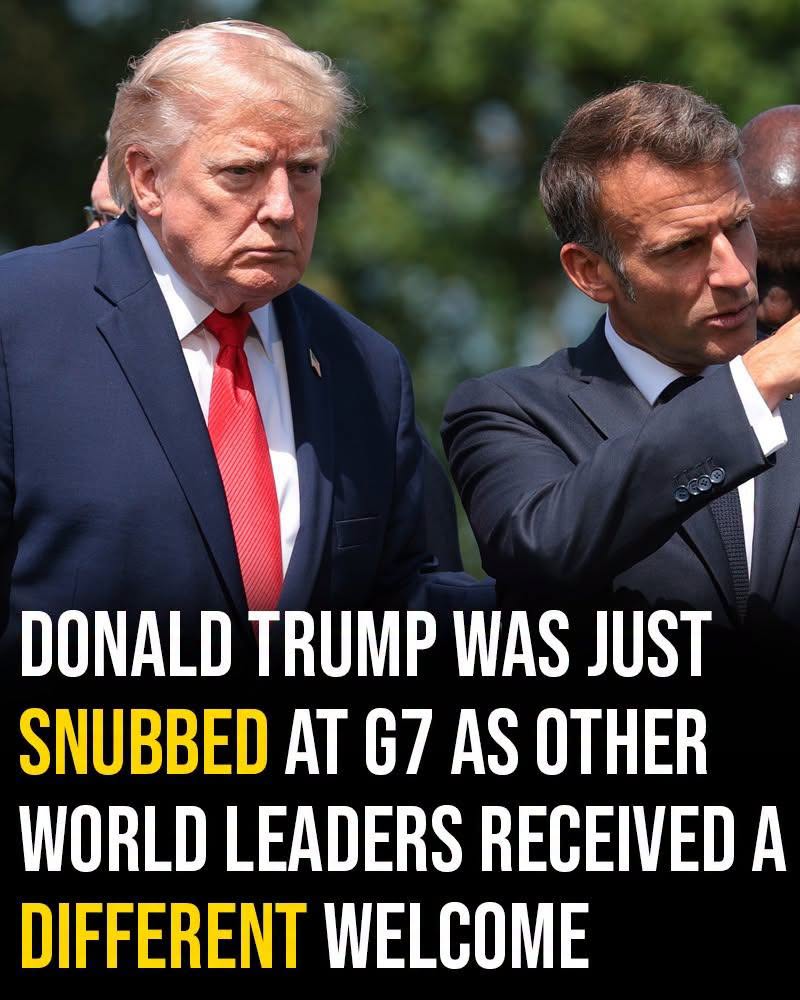
As leaders greeted one another before meetings began, European Commission President Ursula von der Leyen exchanged a formal handshake with Donald Trump.
Moments later, cameras captured her greeting other leaders with noticeably warmer gestures, including embraces and more familiar interactions.
French President Emmanuel Macron received an enthusiastic welcome.
Ukrainian President Volodymyr Zelensky was greeted warmly.
Canadian Prime Minister Mark Carney also appeared to receive a more personal reception.
The contrast was subtle.
But in the age of social media, subtle moments rarely stay small for long.
Videos circulated almost immediately.
Screenshots spread across platforms.
Commentators slowed footage down, analyzed facial expressions, and debated whether the interaction reflected genuine diplomatic dynamics or simply routine variations in personal style.
Within hours, millions of people had formed opinions.
Critics of Trump argued that the moment reflected growing unease among international allies.
According to this interpretation, world leaders remain uncertain about America’s future direction and its long-term commitments on major international issues.
Some pointed to disagreements over foreign policy, security arrangements, and international cooperation as evidence that relationships have become more complicated than they once were.
Supporters rejected that explanation entirely.
They argued that political opponents and media organizations were attempting to manufacture controversy from an ordinary greeting.
From their perspective, a handshake is simply a handshake.
Reading deeper meaning into a few seconds of video, they argued, says more about political bias than about diplomacy.
The disagreement quickly evolved into a broader discussion about symbolism in international politics.
Body language has long fascinated political observers.
A handshake that lasts too long.
A smile that appears forced.
A glance exchanged between leaders during negotiations.
These moments often become subjects of intense analysis because they offer rare glimpses into relationships that are otherwise hidden behind diplomatic protocol.
Sometimes those interpretations prove accurate.
Other times they reveal more about public expectations than actual political realities.
Yet symbolism remains powerful because international politics often depends as much on perception as on policy.
A nation’s strength is measured not only through military capabilities or economic performance.
It is also influenced by trust.
Confidence.
Relationships.
And the ability to persuade others.
That is why even seemingly insignificant moments can generate enormous attention.
What viewers noticed in this particular case was not simply the handshake itself.
It was the broader visual context.
At several points during the event, Trump appeared momentarily separated from groups of leaders who seemed comfortable interacting with one another.
Images of leaders laughing together, exchanging greetings, and engaging in familiar conversations contrasted with photographs showing Trump standing slightly apart.
To supporters, these images were misleading snapshots incapable of capturing the reality of diplomatic discussions taking place behind closed doors.
To critics, they represented something more meaningful.
The debate reflected a larger question that has emerged repeatedly in recent years.
What role does America play in the international order?
For decades, the United States occupied a unique position within global alliances.
American leadership often served as the central organizing force behind major diplomatic initiatives.
Even when disagreements occurred, allies generally viewed Washington as a predictable partner.
Recent years, however, have introduced greater uncertainty.
Different administrations have pursued different priorities.
Allies have adjusted to changing policies.
Relationships that once appeared stable have sometimes become more transactional and less predictable.
As a result, international leaders increasingly balance cooperation with caution.
That reality creates an environment where symbolic moments receive heightened scrutiny.
Every gesture appears to carry significance.
Every interaction becomes a possible indicator of broader geopolitical trends.
Meanwhile, the summit itself focused on issues far more substantial than handshakes and photo opportunities.
Leaders discussed ongoing conflicts affecting global security.
They debated strategies for maintaining economic stability.
Energy markets, international trade routes, and regional security concerns occupied much of the agenda.
Particular attention focused on developments in the Middle East and the security of critical shipping corridors.
Officials emphasized the importance of maintaining open trade routes and preventing further escalation of regional conflicts.
Several leaders described the discussions as productive.
Others stressed the importance of continued cooperation despite disagreements.
Public statements highlighted areas of consensus while carefully avoiding deeper divisions.
That approach reflects the reality of modern diplomacy.
Even when leaders disagree, they often work hard to project unity.
Markets respond to uncertainty.
Allies seek reassurance.
Adversaries look for signs of weakness.
As a result, appearances matter.
The challenge is that appearances can sometimes tell different stories depending on who is watching.
For some viewers, the images from the summit reinforced concerns about strained relationships among allies.
For others, they demonstrated how easily ordinary interactions can be transformed into political narratives.
Both interpretations gained traction online.
Both found audiences eager to confirm existing beliefs.
In many ways, the reaction itself revealed as much as the original moment.
Modern politics increasingly unfolds through short video clips, viral images, and instantaneous reactions.
A few seconds of footage can generate more public discussion than hours of policy negotiations.
Complex diplomatic agreements often receive less attention than a single awkward interaction caught on camera.
This reality has fundamentally changed how political events are experienced.
Leaders no longer communicate solely through speeches and official statements.
Every movement is potentially content.
Every gesture is potentially symbolic.
Every interaction may become tomorrow’s headline.
Whether the greeting reflected genuine diplomatic distance or simply an ordinary moment remains a matter of interpretation.
What is clear, however, is that people around the world saw something worth discussing.
Some saw evidence of shifting alliances.
Others saw media exaggeration.
Still others saw a reminder of how deeply divided political perspectives have become.
Perhaps the most revealing aspect of the entire episode is not what happened in that conference room but how people responded afterward.
A brief handshake became a global conversation.
A few seconds of video inspired thousands of articles, comments, and debates.
And once again, a moment measured in seconds overshadowed discussions that may influence international policy for years.
The summit’s official message emphasized unity, cooperation, and shared responsibility.
Yet the attention focused elsewhere.
It focused on body language.
On perception.
On symbolism.
And on a simple question that continues to shape global politics:
Who stands at the center of the world stage, and who truly wants to stand beside them?