What began as a dispute over a name quickly evolved into a national conversation about politics, public institutions, and the battle over historical legacy.
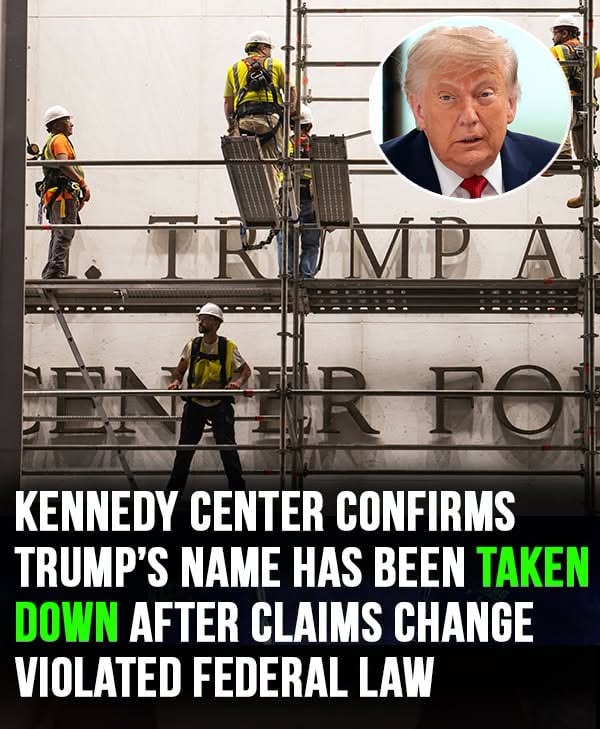
The decision to remove Donald Trump’s name from a section of the Kennedy Center ignited intense reactions across the political spectrum, transforming what might have seemed like a routine administrative matter into a highly visible cultural conflict. Supporters viewed the move as an unfair attempt to diminish the influence of a former president, while critics argued that the removal simply restored long-standing legal and institutional standards.
At the center of the controversy is a broader question that extends far beyond a single building in Washington, D.C.
Who gets to leave a permanent mark on public institutions, and who gets to decide?
For many Americans, the Kennedy Center represents far more than a performing arts venue. Established as a living memorial to President John F. Kennedy, the institution occupies a unique place in American culture. It serves as a tribute to one of the nation’s most remembered leaders while also functioning as a center for music, theater, dance, and artistic expression.
Because of that history, any attempt to alter the building’s identity or associate it with contemporary political figures inevitably attracts attention.
When Trump’s name appeared in connection with part of the Kennedy Center, critics immediately questioned whether proper procedures had been followed. Some argued that federal regulations governing the institution were designed specifically to prevent political leaders from attaching their names to sections of the memorial without authorization.
The issue quickly moved beyond public debate and into legal channels.
Opponents of the naming decision claimed that it violated the spirit and letter of federal law governing the Kennedy Center. According to their arguments, the institution was created as a memorial dedicated to Kennedy himself, and significant naming changes required legal authority that had not been obtained.
Supporters of Trump disagreed.
They argued that honoring a former president should not automatically be viewed as controversial. To them, the dispute reflected broader political hostility toward Trump rather than a genuine concern about regulations or historical preservation.
As legal reviews continued, interest in the controversy grew.
News outlets, commentators, and political analysts weighed in, each presenting dramatically different interpretations of what was taking place.
Some viewed the matter as a straightforward legal correction.
Others saw it as another chapter in the ongoing struggle over Trump’s place in American history.
Eventually, the decision was made to remove Trump’s name.
That action immediately triggered another wave of reactions.
For critics of the original naming decision, the removal represented a victory for institutional integrity. They argued that public memorials should remain focused on their original purpose rather than becoming vehicles for contemporary political branding.
Many longtime supporters of the Kennedy Center expressed relief.
They believed the institution’s identity should remain closely tied to Kennedy’s legacy and that introducing another presidential name risked creating confusion about the center’s historical mission.
Some critics were particularly vocal.
They argued that memorials dedicated to specific historical figures should be protected from political reinterpretation, regardless of which party is in power.
From their perspective, the removal was not about Donald Trump personally.
It was about maintaining consistency and respecting the original intent behind a national cultural landmark.
Trump supporters, however, viewed events very differently.
Many saw the removal as politically motivated.
They argued that figures associated with previous administrations often receive recognition in public spaces without generating the same level of controversy.
To them, the decision reinforced a perception that Trump continues to face unique scrutiny long after leaving office.
Several allies of the former president publicly criticized the removal and vowed to challenge the decision through legal and political channels.
Some framed the controversy as part of a larger cultural battle.
In their view, institutions traditionally viewed as nonpartisan have increasingly become arenas for ideological disputes.
The Kennedy Center, they argued, was simply the latest example.
As debate intensified, the issue began attracting attention far beyond Washington.
People who had never closely followed Kennedy Center governance suddenly found themselves discussing federal law, historical preservation, and the role politics should play in public memorials.
The controversy highlighted a broader reality about modern America.
Even seemingly small symbolic decisions can quickly become national flashpoints.
A name on a building.
A plaque on a wall.
A commemorative dedication.
Each can become a battleground when questions of identity, power, and legacy are involved.
Legal experts also entered the discussion.
Many pointed out that disputes involving public memorials are often more complicated than they initially appear.
Questions about authority, governance, and historical intent frequently intersect, creating situations where legal interpretations and public sentiment do not always align.
For some observers, the most significant aspect of the controversy was not the outcome itself but what it revealed about the current political climate.
The intensity of the reaction demonstrated how deeply divided many Americans remain over Trump’s legacy.
Years after his first presidential campaign transformed American politics, debates involving his name continue to generate strong emotions from supporters and critics alike.
That reality ensures that controversies connected to Trump rarely remain limited to their immediate subject matter.
Instead, they often become symbolic struggles over larger issues.
In this case, the debate expanded beyond a building and into questions about historical memory.
How should public institutions honor the past?
Should modern political figures become part of existing national memorials?
What role should courts play in resolving those disputes?
The answers depend largely on whom you ask.
For some Americans, preserving the Kennedy Center’s original identity represents an important defense of historical continuity.
For others, the removal reflects an unwillingness to acknowledge the influence of a president whose impact on American politics remains undeniable.
As legal appeals and political arguments continue, the controversy shows no signs of disappearing entirely.
Supporters of the decision remain confident that the law supports their position.
Opponents continue searching for ways to reverse what they view as an unfair outcome.
Meanwhile, visitors walking through the Kennedy Center may notice little difference.
The performances continue.
Musicians take the stage.
Audiences gather for concerts, plays, and cultural events.
Life inside the institution moves forward much as it always has.
Yet beyond its walls, the debate continues to resonate.
What happened at the Kennedy Center became about far more than a name.
It became a reflection of how fiercely Americans continue to argue over history, symbolism, and political legacy.
The building itself remains unchanged.
Its marble halls still overlook the Potomac.
Its stages still host artists from around the world.
But the controversy surrounding Trump’s name revealed something deeper about the nation itself.
In today’s America, even the smallest symbols can carry enormous weight.
And when questions of politics, memory, and identity collide, a single name can become the center of a much larger battle.