In the digital age, a photograph rarely remains confined to the moment it was taken. Images can resurface months or even years later, taking on entirely new meanings as public conversations evolve.
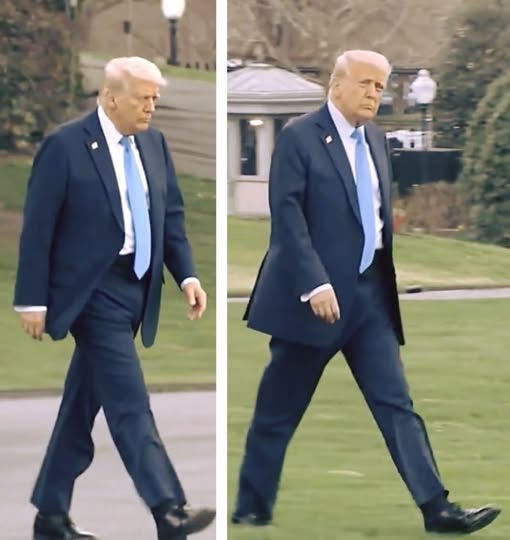
That is exactly what has happened with a series of photographs showing President Donald Trump walking across the South Lawn of the White House toward Marine One. Originally captured and widely shared in 2025, the images have once again gone viral in 2026, sparking fresh discussion across social media platforms and political circles.
The photographs themselves are straightforward. They show Trump making his way toward the presidential helicopter before departing for scheduled events. Such scenes have long been part of the visual routine of American politics, with presidents regularly photographed boarding Air Force One or Marine One during official duties.
Yet in today’s online environment, even ordinary images can quickly become the center of intense debate.
As the photos began circulating again, social media users immediately started analyzing every detail. Some focused on Trump’s posture. Others commented on his appearance, clothing, or the way he walked across the lawn. Within hours, the images had generated thousands of posts, comments, and reactions from supporters, critics, and curious observers alike.
The differing interpretations highlighted just how polarized modern political discourse has become.
To some viewers, the photographs appeared to show Trump looking energetic and active. Supporters pointed to his schedule, public appearances, and campaign activities as evidence that he remains vigorous despite his age. Others suggested that the images reflected confidence and stamina often associated with political leadership.
Critics, however, saw the same photographs differently.
Some users speculated about possible changes in appearance, posture, or physical condition. Others compared the images to older photographs, attempting to identify differences over time. As often happens online, these discussions quickly expanded beyond the original images themselves.
But experts frequently caution that photographs alone offer limited information.
Lighting conditions, camera angles, clothing choices, and even the exact moment an image is captured can significantly influence how a person appears. A still image freezes only a fraction of a second in time, often without the broader context necessary for meaningful conclusions.
Medical professionals have repeatedly emphasized that visual assessments based on photographs are not substitutes for actual medical evaluations.
This distinction has become increasingly important as social media continues to blur the lines between observation, speculation, and fact.
The renewed attention surrounding the Marine One images also coincides with ongoing public interest in Trump’s health and schedule. At 79 years old, Trump remains one of the most closely watched political figures in the world. His age naturally attracts attention, particularly given the physical and mental demands associated with the presidency.
Age and leadership have become recurring topics in American politics.
In recent years, voters across the political spectrum have engaged in broader discussions about the health, stamina, and fitness of national leaders. As a result, public appearances by political figures often receive intense scrutiny far beyond what earlier generations of politicians experienced.
For Trump, this level of attention is hardly new.
Throughout his public life, his health, energy levels, and lifestyle habits have frequently been discussed in media reports, interviews, and public commentary. He has publicly stated on numerous occasions that he feels healthy and capable of handling the demands of office.
At the same time, online speculation continues to emerge whenever new images or videos appear.
Earlier this year, rumors circulated on social media claiming that Trump had been taken to Walter Reed Medical Center. Those reports were later denied by official sources, and no verified evidence emerged to support the claims. Nevertheless, the rumors spread rapidly before being challenged or corrected.
This pattern illustrates one of the defining characteristics of modern information ecosystems.
Information now moves faster than ever before.
Rumors can spread globally within minutes.
Corrections often arrive later.
And by that time, narratives may already have taken root in public discourse.
The resurfaced Marine One photographs demonstrate how this process works in practice. Although the images were originally taken in 2025, their reappearance in 2026 allowed entirely new conversations to emerge around them. In many cases, viewers encountering the photos for the first time may not have realized they were looking at older images.
This phenomenon, often called “content recycling” or “recontextualization,” has become increasingly common on social media.
Old videos, photographs, and statements frequently resurface during new events, sometimes acquiring fresh significance based on current political circumstances. The original context may remain unchanged, but the public conversation surrounding it evolves.
Political images are especially vulnerable to this process.
Supporters and critics alike often use photographs as symbols to reinforce broader narratives about public figures. A single image can be interpreted in multiple ways depending on the viewer’s beliefs, experiences, and political perspectives.
The same photograph may communicate strength to one audience and vulnerability to another.
Neither reaction necessarily reflects objective reality.
Instead, they illustrate how perception is shaped by prior beliefs.
Social scientists have long studied this phenomenon, noting that people often interpret information through existing frameworks and expectations. In politics, this tendency can become especially pronounced because emotions and identity frequently influence interpretation.
As a result, even neutral images can become politically charged.
The online discussion surrounding Trump’s appearance also extended into conversations about lifestyle and diet. Over the years, media coverage has frequently highlighted his well-known preferences for certain foods and beverages. Stories about fast food, dietary habits, and routines have become part of his public image.
However, experts caution against drawing medical conclusions from anecdotal reports or public appearances.
Health is complex.
Appearance alone rarely provides meaningful insight into a person’s overall condition.
Without official medical evaluations or verified information, speculation remains just that speculation.
The Marine One photographs have also underscored the growing role social media plays in shaping public narratives. Platforms designed for rapid sharing often encourage immediate reactions, quick judgments, and emotional responses. Images circulate rapidly, detached from their original context, and become part of larger cultural conversations.
In this environment, public figures live under constant observation.
Every photograph becomes evidence.
Every gesture becomes analysis.
Every appearance becomes a topic of debate.
For political leaders, this reality has transformed the nature of public life.
The renewed attention surrounding these images ultimately says as much about modern media consumption as it does about the photographs themselves. In an era dominated by viral content, old moments rarely disappear completely. Instead, they remain available to be rediscovered, reinterpreted, and recirculated whenever circumstances change.
As the Marine One photographs continue to circulate online, one fact remains clear: there is no verified evidence linking these images to any official medical findings or confirmed health developments.
What the photos do reveal is something broader about contemporary society.
They demonstrate how powerful images remain in shaping public conversation.
They show how quickly narratives can evolve online.
And they highlight the increasingly complex relationship between politics, media, and public perception in the digital age.
In the end, the story may be less about the photographs themselves and more about the world in which they now exist a world where every image can become a debate, every moment can be revisited, and every public figure remains permanently under the lens of millions of watching eyes.