Human perception is one of the greatest mysteries of the brain. Every second of every day, our eyes absorb enormous amounts of information, yet no two people experience the world in exactly the same way.
This becomes especially fascinating when different people look at the same image but notice entirely different things first. One person immediately sees a face. Another notices an object. Someone else focuses on shapes or hidden figures that others completely miss.
Why does this happen? The answer lies deep inside the remarkable machinery of the human brain.
Unlike a camera that simply records whatever appears in front of its lens, the brain actively builds reality. It filters information, fills in missing pieces, compares patterns to memory, and creates meaning from what we see. In many ways, perception is less about what enters our eyes and more about how our minds interpret it.
This is one reason optical illusions have fascinated people for centuries. They reveal something surprising: reality is not always as straightforward as it appears.
Today, images that challenge perception spread rapidly across social media. Millions of people enjoy looking at visual puzzles that ask a simple question: What did you see first?
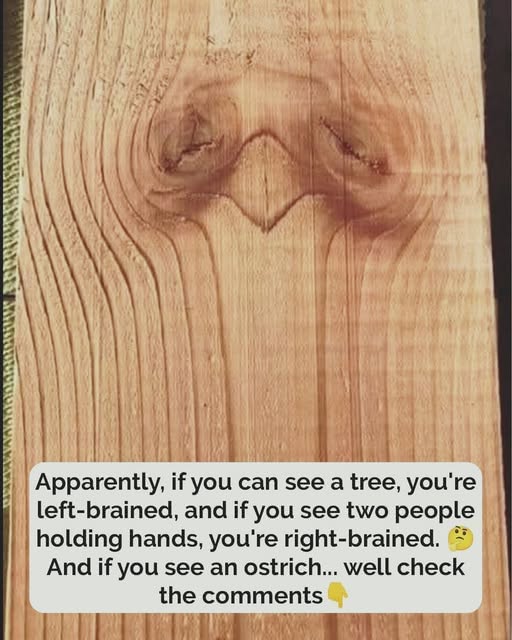
Was it a tree? A face? Two people? An animal hidden within a landscape?
The answers often spark lively debates. Friends compare results. Families argue over what is visible. Comment sections fill with people insisting their interpretation is obvious while others cannot see it at all.
Part of the fun comes from the idea that what you notice first might reveal something about your personality.
Online posts frequently suggest that seeing one object means you are creative, while noticing another indicates you are analytical or logical. Although these interpretations are entertaining, psychologists caution against taking them too seriously.
Real personality assessment is far more complex.
Human personality develops through a combination of genetics, environment, experiences, and countless interactions over a lifetime. A single image cannot accurately define who someone is. Nevertheless, these visual puzzles remain valuable because they reveal something equally interesting: the incredible diversity of human perception.
Scientists who study cognition explain that the brain receives far more information than it can consciously process. Every moment, your eyes collect details about color, movement, light, shape, and depth. Processing all of it at once would overwhelm the mind.
To solve this problem, the brain relies on shortcuts known as perceptual processing.
These mental shortcuts allow us to quickly identify familiar objects and patterns. Without them, everyday tasks such as driving, reading, or recognizing faces would become incredibly difficult.
Imagine walking through a crowded street. Your brain instantly identifies people, signs, vehicles, and obstacles without requiring deliberate thought. This rapid processing happens almost automatically.
The same mechanisms are at work when viewing optical illusions.
When presented with an ambiguous image, the brain rapidly searches its memory for recognizable patterns. Depending on personal experience, attention, and even mood, different people may prioritize different features.
This explains why one person notices a tree while another immediately sees two people holding hands.
Neither interpretation is wrong.
Both are valid.
The brain simply chooses whichever pattern feels most recognizable at that particular moment.
Researchers often distinguish between two types of visual processing: bottom-up processing and top-down processing.
Bottom-up processing begins with raw sensory information. The brain examines lines, shapes, contrast, and color before constructing a larger image.
Top-down processing works differently. It relies on expectations, memories, knowledge, and past experiences to interpret what is being seen.
Optical illusions become powerful because they engage both systems simultaneously.
The brain constantly predicts what it expects to see, then adjusts its interpretation based on incoming information. Sometimes these predictions create surprising results.
One famous psychological phenomenon involved in these illusions is called pareidolia.
Pareidolia refers to the brain’s tendency to recognize familiar patterns especially faces in random or ambiguous stimuli. This is why people sometimes see faces in clouds, animals in rock formations, or expressions on inanimate objects.
Humans evolved this ability for survival.
For early humans, quickly recognizing faces or detecting potential threats in the environment could mean the difference between life and death. As a result, the human brain became exceptionally skilled at finding patterns even when no intentional pattern exists.
This evolutionary advantage continues to influence perception today.
Attention also plays a major role in what we notice first.
At any given moment, countless visual details compete for our awareness. The brain cannot focus on everything simultaneously, so it prioritizes information that appears most relevant or noticeable.
Your current emotional state may influence this process.
Someone feeling relaxed may focus on different details than someone experiencing stress or fatigue. Even subtle changes in lighting, viewing angle, or expectation can alter perception.
This means that what you notice first in an image may vary from day to day.
The same person could even interpret the same illusion differently after seeing it a second time.
That flexibility reveals just how dynamic human perception truly is.
Many viral personality tests claim to uncover hidden traits based on visual choices. Some suggest that people who notice certain objects first are more creative, independent, emotional, or logical.
However, scientific evidence supporting these claims remains limited.
Professional psychologists use carefully designed assessments, behavioral studies, and long-term observations to understand personality. Optical illusions, while entertaining, should not be viewed as diagnostic tools.
Yet their popularity persists because they satisfy a universal human curiosity.
People naturally want to understand themselves and others.
Visual puzzles offer a playful way to explore questions about thinking, perception, and individuality. They encourage conversation and remind us that different perspectives can exist simultaneously.
Perhaps the most fascinating lesson of all is that perception itself is deeply personal.
Two people can look at the same image and honestly experience different realities.
Neither person is mistaken.
Their brains are simply interpreting information through different filters shaped by experience, memory, and attention.
This diversity of perception enriches human life.
It influences art, communication, relationships, and even scientific discovery. The ability to see the world differently allows societies to generate new ideas and solve problems in creative ways.
Optical illusions offer a small window into this extraordinary process.
They remind us that reality is not always fixed and that the mind is far more active than we often realize. Every image we see is not merely observed it is constructed by billions of neurons working together to create meaning.
So the next time you encounter an illusion and someone asks what you saw first, enjoy the experience for what it truly is: not a test of who you are, but a glimpse into the remarkable ways your brain makes sense of the world.
After all, what you notice first may not reveal your destiny or define your personality but it does reveal something equally amazing: the human mind is endlessly complex, beautifully unique, and far more mysterious than we ever imagine.