For years, the world watched Pamela Anderson move in the exact opposite direction of Hollywood expectations.
While celebrity culture doubled down on filters, cosmetic perfection, and carefully engineered beauty routines, Pamela stepped onto red carpets with almost no makeup at all. She appeared at fashion shows barefaced. She attended premieres with soft skin, natural hair, and none of the heavy glamour people once associated with her name. In an industry obsessed with transformation, she became radical simply by refusing to hide behind layers of styling.
At first, the public did not know what to do with it.
Some praised her honesty and called her refreshing. Others treated her decision like a mystery that needed explaining. Headlines questioned whether she was “done” with glamour, while critics dissected every line and shadow on her face as though aging naturally were somehow a public statement demanding debate.
But Pamela never seemed interested in defending herself.
That quiet confidence became part of the fascination.
After decades spent as one of the most photographed women on earth, she appeared to stop performing for the camera entirely. The woman once turned into a global symbol of exaggerated beauty standards suddenly seemed determined to strip everything back to the person underneath.
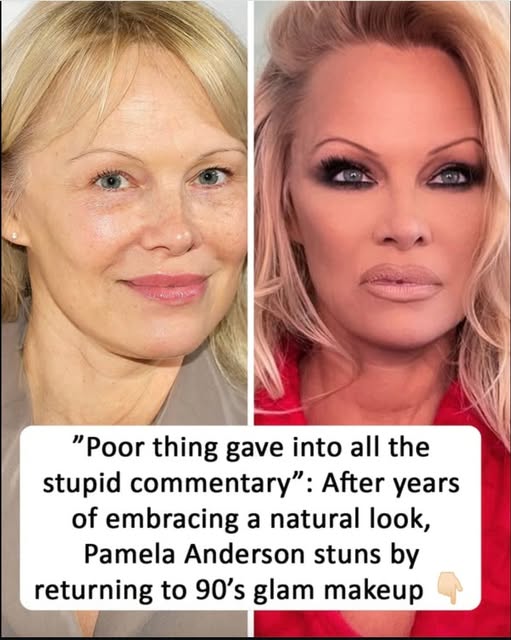
And now, after years of embracing simplicity, Pamela has stunned fans again by stepping directly back into the aesthetic that first made her a cultural phenomenon.
The smoky eyes.
The voluminous blonde hair.
The glossy lips.
The unmistakable 1990s bombshell energy.
The reaction online was immediate.
Photos of her new look spread across social media within hours, with fans calling it “iconic,” “unbelievable,” and “like stepping back into 1995.” Some people celebrated the return of the glamorous image that dominated magazine covers and television screens for years. Others expressed surprise after so much attention had been focused on her makeup-free appearances in recent seasons.
But beneath the excitement and nostalgia, something more meaningful seems to be happening.
Pamela’s transformation does not feel like surrender.
It feels like freedom.
That distinction matters.
For much of her life, Pamela Anderson existed inside a public image so powerful it nearly consumed the person beneath it. During the height of her fame, she became less an individual and more a symbol the blonde bombshell, the fantasy figure, the woman reduced endlessly to headlines, magazine covers, body parts, and stereotypes.
The world often treated her beauty as both her greatest power and her greatest limitation.
People admired her while simultaneously refusing to see beyond the image they projected onto her.
That contradiction followed her for decades.
Few celebrities have experienced the strange burden of hyper-visibility the way Pamela did during the 1990s. At the peak of her fame, every hairstyle, outfit, relationship, interview, and appearance became global entertainment. Her face was everywhere television screens, tabloid covers, billboards, posters, late-night talk shows.
But massive visibility rarely guarantees understanding.
In many ways, the more famous Pamela became, the flatter public perception of her seemed to grow. She was frequently discussed rather than listened to. Defined rather than understood. Desired rather than fully seen.
That is partly why her recent evolution has resonated so deeply with many people.
Over the last several years, Pamela slowly reclaimed authorship over her own image. Her documentaries, interviews, memoirs, and stripped-down public appearances revealed someone more thoughtful, introspective, and emotionally grounded than the caricature pop culture had often constructed around her.
She began speaking openly about vulnerability, loneliness, motherhood, fame, and the emotional cost of constantly being turned into fantasy.
The absence of makeup became symbolic not because cosmetics are inherently false, but because Pamela herself chose the removal. The decision belonged entirely to her.
That autonomy changed everything.
People suddenly realized that what seemed shocking was not her bare face itself, but the fact that a woman once defined by glamour no longer appeared interested in seeking validation through it.
And now, ironically, her return to full glam carries the exact same message.
Because this version is also her choice.
That is what many observers miss when they frame her transformation as either “returning” to beauty or “abandoning” authenticity. Pamela’s evolution is not about choosing between natural simplicity and old Hollywood glamour.
It is about rejecting the idea that women must remain trapped inside a single acceptable version of themselves.
She can wear no makeup one week and dramatic eyeliner the next.
She can age naturally while still embracing sensuality.
She can reject impossible beauty standards while still enjoying beauty itself.
Those ideas are not contradictions unless society insists they must be.
The intense public reaction to her appearance says as much about cultural expectations as it does about Pamela herself. Few male celebrities experience this level of scrutiny over whether they appear “too natural,” “too glamorous,” “too old,” or “too changed.” Female faces, particularly those associated with beauty and desire, often become public property in ways that feel relentless.
Every wrinkle becomes debate.
Every cosmetic decision becomes ideology.
Every transformation becomes symbolic.
Pamela has spent decades living inside that microscope.
And yet she now appears strangely untouched by it.
There is a calmness in the way she moves through public life today that feels fundamentally different from the chaotic celebrity machine that once surrounded her. Whether posing naturally for magazine shoots or appearing fully styled with dramatic makeup and polished hair, she no longer seems interested in negotiating with public approval.
That may be the most dramatic transformation of all.
Because confidence built from external admiration is fragile. It rises and falls depending on applause, trends, and attention. But confidence rooted in self-definition carries a different kind of stability.
Pamela appears to have found that stability after years of turbulence.
The nostalgic power of her recent look also reflects something larger happening culturally. The 1990s aesthetic has returned across fashion, beauty, and entertainment, with younger generations rediscovering the exaggerated glamour of that era. But while many celebrities imitate the look stylistically, Pamela embodies something more authentic: she lived it originally.
The teased hair, dramatic liner, glossy skin, and effortless bombshell image are not costumes for her.
They are fragments of cultural memory attached directly to her identity.
Seeing her revisit that visual era therefore triggers something emotional for audiences. It reminds people not only of celebrity culture’s past, but of their own lives during that period old magazines, music videos, television nights, fashion obsessions, youth itself.
Nostalgia is rarely just about appearance.
It is about memory.
And Pamela’s face has been embedded inside decades of collective memory more deeply than almost any celebrity of her generation.
Yet what makes her current moment compelling is not simply the recreation of old glamour. It is the emotional context surrounding it now. In the 1990s, many people saw only the fantasy. Today, audiences also recognize the human being underneath it.
That deeper understanding changes the image entirely.
The makeup now feels less like armor and more like play.
Less like obligation and more like expression.
Less like performance for others and more like ownership of self.
Perhaps that is why her return to glam has resonated so strongly. People are not simply reacting to eyeliner or blonde hair. They are witnessing a woman who has finally reached the point where every version of herself belongs entirely to her.
The barefaced activist.
The reflective writer.
The acclaimed actress.
The cultural icon.
The bombshell.
For years, the world tried to force Pamela Anderson to choose one identity and stay there forever.
Now she seems completely uninterested in asking permission to be all of them at once.