At first, the math feels simple.
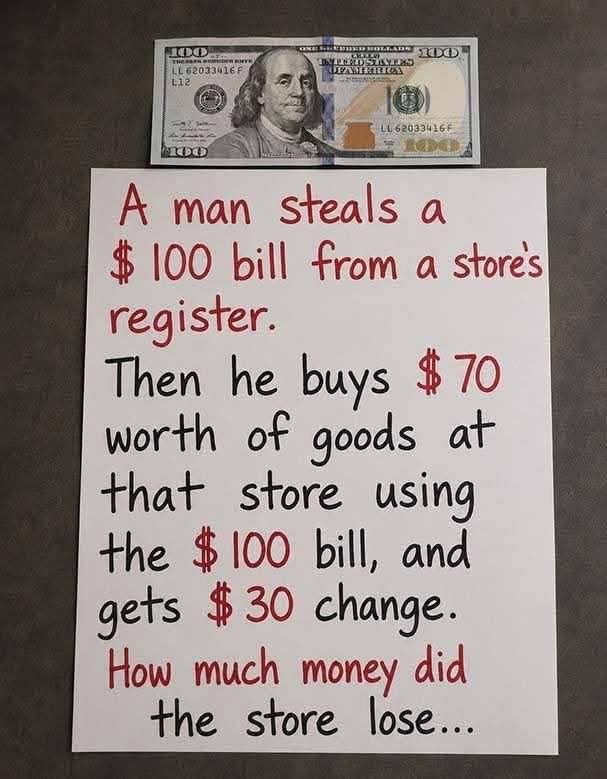
A thief steals $100 from a store register. Later, he returns to the same store and uses that exact $100 bill to buy $70 worth of merchandise. The cashier, unaware the money was stolen, accepts the bill and gives the thief $30 in change.
Then comes the question that has driven people into endless online arguments for years:
How much money did the store actually lose?
Most people answer too quickly.
Some confidently say the store lost $170. Others insist the answer is $200. A few become so convinced of their logic that they argue passionately in comment sections for hours, convinced everyone else is misunderstanding basic arithmetic.
But the real trick hiding inside the puzzle has almost nothing to do with math.
It has everything to do with perception.
That is why this riddle continues confusing people across classrooms, workplaces, social media, and family dinner tables. The numbers themselves are not difficult. The challenge lies in how the human brain instinctively organizes the story.
Most people unconsciously split the situation into two completely separate events.
First comes the robbery.
Then comes the shopping transaction.
The mind automatically treats them as unrelated incidents, even though both revolve around the exact same hundred-dollar bill.
That mental separation is where the confusion begins.
The moment people divide the story into “stolen money” plus “lost merchandise,” many accidentally count the same money twice without realizing it. The brain hears “theft” and immediately locks onto the emotional idea of missing cash. Then it hears “purchase” and begins calculating inventory loss separately.
Suddenly people start adding numbers that should never be added together.
The result feels convincing.
But it is wrong.
The truth is far simpler once the path of the money is followed carefully from beginning to end.
At the start of the story, the store possesses all of its inventory and all of its cash. Everything balances normally.
Then the thief steals $100 directly from the register.
At that moment, the store’s total loss is exactly $100.
Nothing complicated yet.
Now comes the part that tricks people psychologically.
The thief later returns and uses the exact same stolen hundred-dollar bill to buy $70 worth of merchandise. The cashier accepts the money because nobody realizes it is the stolen bill.
The moment the sale happens, something important occurs:
The original stolen cash returns directly back into the register.
That means the store is no longer missing the original $100 bill.
The money came home.
But during the transaction, the store gives the thief two things:
$70 worth of products.
And $30 in legitimate change.
Those two losses together equal exactly $100.
That is the final answer.
No more.
No less.
The store ultimately loses $70 in inventory plus $30 in cash.
Total loss: $100.
The reason so many people resist this answer at first is because the wording of the riddle creates an emotional illusion. The moment the story introduces theft, the brain begins emotionally tracking the stolen cash as a permanent loss, even after the bill physically returns to the register later.
Humans are surprisingly vulnerable to this kind of mental shortcut.
Psychologists call these mistakes cognitive biases situations where the brain prioritizes quick interpretation over careful logical analysis. The brain prefers simple emotional narratives because they help people process information faster. In everyday life, this efficiency usually works well.
But riddles exploit those shortcuts intentionally.
This particular puzzle works because people instinctively focus on the drama of the crime instead of calmly tracing the actual movement of value. The word “stolen” carries emotional weight, so the brain treats the hundred dollars as permanently gone even after the exact same bill is recovered during the purchase.
In reality, the money itself ends exactly where it started: inside the store register.
That means it cannot still be counted as missing.
The only things truly gone by the end are the merchandise and the change.
Once people finally see this clearly, the answer suddenly feels obvious.
That moment of realization is almost always followed by one of two reactions:
Laughter.
Or frustration.
Some people laugh because they enjoy the cleverness of the trick once it clicks into place. Others become annoyed because they realize the puzzle fooled them into overcomplicating something surprisingly simple.
And that emotional reaction reveals why riddles like this remain so popular.
They expose how human reasoning actually works.
Most people assume intelligence means calculating faster or memorizing formulas. But puzzles like this demonstrate something deeper: reasoning often matters more than raw mathematics. The hardest part is not adding numbers correctly. It is resisting the brain’s tendency to organize information emotionally instead of logically.
In fact, if the story were rewritten differently, almost nobody would answer incorrectly.
Imagine the riddle phrased this way:
A man leaves a store carrying $70 worth of products and $30 in cash that do not belong to him. How much did the store lose?
Everyone would immediately answer $100.
Simple.
But the introduction of the stolen hundred-dollar bill creates a loop that distracts people from the bottom line. The mind becomes so focused on the movement of the bill that it forgets to look at where everything ultimately ends up.
The hundred-dollar bill returns to the store.
Therefore, it is not part of the final loss.
That single realization untangles the entire puzzle instantly.
What makes the riddle especially fascinating is how fiercely people defend incorrect answers even after the logic is explained carefully. Once the brain commits emotionally to an interpretation, changing course can feel uncomfortable. Admitting error, even in a meaningless puzzle, creates subtle psychological resistance.
People begin searching desperately for reasons their original answer might still work.
They reframe the math.
They reinterpret the wording.
They invent additional losses.
Anything to avoid the uncomfortable sensation of realizing they misunderstood something that now appears obvious.
This happens constantly in real life far beyond riddles.
Humans often cling to first impressions even when presented with better explanations later. The brain values consistency because changing beliefs requires mental effort and temporary uncertainty. That is why debates online grow so intense over even trivial subjects.
People do not simply defend facts.
They defend the feeling of being correct.
This little store puzzle quietly exposes that truth in a surprisingly effective way.
It also demonstrates how storytelling shapes reasoning. The same numbers presented differently can completely alter how people process information emotionally. The brain is not a perfect calculator. It is a storytelling machine constantly trying to build coherent narratives quickly.
Sometimes those narratives distort logic.
That is exactly what happens here.
The theft feels separate from the purchase because the story emotionally frames them as separate events. But financially, they are connected entirely through the same hundred-dollar bill moving in a circle.
Once people stop separating the events mentally, the illusion disappears.
The accounting becomes simple again.
The store started with all its money and merchandise.
The stolen cash eventually returned.
Only $70 worth of goods and $30 in real change permanently left the store.
Final loss: $100.
No hidden trick.
No advanced mathematics.
Just careful reasoning.
And perhaps that is why the riddle remains so memorable. It reminds people how easily the mind can complicate simple situations once emotion, assumption, and storytelling enter the picture. The puzzle feels frustrating because the answer seems simultaneously obvious and invisible at the same time.
That strange tension is exactly what makes logic riddles so satisfying.
They force people to slow down, question assumptions, and follow reality step by step instead of trusting instinct blindly.
And in the end, the lesson becomes larger than the puzzle itself.
Sometimes the hardest problems are not the ones requiring more intelligence.
They are the ones requiring clearer thinking.