
It started as what seemed like an ordinary morning.
I rolled out of bed, shuffled toward the bathroom mirror, and splashed cold water on my face like I had done thousands of times before. Nothing felt unusual. I wasn’t sick. I didn’t have a fever. I wasn’t in pain.
But the moment I looked into the mirror, something immediately caught my attention.
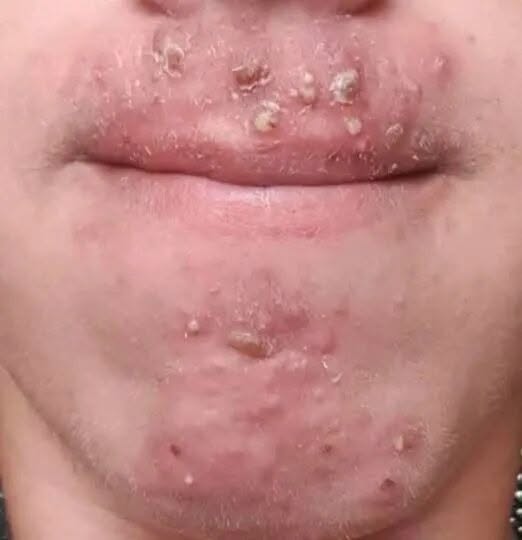
There were several small red spots clustered around my mouth.
At first, I assumed they were simple pimples.
Maybe I had slept with my face pressed against the pillow.
Maybe I’d had an allergic reaction to something I’d eaten the night before.
Whatever it was, I figured it would disappear within a day or two.
Instead, the opposite happened.
By that evening, the redness had spread.
Tiny bumps began appearing around my lips and chin.
Some areas felt tender.
Others itched just enough to become impossible to ignore.
The more I looked at them, the more concerned I became.
Like many people, my first instinct wasn’t to call a doctor.
Instead, I opened my phone.
Within minutes I was scrolling through endless articles, social media posts, and discussion forums.
One website suggested acne.
Another claimed it was an allergic reaction.
Someone else insisted it had to be a fungal infection.
A different post warned it might be herpes.
Every answer seemed completely different.
The more I searched, the more anxious I became.
Friends offered advice too.
“Use toothpaste.”
“Put rubbing alcohol on it.”
“Try acne cream.”
“Scrub your face.”
“Cover it with makeup.”
Everyone seemed confident.
Nobody actually knew.
What many people don’t realize is that rashes around the mouth can have dozens of different causes.
Although they may look similar at first glance, the treatments can be completely different.
In some cases, using the wrong product can actually make the condition significantly worse.
One common possibility is impetigo.
Impetigo is a highly contagious bacterial skin infection.
It often begins with small red sores that quickly break open before developing their familiar yellow or honey-colored crust.
The bacteria responsible usually enter through tiny breaks in the skin sometimes so small the person never notices them.
Without treatment, impetigo can continue spreading across the face or even to other parts of the body.
Because it is contagious, it can also spread through shared towels, pillowcases, razors, clothing, or direct skin contact.
Another possible explanation is perioral dermatitis.
Unlike impetigo, this condition is usually inflammatory rather than bacterial.
It often appears as clusters of tiny red bumps surrounding the mouth while leaving a narrow ring of unaffected skin immediately around the lips.
The rash may burn, itch, or feel unusually sensitive.
Ironically, one of the biggest reasons perioral dermatitis becomes worse is because people mistake it for eczema and begin applying steroid creams.
While steroids may briefly improve the appearance, they frequently cause the rash to return even more aggressively once treatment stops.
Dermatologists encounter this cycle regularly.
Patients become trapped in an endless loop.
The rash improves.
They stop the cream.
The rash returns worse.
They restart the cream.
The cycle continues.
Other conditions can create similar symptoms.
Contact dermatitis may develop after exposure to irritating cosmetics, toothpaste, lip balm, sunscreen, shaving products, or even certain foods.
The skin reacts with redness, itching, swelling, or blistering.
Sometimes the trigger is obvious.
Other times, identifying the cause requires careful investigation.
Fungal infections can occasionally produce facial rashes as well.
So can viral illnesses.
Even autoimmune disorders may first reveal themselves through subtle changes around the mouth.
That is why appearance alone rarely tells the whole story.
Trying to diagnose yourself from photographs online can be surprisingly misleading.
One condition may closely resemble another despite requiring completely different treatments.
In some situations, the medications used for one disorder can actually worsen another.
Unfortunately, many people unintentionally create larger problems by experimenting with random skincare products.
Facial skin is naturally delicate.
When irritation develops, the instinct is often to clean more aggressively.
People scrub harder.
They wash repeatedly.
They apply stronger products.
They combine acne creams, exfoliants, alcohol-based cleansers, and medicated ointments all at once.
Instead of helping, this often damages the skin barrier further.
The protective outer layer begins losing moisture.
Small cracks develop.
Inflammation increases.
Bacteria find it easier to enter.
Healing slows dramatically.
Scratching creates another problem.
Even mild itching becomes difficult to ignore.
Yet every scratch creates tiny injuries that may introduce additional bacteria or spread existing infection into surrounding skin.
Picking at scabs carries similar risks.
Besides increasing the chance of infection, repeated picking greatly increases the possibility of permanent scarring.
Simple habits often play a surprisingly important role during recovery.
Gentle cleansing with mild soap or fragrance-free cleansers helps remove dirt without stripping away the skin’s natural protection.
Using clean towels every day reduces opportunities for bacteria to spread.
Avoiding shared razors, washcloths, pillowcases, and cosmetics protects both you and those around you if an infectious condition is present.
Sometimes doing less is actually the best approach.
Many dermatologists recommend temporarily stopping unnecessary skincare products until an accurate diagnosis has been made.
Strong acids.
Retinoids.
Exfoliants.
Heavy fragrances.
Harsh acne treatments.
All of these may further irritate already inflamed skin.
Instead, allowing the skin barrier to recover often becomes one of the most important parts of treatment.
Of course, professional evaluation remains essential whenever symptoms continue worsening or fail to improve.
Doctors consider factors that photographs simply cannot show.
They examine the exact pattern.
They ask about medications.
They review recent illnesses.
They consider allergies.
They evaluate possible bacterial, fungal, viral, or inflammatory causes.
Sometimes a diagnosis is obvious.
Sometimes laboratory testing becomes necessary.
Once the correct diagnosis is established, treatment becomes much more effective.
Bacterial infections may require prescription antibiotics.
Inflammatory conditions often respond to specialized topical medications.
Allergic reactions improve once the trigger is identified and avoided.
Each condition follows its own path.
That is why accurate diagnosis matters so much.
Certain warning signs deserve especially prompt medical attention.
Rapidly spreading redness.
Increasing pain.
Large amounts of swelling.
Pus.
Fever.
Difficulty breathing.
Eye involvement.
Or any rash accompanied by severe illness should never be ignored.
Although many facial rashes remain relatively minor, some infections can become significantly more serious if treatment is delayed.
Most importantly, these skin changes are not something to feel embarrassed about.
Skin is one of the body’s largest organs.
Like every other organ, it sometimes becomes irritated, infected, inflamed, or injured.
Seeking appropriate care is simply part of protecting your overall health.
The mirror may reveal changes before you fully understand what caused them.
But panic rarely helps.
Observation.
Gentle care.
Good hygiene.
And timely medical evaluation usually provide the fastest path toward healing.
The small rash that first appears around the mouth may seem insignificant at first.
Yet your skin often communicates long before other symptoms appear.
Learning to recognize those early signals and responding with informed care rather than guesswork can make all the difference between a problem that heals quickly and one that becomes far more difficult to treat.
Sometimes the most important message your skin sends isn’t how it looks.
It’s reminding you that even the smallest changes deserve attention before they become something much bigger.