It looks almost too simple.
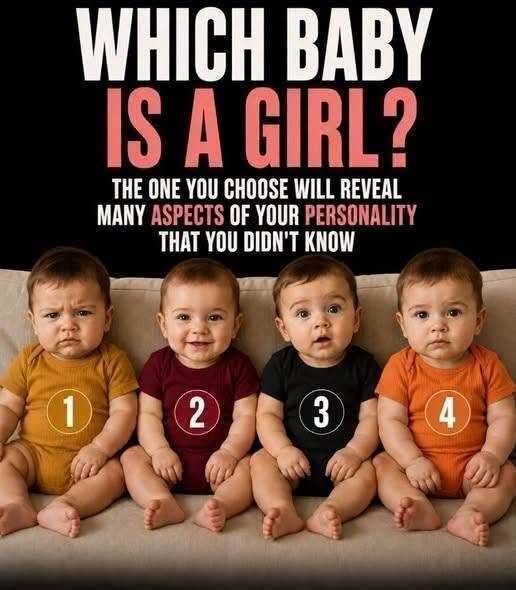
Four babies sit side by side, each wearing a different expression, each appearing almost identical at first glance. Then comes the challenge that has captivated millions of people across social media:
Which one is the little girl?
Most people don’t hesitate.
Within seconds, they point to one baby with surprising confidence.
Some immediately choose Baby Number One.
Others are convinced it’s Number Three or Number Four.
Yet a huge number of people instinctively settle on Baby Number Two.
Then the puzzle takes an unexpected turn.
Instead of revealing whether your answer is correct, it claims to reveal something about you.
According to the popular version of the test, people who select Baby Number Two are naturally warm-hearted, emotionally intelligent, compassionate, and highly intuitive. They supposedly trust their instincts, care deeply about others, and possess a quiet sensitivity that helps them understand emotions before anyone speaks a word.
For many viewers, the description feels strangely accurate.
“That’s exactly me.”
“I’ve always trusted my intuition.”
“My friends say I’m the listener in the group.”
Comments like these flood social media every time the image resurfaces.
Before long, people begin sharing it with family members, coworkers, and friends.
The conversation shifts.
Nobody is talking about the babies anymore.
Everyone is talking about themselves.
Could a single decision made in just a few seconds actually reveal hidden aspects of your personality?
It’s an intriguing question.
The answer, however, is even more fascinating than the puzzle itself.
The real secret has almost nothing to do with identifying a little girl.
Instead, it reveals something remarkable about the way the human brain works.
Our minds are designed to make fast decisions.
Every single day, your brain processes enormous amounts of information without asking for permission.
Faces.
Voices.
Movements.
Expressions.
Colors.
Patterns.
Most of these decisions happen automatically.
Long before modern society existed, this ability helped our ancestors survive.
Recognizing danger within seconds often meant staying alive.
Detecting tiny changes in facial expressions helped people understand whether someone was a friend or a threat.
Those instincts remain with us today.
The difference is that we now apply them to situations where there isn’t necessarily a correct answer.
Instead of identifying danger, we identify personalities.
Instead of reading threats, we read emotions.
The four babies become blank canvases.
Without realizing it, our brains immediately begin assigning characteristics to each child.
One looks cheerful.
Another seems thoughtful.
One appears confident.
Another feels shy.
None of those impressions actually come from the babies themselves.
They come entirely from us.
That process is known as projection.
Projection happens when we unconsciously place our own expectations, experiences, emotions, and beliefs onto other people.
The babies aren’t communicating personality traits.
Our minds are creating them.
It’s something humans do constantly.
We meet someone for the first time and decide they seem trustworthy.
We hear someone’s voice and assume they’re kind.
We see a smile and believe someone is confident.
Sometimes we’re correct.
Sometimes we’re completely wrong.
The baby puzzle simply makes this invisible mental process visible.
Then comes another interesting psychological twist.
After you’ve chosen your baby, you’re given a flattering explanation.
If you selected Baby Number Two, you’re told you’re emotionally aware, caring, generous, and intuitive.
Most people enjoy hearing descriptions like that.
In fact, psychologists have studied this exact reaction for decades.
They call it the Barnum Effect.
The Barnum Effect describes our tendency to believe that vague, positive personality descriptions are uniquely accurate—even when those same descriptions could apply to almost anyone.
Statements like:
“You care deeply about people close to you.”
“You sometimes question your own decisions.”
“You value honesty.”
“You enjoy helping others.”
Almost everyone recognizes themselves somewhere in those sentences.
Because they feel personal, they become convincing.
That’s why personality quizzes remain so incredibly popular.
Whether they’re based on favorite colors, animals, shapes, foods, or babies, they all satisfy the same human desire.
We want to understand ourselves.
We enjoy discovering hidden meanings.
We like feeling seen.
The puzzle offers exactly that.
Even though it isn’t scientifically measuring anything, it creates a moment of reflection.
People pause.
They compare answers.
They think about who they are.
That’s what makes it memorable.
Interestingly, the original question itself has no reliable answer.
Babies this young are remarkably similar.
Without clues like clothing, hairstyles, accessories, or labels, identifying gender purely from facial features is nearly impossible.
Even pediatric professionals generally avoid guessing because there simply aren’t dependable visual differences at that age.
Yet almost everyone feels confident.
“I knew immediately.”
“It was obvious.”
“I’m certain.”
Confidence can feel persuasive.
But confidence isn’t evidence.
It often reflects how efficiently the brain creates stories from limited information.
Once we’ve made a choice, another mental shortcut appears.
Psychologists call it confirmation bias.
After deciding something, our brains naturally begin searching for reasons proving we were right.
If you selected Baby Number Two and receive a positive personality description, you’ll likely notice all the ways it fits your life.
If you picked another baby, you may question the puzzle instead.
Neither reaction is unusual.
Both are perfectly human.
Social media amplifies this even further.
Thousands of comments influence new viewers before they’ve even looked carefully at the image.
Some people intentionally choose differently than everyone else.
Others follow the crowd.
Either way, the opinions of strangers quietly influence individual decisions.
The babies themselves never change.
Only our interpretations do.
Perhaps that’s the greatest lesson hidden inside this challenge.
Human beings are extraordinary meaning-makers.
Our brains dislike randomness.
We naturally search for patterns, explanations, and stories—even when none objectively exist.
That’s not a weakness.
It’s one of humanity’s greatest strengths.
The same imagination that helps us solve puzzles also fuels creativity, innovation, empathy, and storytelling.
The baby puzzle simply offers a playful glimpse into that remarkable ability.
Rather than revealing hidden truths about personality, it reveals how quickly we create narratives from incomplete information.
It reminds us that first impressions are often shaped as much by our own experiences as by the people standing in front of us.
And maybe that’s why millions of people continue sharing this image year after year.
Not because they’re desperate to discover which baby is a little girl.
But because, for just a few moments, they get to explore the fascinating machinery of their own minds.
The photograph never judges anyone.
It never measures intelligence.
It never uncovers secret personality traits.
It simply waits.
Everything else happens inside the person looking at it.
In the end, the babies remain exactly as they always were.
Ordinary children captured in a single photograph.
The real mystery was never hidden in their faces.
It has always been hidden in ours.
Every glance, every assumption, every instant decision says a little more about the observer than the image itself.
And perhaps that’s the true reason this simple challenge refuses to disappear.
It isn’t testing the babies.
It’s quietly inviting us to discover how wonderfully, creatively, and sometimes imperfectly our own minds make sense of the world.