At first glance, it looked like nothing more than another elegant royal accessory.
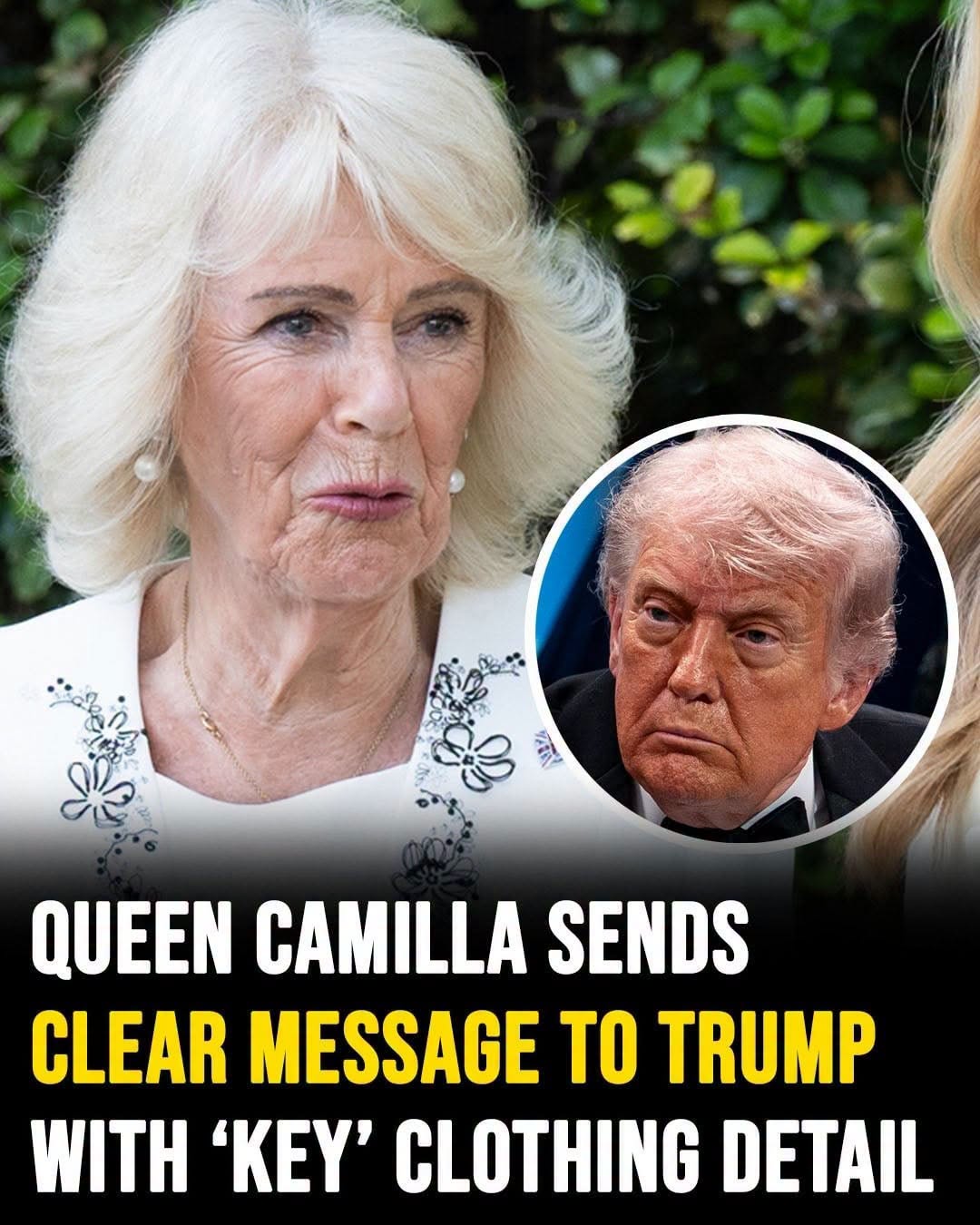
Queen Camilla stepped into the spotlight wearing a beautifully crafted brooch, smiling as cameras flashed and dignitaries gathered for another carefully choreographed royal engagement. To many observers, it appeared to be just another example of the timeless jewelry often worn by members of the British royal family.
But royal historians, fashion experts, and longtime palace watchers immediately noticed something unusual.
This was not an ordinary piece selected simply because it matched her outfit.
It carried history.
It carried symbolism.
And many believe it carried a message.
Royal wardrobes have always communicated far more than personal style.
Every color, every jewel, every decoration, and every accessory is often selected with extraordinary care. While politicians deliver speeches through words, senior royals frequently communicate through symbolism, tradition, and subtle visual cues.
Those details rarely happen by accident.
That is precisely why Queen Camilla’s choice attracted so much attention.
The brooch she wore traces its origins back to 1957, when it was presented to Queen Elizabeth II as a gift celebrating the enduring friendship between the United Kingdom and the United States.
Its design beautifully combines two instantly recognizable national symbols.
One side reflects the Union Jack.
The other incorporates the Stars and Stripes.
Together they represent what generations of leaders have described as the “special relationship” between Britain and America.
For decades, the brooch remained more than an elegant jewel.
It became a quiet reminder of diplomatic cooperation built through war, peace, political change, and countless moments of shared history.
Queen Elizabeth II occasionally selected it during events involving American leaders or important transatlantic occasions.
Each appearance reinforced the same underlying message.
Friendship.
Respect.
Partnership.
Now, years later, Queen Camilla has brought that same symbol back into public view.
Its timing immediately prompted discussion.
King Charles has continued emphasizing cooperation between democratic allies while representing Britain on the world stage.
His speeches frequently reference shared values, historical partnerships, and the importance of maintaining strong international relationships during uncertain times.
As preparations continue for major diplomatic engagements involving the United States, every royal appearance naturally attracts additional scrutiny.
That context transformed one carefully chosen brooch into one of the day’s biggest talking points.
Royal commentators quickly pointed out that such historic jewelry is rarely selected randomly.
Palace wardrobes are planned well in advance.
Senior advisers understand that every photograph taken during an international visit will be examined by audiences around the world.
In royal diplomacy, visual symbolism often becomes part of the conversation itself.
Some observers interpreted Queen Camilla’s choice as a warm reminder of the decades-long alliance connecting both nations.
Others suggested it subtly acknowledged recent political tensions while emphasizing the importance of preserving cooperation despite changing governments and personalities.
Neither interpretation required a spoken statement.
That is precisely what makes royal symbolism so powerful.
It allows messages to exist without official declarations.
Unlike elected politicians, members of the royal family traditionally avoid direct involvement in political debate.
Constitutional neutrality remains one of the monarchy’s defining principles.
They rarely criticize elected officials publicly.
They do not campaign.
They do not endorse parties.
Instead, they represent continuity.
That neutrality means clothing sometimes becomes one of the few ways symbolic communication naturally occurs.
A flower may represent remembrance.
A color may honor another nation.
A brooch may quietly recall decades of friendship.
Nothing explicit is said.
Yet millions understand the reference.
That tradition stretches back generations.
Queen Elizabeth II became especially well known for using jewelry with historical significance during state visits.
Foreign leaders frequently recognized familiar pieces appearing during important meetings.
Some brooches honored previous diplomatic relationships.
Others celebrated anniversaries or reflected shared cultural history.
Many became closely associated with particular countries.
Queen Camilla appears to have embraced that same approach.
By selecting this specific brooch, she connected today’s events with memories reaching back nearly seventy years.
The decision reminded audiences that international relationships extend beyond individual political administrations.
Governments change.
Prime ministers change.
Presidents change.
Kings and queens themselves eventually change.
But enduring alliances often survive those transitions.
That broader perspective lies at the heart of constitutional monarchy.
Royal figures are expected to represent stability across generations rather than the priorities of any single political moment.
Some commentators specifically discussed how the symbolism intersected with Donald Trump’s long-publicized admiration for Britain’s royal family.
Throughout his political career, Trump has repeatedly spoken about the relationship between the United States and the United Kingdom, often describing it as uniquely important.
At various times, however, disagreements over trade, foreign policy, and diplomatic rhetoric also generated public discussion about the health of that relationship.
Against that backdrop, Queen Camilla’s choice inevitably sparked further interpretation.
Supporters viewed it as reaffirming friendship regardless of political disagreements.
Others saw it as a gentle reminder that historic alliances require careful stewardship rather than assumption.
Neither interpretation has been confirmed by Buckingham Palace.
The royal household almost never explains wardrobe symbolism.
That silence allows observers to reach their own conclusions.
Perhaps that ambiguity is intentional.
Royal symbolism often succeeds precisely because it invites reflection without creating confrontation.
The brooch itself also serves as a reminder of the remarkable continuity preserved within the royal collection.
Many jewels worn today have witnessed decades of global history.
They have appeared during coronations, wartime commemorations, state dinners, international tours, and meetings between generations of world leaders.
Each appearance adds another chapter to their story.
When Queen Camilla wears such pieces, she is not simply displaying beautiful jewelry.
She is wearing history itself.
That historical connection resonates particularly strongly during moments of international diplomacy.
The symbolism becomes larger than one person.
Larger than one visit.
Larger even than one political era.
For many historians, this represents one of the monarchy’s unique strengths.
While governments often focus on immediate priorities, the Crown naturally operates across much longer timelines.
Its perspective stretches through decades rather than election cycles.
Objects like this brooch quietly reinforce that continuity.
Public fascination with royal fashion reflects more than interest in clothing.
People understand that every detail may contain layers of meaning.
Designers are carefully selected.
Colors are often researched.
Jewelry frequently references previous generations.
Even seemingly ordinary accessories can become diplomatic statements once placed within historical context.
That is exactly what happened here.
One small brooch generated conversations around diplomacy, history, tradition, symbolism, and the future of one of the world’s longest-standing international partnerships.
Its value was never measured solely in precious metals or gemstones.
Its greatest significance lies in what it represents.
A reminder of cooperation.
A reminder of shared history.
A reminder that relationships built over generations deserve thoughtful care.
Whether viewers interpreted Queen Camilla’s choice as encouragement, reassurance, remembrance, or subtle commentary ultimately depends on their own perspective.
The Palace has offered no official explanation.
Perhaps none is necessary.
Sometimes the most memorable messages are delivered without speeches.
Sometimes history speaks through symbols instead.
And sometimes, a single brooch worn over a queen’s heart says more than an entire press conference ever could.