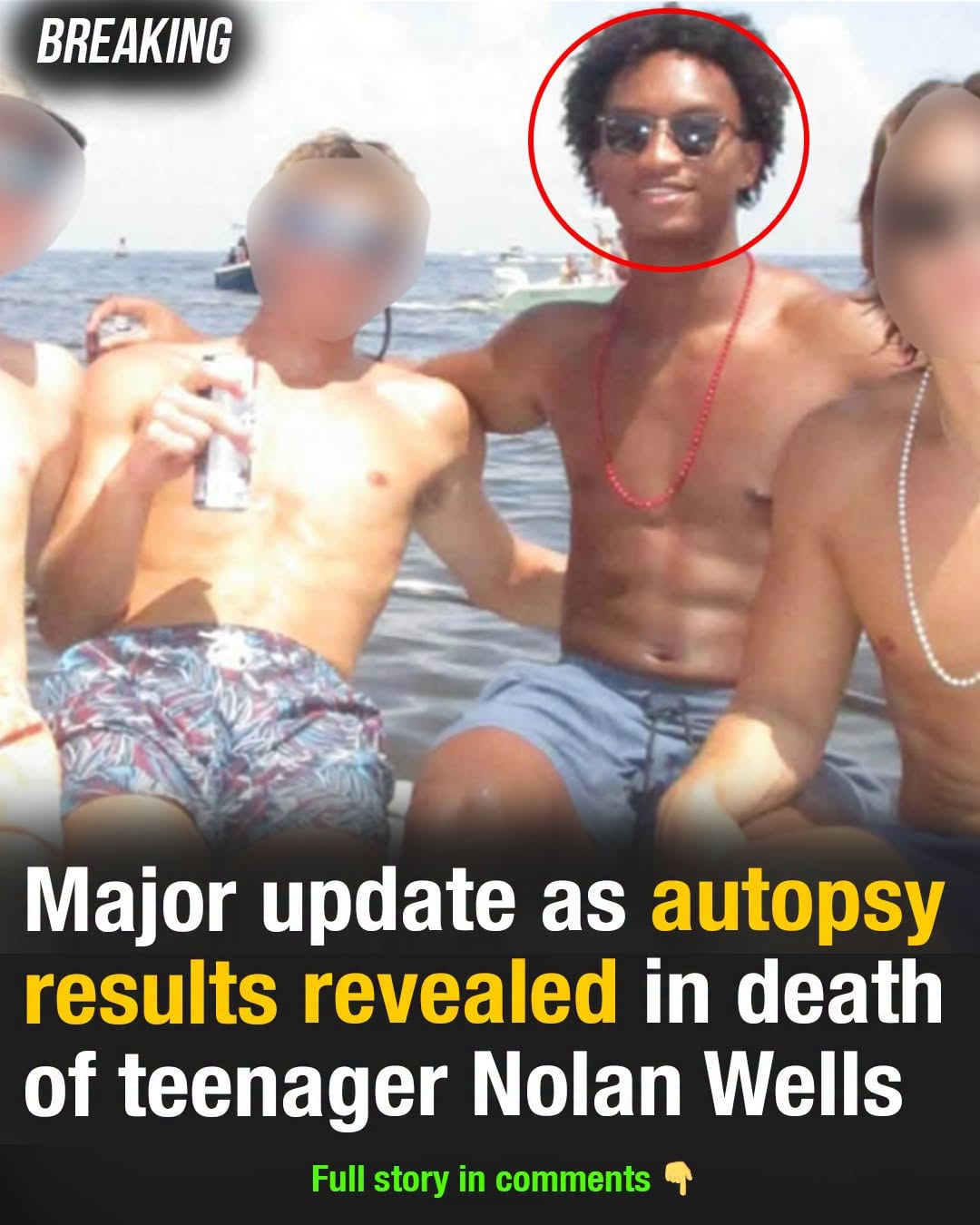
What began as a holiday celebration ended in a tragedy that continues to leave a family searching for answers. Weeks after the death of teenager Nolan Wells, newly revealed details from an independent autopsy have only deepened the mystery surrounding his final hours, raising fresh questions while offering few clear conclusions.
For Nolan’s family, every new piece of information has become another part of a heartbreaking puzzle they never imagined they would have to solve.
The story began on what was supposed to be an ordinary Fourth of July outing.
Like countless teenagers enjoying the holiday, Nolan spent the day with friends. There was nothing unusual about the plans. It was a chance to celebrate, spend time outdoors, and enjoy the long summer evening.
According to those who were with him, the day unfolded normally for hours.
At one point, friends reportedly said Nolan wandered away after mentioning that he was going to talk with a girl nearby.
Nobody believed that brief decision would become the last confirmed sighting of him alive.
As the evening progressed, the group eventually returned without Nolan.
At first, there was confusion.
Friends reportedly assumed he had made other plans or found another way home.
But as the hours passed and nobody heard from him, concern rapidly turned into panic.
His family soon realized something was terribly wrong.
Nolan’s mother began reaching out in every way she could think of.
Like many families facing the unimaginable, she turned to social media, posting emotional appeals asking anyone with information to come forward.
Friends shared the posts.
Neighbors spread the word.
Community members searched for any clue that might explain where Nolan had gone.
Every notification carried a mixture of hope and fear.
Every phone call became a possibility.
For days, the uncertainty weighed heavily on everyone who knew him.
Then came the news no family ever wants to receive.
Authorities located a body on Horn Island.
Soon afterward, officials confirmed the identity.
It was Nolan.
The confirmation ended the search.
It did not end the questions.
In the days that followed, investigators began examining the circumstances surrounding his death.
Officials stated that, based on their initial investigation, they did not believe foul play was involved.
However, many details surrounding the case remained unclear.
For Nolan’s loved ones, accepting broad conclusions without understanding exactly what happened proved nearly impossible.
Seeking additional answers, the family requested an independent autopsy.
They hoped another medical examination might provide clarity where uncertainty remained.
Instead, the results created even more questions.
According to reports from the independent examination, Nolan’s body showed no major fractures or obvious traumatic injuries that would immediately explain his death.
That finding surprised many people following the case.
If there had been no significant physical injuries, what exactly had happened during his final moments?
Among the observations documented during the examination was an area of unexplained red discoloration located on the back of Nolan’s head.
Medical experts have not publicly concluded what caused that discoloration.
Without additional evidence, its significance remains uncertain.
Yet for a grieving family searching for every possible clue, even an unexplained mark becomes impossible to ignore.
Another complication emerged during the independent review.
Several internal organs had already been removed as part of the original autopsy process before the second examination took place.
That meant independent specialists were unable to fully evaluate certain findings for themselves.
One of the most important unanswered questions involves whether Nolan drowned.
Without access to every original organ and tissue sample, confirming or excluding drowning as the definitive cause becomes significantly more difficult.
This limitation has understandably frustrated the family.
They had hoped the independent examination would either reinforce or challenge the initial conclusions.
Instead, they were left with important questions that could no longer be fully investigated through a second physical examination.
Meanwhile, authorities continue waiting for additional laboratory results.
Toxicology testing has not yet been publicly released.
Those results may provide important information regarding whether alcohol, drugs, medications, or other substances played any role in Nolan’s death.
Until those findings become available, investigators remain unable to complete the full medical picture.
Likewise, the official state autopsy report has not yet been publicly released in its entirety.
That has contributed to growing speculation across social media, where countless theories continue circulating despite limited verified information.
Investigators have repeatedly urged patience while emphasizing that official conclusions should be based on evidence rather than assumptions.
Still, waiting is often one of the most difficult parts of grief.
For Nolan’s family, each passing day without complete answers extends the emotional uncertainty.
Friends have also shared differing accounts of Nolan’s final known movements.
Some descriptions generally align.
Others contain small inconsistencies that investigators continue reviewing.
Such variations are common during investigations involving multiple witnesses.
Memory changes over time.
Stress affects recollection.
People may honestly remember events differently without intentionally misleading investigators.
Even so, every conflicting detail has become another piece of a timeline that investigators continue attempting to reconstruct.
The community has remained deeply affected by Nolan’s death.
Memorials have appeared in his honor.
Friends have shared photographs and personal stories celebrating the kind of person he was.
Teachers, classmates, relatives, and neighbors have remembered him as someone whose future seemed filled with possibility.
Those memories now stand beside an overwhelming desire to understand exactly what happened.
Many families who have experienced sudden, unexplained loss describe the same painful reality.
Grief is difficult enough on its own.
When uncertainty is added, healing often becomes even more complicated.
Instead of mourning with clear understanding, loved ones find themselves replaying timelines, conversations, and unanswered questions over and over again.
That appears to be the position Nolan’s family now faces.
Officials continue maintaining that, based on the evidence currently available, they do not suspect criminal involvement.
However, investigators also acknowledge that important aspects of the investigation remain active while additional medical findings are completed.
For Nolan’s loved ones, every official update is read carefully.
Every statement is analyzed.
Every new report is weighed against everything they already know.
They are not simply seeking closure.
They are seeking certainty.
They want to understand the final hours of someone they loved.
They want to know how an ordinary holiday with friends became an unimaginable tragedy.
Most of all, they want confidence that every possible question has been asked and every available answer has been pursued.
Until the remaining toxicology results are completed and the official findings are fully released, much of Nolan’s story remains unfinished.
For investigators, the process continues.
For the public, speculation continues.
But for Nolan’s family, life has become defined by something far more painful than headlines.
It is defined by waiting.
Waiting for reports.
Waiting for explanations.
Waiting for the truth they hope will finally bring some measure of understanding to a loss that has already changed their lives forever.