The white smoke had barely begun to drift above the Sistine Chapel when millions of people around the world understood that history had been made.
Inside Vatican City, centuries of tradition had once again unfolded with remarkable precision. Bells rang across Rome. Pilgrims embraced complete strangers. Cameras turned toward the balcony overlooking St. Peter’s Square, where countless eyes waited for the appearance of the man chosen to lead the Roman Catholic Church into a new chapter.
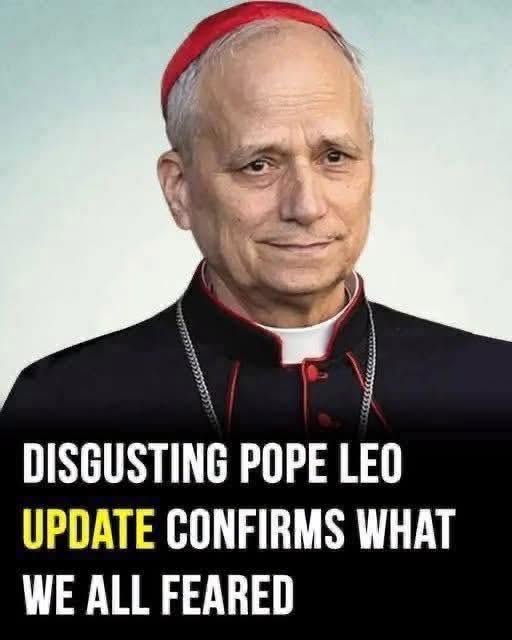
When Cardinal Robert Francis Prevost stepped forward as Pope Leo XIV, the atmosphere was unforgettable.
Thousands gathered below erupted into applause.
Flags from every continent waved through the evening air.
Some people cried openly.
Others stood silently, overwhelmed by the significance of witnessing a moment that only a handful of generations ever experience.
For Catholics, the election of a new pope is far more than the appointment of a religious leader.
It represents continuity stretching across nearly two thousand years.
Every new pontiff inherits not only an office but a legacy shaped by faith, history, conflict, reform, and hope.
By choosing the name Leo XIV, the newly elected pope immediately connected himself to one of the Church’s oldest traditions.
The name carries enormous historical weight.
Thirteen popes before him bore the name Leo, each leading the Church during dramatically different periods of world history.
Some defended doctrine during moments of political turmoil.
Others guided the Church through periods of social transformation.
One of the most remembered was Pope Leo XIII, whose leadership in the late nineteenth and early twentieth centuries left a lasting influence on Catholic social teaching and the relationship between faith and the modern world.
Selecting the name Leo XIV naturally invited comparisons with those earlier leaders.
Many observers wondered what message the choice was intended to send.
Would this new pope emphasize continuity?
Renewal?
Dialogue?
Reform?
Only time would provide those answers.
For the moment, the world simply watched.
His first appearance on the balcony reflected the quiet dignity expected from the office.
There were no dramatic gestures.
No political speeches.
No lengthy declarations.
Instead, he greeted the faithful, offered blessings, and began what countless Catholics hoped would become a ministry centered on unity, compassion, and spiritual leadership.
In St. Peter’s Square, the scene felt almost outside of time.
Ancient architecture surrounded modern technology.
Centuries-old rituals unfolded while millions followed every second through live broadcasts, smartphones, and social media platforms.
History and the digital age stood side by side.
Yet outside the square, another conversation was already unfolding.
Within minutes, reactions flooded social media.
Some celebrated enthusiastically.
Others immediately began analyzing every known detail of Pope Leo XIV’s background, past statements, and public record.
Political commentators from across the ideological spectrum quickly attempted to place the new pontiff into familiar categories.
Supporters praised qualities they believed reflected their own priorities.
Critics questioned whether his future leadership might align with positions they opposed.
Among some conservative political voices in the United States, particularly commentators associated with the MAGA movement, skepticism emerged almost immediately.
Rather than viewing the pope primarily as a spiritual figure, some interpreted his election through the lens of contemporary political debates.
Discussions that ordinarily belong to religious institutions suddenly became intertwined with arguments about culture, ideology, immigration, economics, and public policy.
It illustrated something much larger than one individual.
Modern public life increasingly leaves very little untouched by politics.
Institutions once viewed as separate from partisan debate now often find themselves drawn into it.
Religious leaders.
Universities.
Businesses.
Sports organizations.
Entertainment.
Even centuries-old traditions can quickly become subjects of political interpretation.
Social media accelerates that process dramatically.
News once unfolded gradually.
People read newspapers the following morning.
Commentators reflected for days before forming conclusions.
Today, opinions appear within seconds.
Before many people have learned basic facts, thousands of reactions may already be circulating online.
Algorithms reward speed more than reflection.
The fastest response often receives the greatest attention.
That environment presents unique challenges for modern leaders.
Every speech, photograph, gesture, and decision may be examined from countless perspectives simultaneously.
Supporters celebrate.
Critics object.
Neutral observers analyze.
The discussion never truly pauses.
For Pope Leo XIV, this reality became apparent almost immediately.
His first public appearance represented two very different experiences depending on where people were watching.
In Vatican City, the focus remained on faith, continuity, prayer, and tradition.
Online, many conversations shifted rapidly toward politics, identity, and ideological conflict.
The contrast could hardly have been sharper.
One scene featured centuries-old ceremonies conducted beneath Renaissance architecture.
The other consisted of endless scrolling feeds filled with hashtags, headlines, commentary, and debate.
Incense floated through the basilica.
Algorithms carried arguments across the internet.
Both unfolded at the same moment.
Yet despite the immediate controversy surrounding portions of the online discussion, many observers urged patience.
A papacy cannot be understood through its opening hours.
History consistently shows that the true character of any pope emerges over years rather than days.
Major decisions.
Pastoral priorities.
International diplomacy.
Relations with other faiths.
Responses to humanitarian crises.
Efforts toward unity within the Church.
These are the responsibilities that ultimately define a pontificate.
The challenges facing Pope Leo XIV are substantial.
The Catholic Church continues to navigate questions surrounding declining participation in some regions while experiencing rapid growth in others.
Global conflicts, migration, poverty, technological change, and cultural division all influence the communities he now serves.
More than one billion Catholics live across dramatically different political systems, cultures, languages, and social realities.
Leading such a diverse global community requires balancing continuity with adaptation.
It also requires resisting pressure to become merely another political figure.
Many believers hope Pope Leo XIV can remind the world that faith speaks to something deeper than partisan disagreement.
Religious leadership has historically attempted to address moral questions that transcend election cycles and ideological divisions.
Whether people agree or disagree with particular decisions, many still expect the pope to represent a voice that reaches beyond ordinary political conflict.
That may become one of his greatest tests.
Can a spiritual leader remain focused on faith in an age where nearly every public figure is pulled into political narratives?
Can ancient traditions continue speaking meaningfully to a generation shaped by constant digital debate?
Can unity survive in an environment increasingly rewarded for division?
Those questions now accompany Pope Leo XIV as he begins his historic journey.
The cheers that filled St. Peter’s Square marked only the beginning.
The applause will eventually fade.
The headlines will change.
The online arguments will move toward new subjects.
What remains will be the patient work of leadership.
History will not remember the first viral reactions nearly as much as it remembers the years that follow.
For Pope Leo XIV, the white smoke announced not only his election, but the beginning of one of the world’s most closely watched spiritual missions one that must navigate ancient tradition while facing the relentless speed and scrutiny of the modern age.