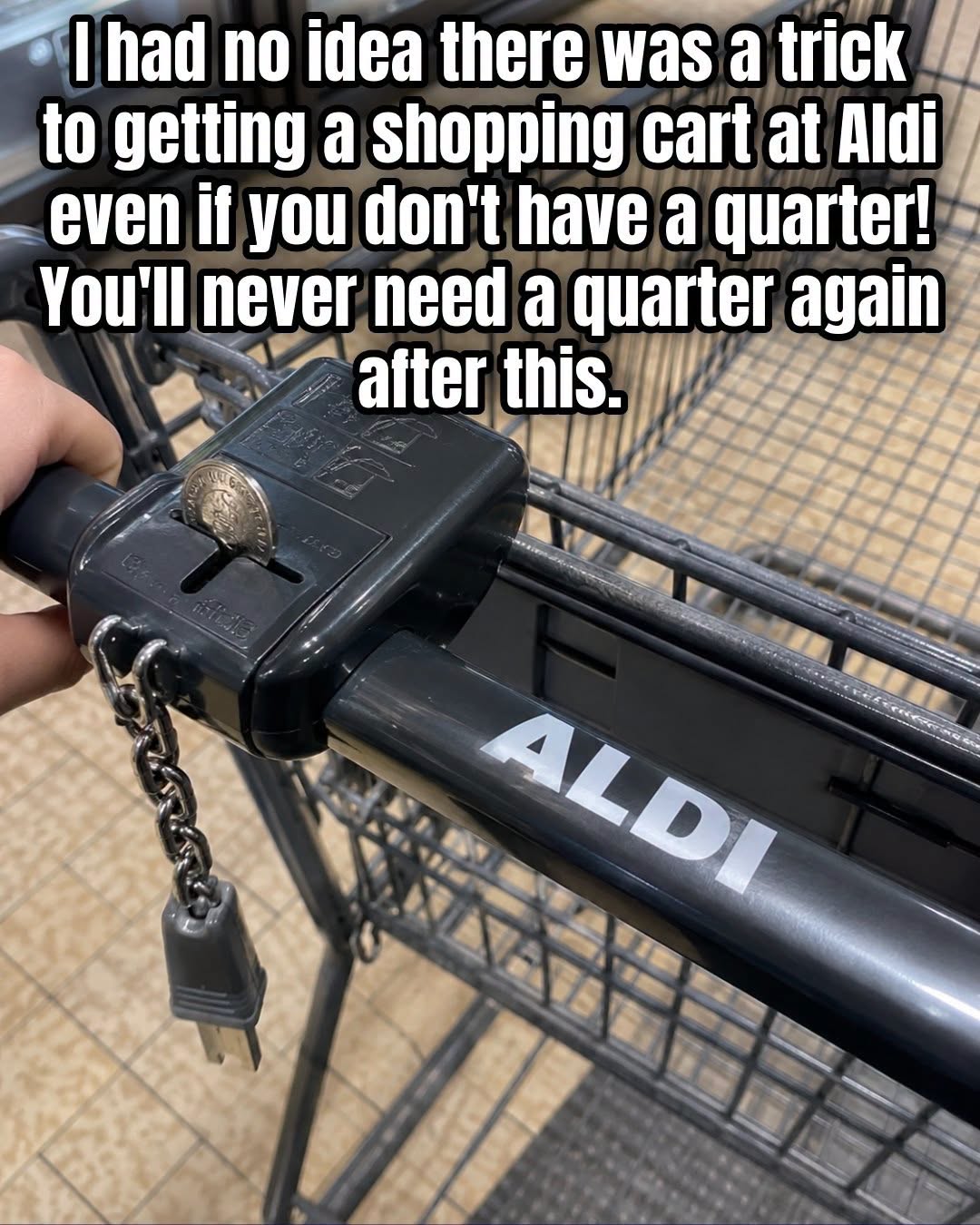
It usually happens when you’re already in a hurry.
You pull into the Aldi parking lot, mentally reviewing your grocery list and planning to get in and out as quickly as possible. You park, grab your reusable bags, lock the car, and head toward the row of shopping carts waiting outside the entrance.
Then you remember.
You don’t have a quarter.
For a moment, it feels strangely frustrating.
After driving all the way to the store, organizing your shopping list, and setting aside time for errands, your entire trip seems to come to a halt because of a single twenty-five-cent coin.
It sounds almost ridiculous.
How could something worth so little suddenly become so important?
Yet anyone who shops at Aldi regularly has probably experienced that exact moment of realization.
You search your pockets.
Nothing.
You check your wallet.
Only bills and credit cards.
Maybe you dig through the center console of your car, hoping an old coin rolled into a forgotten corner.
Still nothing.
Standing beside a line of locked shopping carts, it’s easy to wonder why Aldi continues using a system that seems inconvenient compared to nearly every other grocery store.
The answer actually goes back to one of the company’s biggest priorities: keeping prices low.
Unlike many supermarkets, Aldi operates with a business model focused on efficiency.
The quarter deposit isn’t designed to make money.
It exists to encourage shoppers to return their own carts instead of leaving them scattered across the parking lot.
When customers return the cart and unlock it from the next one, they receive their quarter back.
Because nearly everyone wants their coin returned, employees spend far less time collecting carts from around the parking lot.
That means fewer labor costs.
Those savings become part of Aldi’s overall strategy to keep grocery prices competitive.
It’s a surprisingly simple idea.
Instead of paying employees to retrieve hundreds of abandoned carts every day, customers take care of the task themselves.
Everyone gets their quarter back.
The parking lot stays organized.
The store reduces operating expenses.
For shoppers who remember their coin, the process becomes second nature.
Insert the quarter.
Take the cart.
Shop.
Return the cart.
Retrieve the quarter.
After a few visits, many people barely think about it anymore.
The challenge comes on the days when that little coin isn’t available.
Fortunately, forgetting a quarter doesn’t necessarily mean your shopping trip is ruined.
One of the easiest solutions is simply asking for help.
Many Aldi employees understand exactly what happened because they see it regularly.
If you explain that you’ve forgotten your quarter, a cashier or store associate may be able to unlock a cart for you.
Policies can vary from one location to another, but employees are often willing to help whenever possible.
Another option is asking another shopper.
Many regular Aldi customers have experienced the same situation themselves.
If someone is returning a cart as you arrive, they may simply hand it to you instead of reconnecting it to the row.
Some people even refuse to take the quarter back, treating it as a small act of kindness toward another customer.
These tiny exchanges happen every day.
One person leaves the store.
Another arrives.
A cart changes hands.
A stranger saves someone else’s trip over twenty-five cents.
Moments like that remind us that grocery shopping can still include unexpected acts of generosity.
Some shoppers eventually decide to solve the problem permanently.
Rather than hoping they’ll always remember a quarter before leaving home, they create a dedicated place for one.
Many people keep a quarter inside the center console of their car.
Others place one in the glove compartment.
Some attach a coin holder directly to their keychain.
There are even inexpensive plastic tokens designed specifically for Aldi carts.
They are shaped like quarters, fit into the cart lock, and can stay attached to your keys so they’re always available.
For frequent Aldi shoppers, this tiny accessory quickly becomes one of those everyday items that saves time over and over again.
Of course, not everyone needs a cart.
If you’re only buying a few items, you may decide to shop without one.
Aldi stores often provide empty cardboard boxes left over from stocking shelves.
Customers regularly use them to carry groceries around the store before taking them home.
Reusable shopping bags can also serve the same purpose for smaller purchases.
If your list contains only a handful of products, skipping the cart altogether may actually make your trip even faster.
Still, the experience teaches an interesting lesson.
Sometimes the smallest inconveniences feel much larger than they really are.
Standing outside without a quarter may briefly feel like a major obstacle.
Yet within a few minutes, a solution usually appears.
An employee helps.
Another customer offers a cart.
A forgotten coin turns up in your vehicle.
Or you simply shop using a box instead.
What initially seemed like a problem quietly disappears.
Many longtime Aldi customers eventually laugh about it.
They remember their first visit, the confusion over the cart system, and the frantic search through pockets and cup holders.
Months later, keeping a quarter available becomes as automatic as bringing reusable bags.
The inconvenience fades into routine.
In fact, many shoppers come to appreciate the system.
Parking lots tend to stay cleaner.
Carts are neatly organized instead of scattered across parking spaces.
There are fewer damaged vehicles caused by loose carts rolling across the pavement.
Employees spend more time helping customers and stocking shelves instead of chasing carts around the lot.
That tiny coin quietly contributes to a smoother shopping experience for everyone.
The next time you prepare for an Aldi trip, you’ll probably remember your reusable bags.
You may double-check your grocery list.
And if you’ve learned the lesson once, you’ll probably reach for that dedicated quarter sitting exactly where you left it.
It may be tucked inside your glove compartment.
Clipped to your keys.
Hidden in your wallet.
Or waiting patiently inside your car’s cup holder.
Its value hasn’t changed.
It’s still only twenty-five cents.
But somehow, that little coin carries something much more valuable than its monetary worth.
It carries convenience.
Preparation.
Peace of mind.
And the quiet confidence that no matter how busy your day becomes, you won’t find yourself standing at the cart corral wondering how something so small managed to interrupt your entire shopping trip.
Sometimes the smartest shopping trick isn’t finding the biggest discount.
It’s simply remembering the smallest coin.