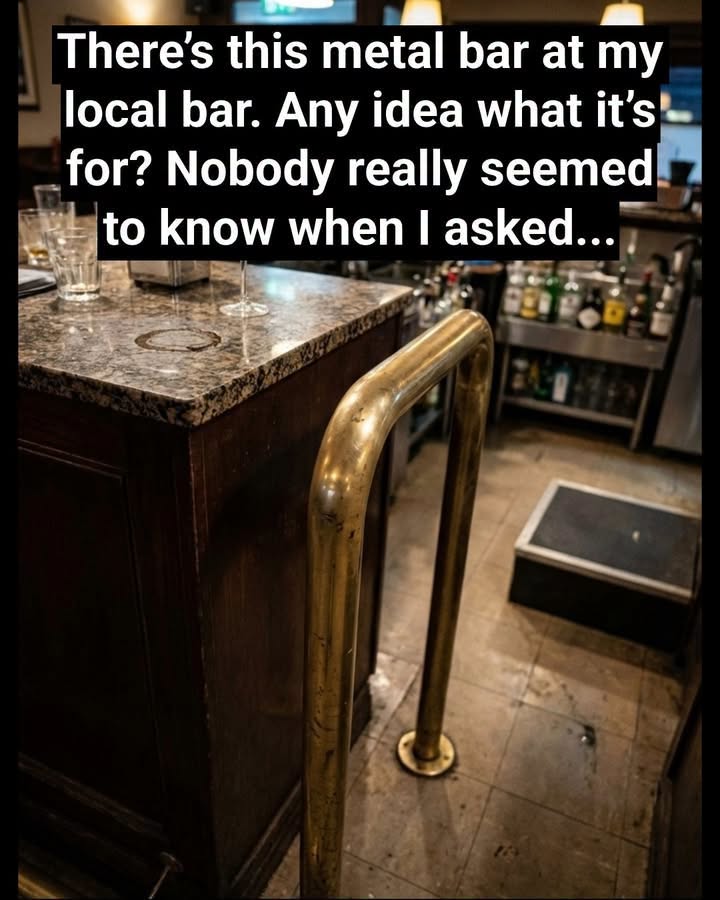
If you’ve ever sat at a restaurant bar or waited for a drink at your favorite pub, you’ve probably noticed a polished metal bar running along the front edge of the counter. Most people barely give it a second thought. It blends naturally into the design, looking like just another decorative feature added to complete the classic appearance of the bar.
But that simple metal rail is there for a very specific reason.
In fact, it quietly helps restaurants operate more efficiently every single day, guiding customers without them even realizing it. While it may appear to be nothing more than an attractive design element, it plays an important role in keeping both guests and employees safe while ensuring that service runs as smoothly as possible.
Like many of the best pieces of design, its purpose often goes completely unnoticed because it works so well.
The metal bar is commonly known as a service bar rail or service rail.
Although every restaurant is designed a little differently, this rail creates a subtle but important boundary between the customer area and the bartender’s workspace. It establishes an invisible line that encourages guests to stay on one side while allowing staff to move freely on the other.
Unlike ropes, signs, or barriers that loudly tell people where they can and cannot stand, the service rail accomplishes the same goal quietly.
Most customers instinctively recognize that they shouldn’t lean over or step beyond it.
Without saying a single word, it communicates exactly where the working area begins.
This may not seem like a big deal when the restaurant is quiet.
But during the busiest hours of the day, that small metal rail becomes incredibly valuable.
Behind every busy bar is a carefully organized system.
Bartenders are constantly preparing cocktails, pouring beer, washing glasses, stocking supplies, processing payments, speaking with customers, and coordinating with servers—all while moving quickly through a relatively small space.
Every step matters.
Every second counts.
Servers frequently approach the bar to collect drinks for their tables.
Bartenders often have multiple orders waiting simultaneously.
One unexpected customer stepping into that workflow can instantly create confusion.
The service rail helps prevent exactly that.
Rather than allowing customers to drift into the service area, the rail gently encourages everyone to remain where they belong.
That extra bit of separation reduces congestion and allows employees to focus on their jobs without constantly navigating around guests.
Imagine carrying a tray loaded with drinks through a crowded restaurant.
One unexpected person standing in the wrong place could easily lead to spilled beverages, broken glass, or even injuries.
Restaurants are fast-moving environments.
Anything that improves traffic flow helps everyone.
The service rail is one of those small features that quietly makes a huge difference.
It also protects what restaurant employees often refer to as the “service station.”
This is the section of the bar where servers pick up completed drink orders before taking them to customers.
Unlike the seating area, this space is designed strictly for employees.
When customers gather around this location, it becomes difficult for servers to retrieve drinks efficiently.
The rail helps discourage that behavior without requiring employees to repeatedly ask people to move.
Instead of creating uncomfortable conversations, the design itself encourages proper spacing.
Many people also assume the rail exists simply because it looks attractive.
There is actually some truth to that.
Function came first.
Beauty followed.
Traditionally, these rails have often been made from brass.
Brass became popular not because it was the only suitable material, but because it offered several advantages.
It is durable.
It resists corrosion.
It develops an attractive patina over time.
Most importantly, it complements the warm appearance of traditional wood bars.
Brass also matches another familiar feature found beneath many bar counters the foot rail.
That lower rail gives seated guests a comfortable place to rest their feet.
Together, the upper service rail and lower foot rail create a balanced, classic appearance that has become closely associated with traditional pubs, taverns, and cocktail lounges.
Today, restaurants use many different materials.
Stainless steel has become increasingly common because it is easy to clean and highly durable.
Some upscale establishments choose brushed nickel or custom finishes that better match their interior design.
Regardless of the material, however, the purpose remains exactly the same.
Interestingly, the service rail also provides subtle protection for the bar itself.
Customers naturally lean against counters while waiting for drinks or chatting with friends.
Without the rail, constant pressure could gradually wear down wood finishes or decorative panels.
The rail absorbs much of that contact, helping preserve the appearance of the counter over many years of daily use.
It acts almost like a protective bumper.
Many restaurants invest significant amounts of money in custom-built bars.
Protecting those surfaces from unnecessary damage makes good business sense.
Another overlooked detail often appears right beside the service rail.
Many bars include an opening or gate where employees enter and exit the work area.
The rail typically stops at that entrance.
That gap is intentional.
It creates a designated access point for bartenders and servers while reinforcing that the remaining section is not intended for customer traffic.
Without even thinking about it, most guests recognize that they shouldn’t cross the rail except where invited by staff.
Design often influences behavior more effectively than written instructions.
Restaurants have relied on this principle for decades.
Good restaurant layouts minimize confusion.
They naturally guide customers through the space.
Host stands direct arriving guests.
Partitions create waiting areas.
Furniture shapes traffic flow.
The service rail performs the same function behind the bar.
It helps organize movement without feeling restrictive.
Many people first notice the rail only after someone points it out.
After that, it’s impossible to ignore.
Suddenly, you begin seeing it everywhere.
Neighborhood sports bars.
Historic pubs.
Upscale cocktail lounges.
Hotel bars.
Airport restaurants.
Fine dining establishments.
The design remains remarkably consistent because it continues working exactly as intended.
Some modern restaurants have experimented with more open concepts where the service rail is reduced or removed entirely.
While this creates a more casual atmosphere, it can also increase crowding around bartenders during busy periods.
For this reason, many hospitality professionals still prefer incorporating some form of physical boundary, even if it appears more subtle than traditional brass rails.
Customers also benefit from the separation.
Waiting for drinks becomes more organized.
Orders are easier to collect.
Employees can focus on serving rather than directing traffic.
The overall experience becomes smoother for everyone involved.
Sometimes the smallest details have the biggest impact.
The service rail is rarely discussed.
It never appears in restaurant advertisements.
Most guests leave without realizing it served a purpose at all.
Yet countless restaurants rely on it every day.
It’s a perfect example of thoughtful design solving practical problems without drawing attention to itself.
The next time you visit a restaurant or sit down at a bar, take another look at that polished metal rail running along the front of the counter.
What once seemed like a decorative strip of metal is actually a carefully planned feature that helps bartenders work efficiently, protects the workspace, improves customer flow, reduces accidents, and preserves the bar itself.
Its job isn’t to stand out.
Its job is to quietly keep everything running exactly as it should.
And after learning its real purpose, you’ll probably never look at that simple metal bar the same way again.