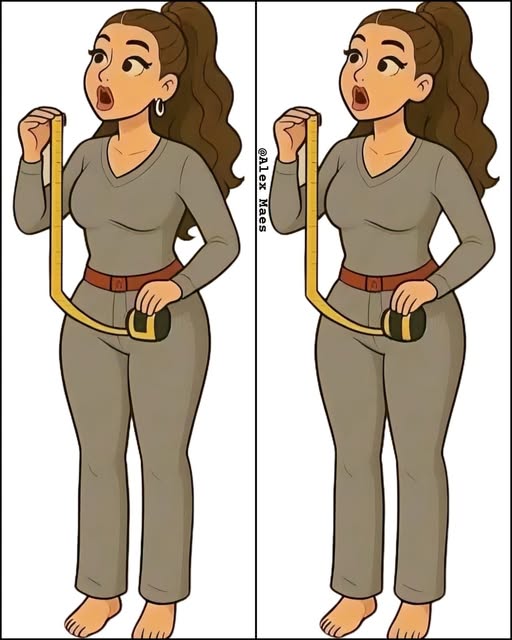
At first glance, the two images look exactly the same. Every color, every shape, every tiny detail appears perfectly aligned, as if nothing has changed at all.
But look a little closer, and the illusion begins to crack. Somewhere within those nearly identical scenes are three subtle differences, carefully hidden in plain sight, waiting for someone patient enough to uncover them.
This is the essence of the classic spot-the-difference challenge, a deceptively simple game that has fascinated people of all ages for generations. What begins as a quick glance often turns into a test of endurance, concentration, and perception. The longer you look, the more your brain begins to question what it thought it saw just seconds before. That moment of doubt is where the real challenge begins.
Your task sounds straightforward: compare two images and find three differences. But the simplicity is what makes it so engaging. The human brain is designed to recognize patterns quickly, often skipping over fine details in favor of efficiency. That’s why these puzzles work so well. They force you to slow down, to resist the urge to assume, and to truly observe.
At first, you might scan the images quickly, expecting the differences to jump out at you. Sometimes one does—a missing object, a color that feels slightly off, or a shape that doesn’t quite match. But after that initial discovery, things get harder. Your eyes begin to drift over the same areas repeatedly, your brain convincing you that you’ve already seen everything there is to see. This is where patience becomes your greatest tool.
Spot-the-difference games are more than just a way to pass time. They actively engage multiple areas of your brain, turning a simple activity into a full mental workout. Your visual processing skills are put to the test as your eyes move back and forth between the images, searching for inconsistencies. At the same time, your memory is working to hold onto small details so you can compare them accurately. Your attention is sharpened with every second you stay focused, resisting distractions and staying locked into the task.
One of the most rewarding aspects of these puzzles is how they strengthen your problem-solving abilities. Each difference you find is a small victory, proof that careful observation and persistence can reveal what initially seemed invisible. Over time, this kind of thinking carries over into everyday life. You become more attentive, more detail-oriented, and more willing to question first impressions.
Focus is another skill that grows stronger with every challenge. In a world filled with constant interruptions, maintaining deep concentration can feel difficult. But when you immerse yourself in a puzzle like this, everything else fades away. Your attention narrows, your thoughts quiet, and you become fully present in the moment. It’s a rare kind of mental clarity that feels both productive and calming at the same time.
There’s also a surprising sense of relaxation that comes with this kind of focused activity. While your brain is actively working, it’s also escaping from the noise of daily life. The steady rhythm of scanning, comparing, and analyzing creates a calming effect, almost like meditation. It allows you to reset, recharge, and return to your day with a clearer mind.
And then there’s the satisfaction. The moment you finally spot that last hidden difference is more than just a small win. It’s a surge of accomplishment, a reminder that persistence pays off. Your brain rewards you with a burst of dopamine, reinforcing the effort you’ve put in and encouraging you to take on the next challenge.
What makes these puzzles even more interesting is how differently people approach them. Some focus on the bigger elements first, scanning for obvious changes in shapes or objects. Others dive straight into the details, examining colors, textures, and tiny inconsistencies. There’s no single correct strategy, only the one that works best for your way of thinking. That’s what makes it such a personal experience.
These challenges can also become a shared activity, bringing people together in a fun and engaging way. Whether you’re competing to see who can find the differences fastest or working together to solve the puzzle, the experience becomes more dynamic when multiple perspectives are involved. Sometimes, the difference you’ve been searching for feels impossible to find until someone else points it out in an instant.
Beyond the fun and competition, spot-the-difference games play an important role in maintaining cognitive health. Regularly challenging your brain helps keep it active, improving memory, attention, and overall mental agility. It’s a simple yet effective way to keep your mind sharp, no matter your age.
Patience is perhaps the most valuable lesson these puzzles offer. In a fast-paced world where everything is designed for speed, taking the time to carefully observe and think deeply can feel unfamiliar. But it’s in that slower pace that real understanding happens. These puzzles teach you to trust the process, to keep looking even when it feels like there’s nothing left to find.
At their core, these challenges are about more than just spotting differences. They’re about learning to see. To move beyond assumptions, to notice the small details, and to appreciate how much can be hidden within something that seems ordinary. They remind us that the world is full of subtle variations, and that sometimes, all it takes is a little more attention to uncover them.
So as you look at the two images in front of you, remember that the answer isn’t just about quick thinking or sharp eyesight. It’s about patience, focus, and curiosity. The differences are there, quietly waiting to be discovered. The question is, will you take the time to truly see them?