What began as an ordinary evening quickly became a nightmare that would change one family’s life forever.
An 11-year-old girl had simply accompanied her father and younger siblings to pick up dinner. They were sitting together in their vehicle outside a McDonald’s restaurant, waiting for their order, when violence erupted without warning.
Within seconds, everything changed.
A dispute involving other people suddenly escalated nearby, and gunfire shattered what had moments earlier been a routine family outing.
The children never saw it coming.
Neither did their father.
One moment they were talking and waiting for their food.
The next, windows exploded, terrified screams filled the air, and bullets tore through the vehicle.
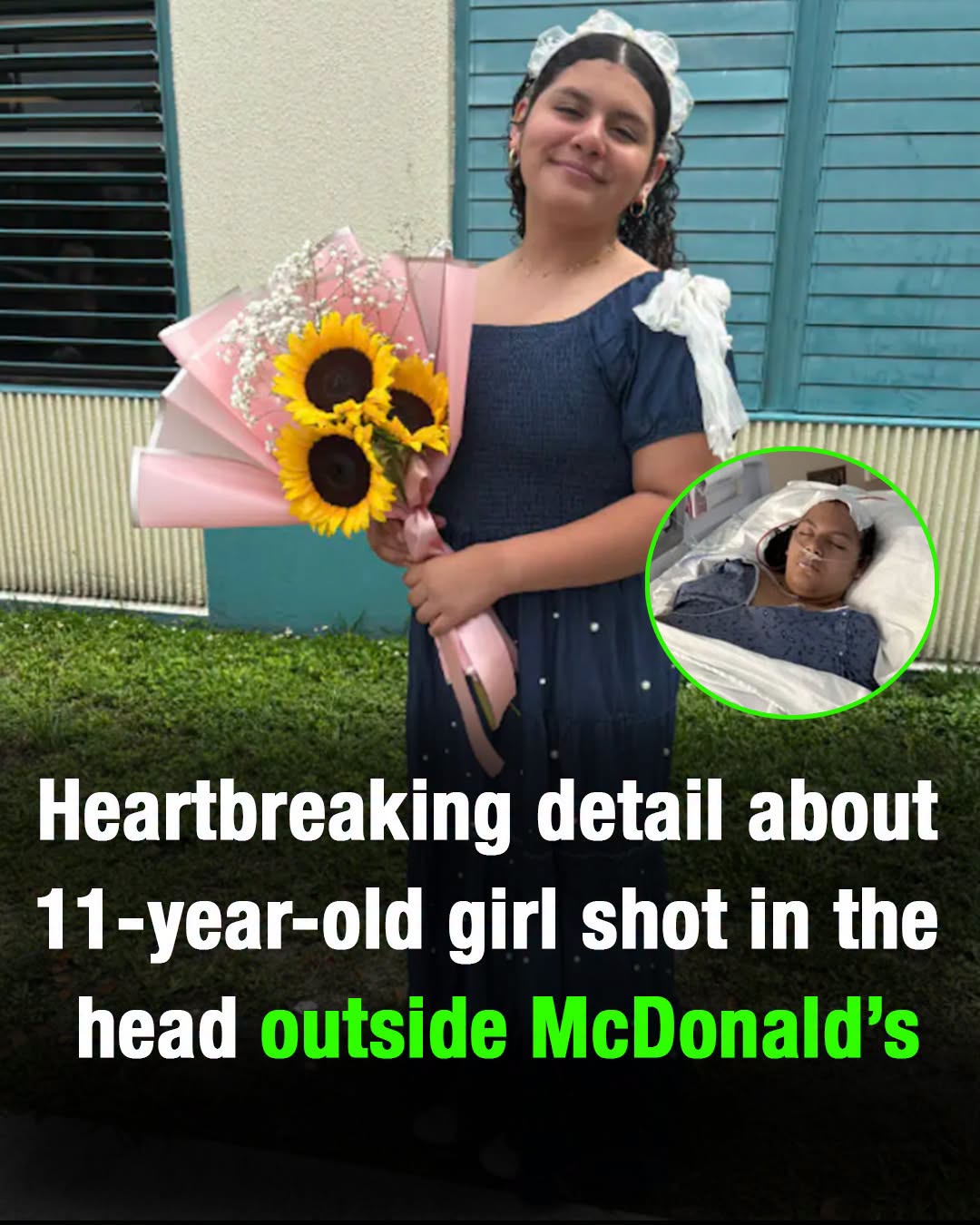
Among those struck was the family’s oldest daughter, Dora.
A single bullet entered her head, leaving everyone at the scene fearing the worst.
Her father was also injured during the shooting, but despite his own wounds, his immediate concern was his daughter.
Emergency responders rushed to the scene as panic unfolded around the restaurant.
Medical personnel quickly recognized the severity of Dora’s injuries.
She was transported to a nearby hospital where trauma specialists immediately prepared for emergency surgery.
Her condition was critical.
Doctors worked through the night, knowing that every minute could determine whether she survived.
Family members gathered anxiously, waiting for updates that seemed to take forever.
Inside the operating room, surgeons faced an extraordinarily difficult challenge.
The bullet had become lodged deep inside Dora’s head.
While removing it might appear to be the obvious solution, the reality was far more complicated.
After carefully examining the damage, doctors concluded that attempting to remove the projectile could cause catastrophic additional injuries.
The operation itself carried the possibility of permanently damaging vital areas of the brain.
In the end, the medical team made a decision no family ever expects to hear.
The bullet would remain where it was.
Although the thought seemed almost impossible to accept, doctors believed leaving it in place offered Dora the greatest chance of survival and future recovery.
The announcement stunned everyone.
Her loved ones struggled to process how such a decision could be necessary.
Yet they also understood the reality.
The priority had become preserving as much brain function as possible.
The surgery succeeded in stabilizing her condition.
Against tremendous odds, Dora survived.
But survival marked only the beginning of a long and uncertain journey.
The injuries she sustained would require months, and possibly years, of rehabilitation.
Simple daily activities suddenly became enormous challenges.
Walking.
Speaking.
Remembering.
Concentrating.
Tasks that most people perform without thinking would now require determination, therapy, and extraordinary patience.
Doctors explained that every brain injury follows a unique path.
No one could predict exactly how much recovery Dora might achieve.
Progress would likely come slowly.
Some improvements might happen quickly.
Others could take years.
There were no guarantees.
Despite the uncertainty, one thing became immediately clear.
Dora possessed remarkable determination.
As she slowly regained strength, therapists helped her relearn movements many people take for granted.
Each small achievement became a celebration.
Standing independently.
Taking a few careful steps.
Completing simple exercises.
Every milestone represented another victory against overwhelming circumstances.
Meanwhile, her father faced his own painful recovery.
Although his physical injuries required treatment, the emotional impact proved equally significant.
He continued replaying the terrifying moments outside the restaurant, wondering if anything could have prevented what happened.
Like many parents who experience traumatic events involving their children, he carried an enormous burden of guilt despite having done nothing wrong.
Friends and relatives repeatedly reminded him that he could not have anticipated random violence.
Still, the questions remained.
He had left home intending only to buy dinner.
Instead, he watched emergency crews fight to save his daughter’s life.
As Dora’s rehabilitation continued, the family’s daily routine transformed completely.
Hospital visits replaced ordinary activities.
Medical appointments filled the calendar.
Therapy sessions became part of everyday life.
The practical realities also became increasingly difficult.
Because Dora required constant care, her father could no longer maintain his regular work schedule.
Supporting his daughter’s recovery demanded his full attention.
Financial pressures quickly followed.
Medical expenses accumulated.
Transportation costs increased.
Lost income created additional challenges.
Friends, neighbors, and compassionate strangers soon began searching for ways to help.
A fundraising campaign was established to assist the family with mounting expenses while allowing Dora’s father to remain at her side throughout her recovery.
Support arrived from people who had never met the family.
Many explained that Dora’s story deeply affected them.
Parents imagined their own children sitting in that vehicle.
Others simply wanted to remind the family they were not facing this difficult journey alone.
The generosity provided practical assistance, but perhaps even more importantly, it offered emotional encouragement during an unimaginably difficult period.
As Dora slowly became stronger, she eventually addressed those who had supported her.
Many expected anger.
Others anticipated sadness.
Instead, her message reflected gratitude.
She thanked the doctors who saved her.
She thanked everyone who had prayed for her recovery.
She thanked complete strangers who had offered kindness to her family.
Her quiet strength inspired countless people.
Observers noted that despite enduring unimaginable trauma, she focused not on revenge or bitterness but on appreciation for those helping her move forward.
Medical experts continue monitoring Dora’s condition closely.
Because the bullet remains inside her head, regular examinations are necessary to ensure no additional complications develop.
Doctors remain cautiously optimistic while emphasizing that recovery from severe brain injuries requires patience.
Every small improvement represents meaningful progress.
The family understands there is still a long road ahead.
Some days bring encouraging signs.
Others present setbacks.
That unpredictability has become part of their new reality.
Through it all, Dora’s father remains by her side.
He describes every smile, every successful therapy session, and every new accomplishment as reminders that hope still exists.
Although life will never return to what it once was, the family continues focusing on the future rather than the tragedy that changed everything.
Their story has also renewed conversations about the devastating consequences of gun violence, particularly when innocent families become unintended victims.
An ordinary evening meal should never become a medical emergency.
Children waiting for dinner should never become trauma patients.
Yet for Dora and her family, one unexpected burst of violence permanently altered the course of their lives.
Today, the bullet remains where surgeons determined it must stay.
But so does something else.
Hope.
Hope that rehabilitation will continue bringing progress.
Hope that healing, while slow, remains possible.
Hope that one day this courageous young girl will reclaim as much of her future as possible.
For her family, every new step she takes is proof that another chance at life is something worth fighting for every single day.