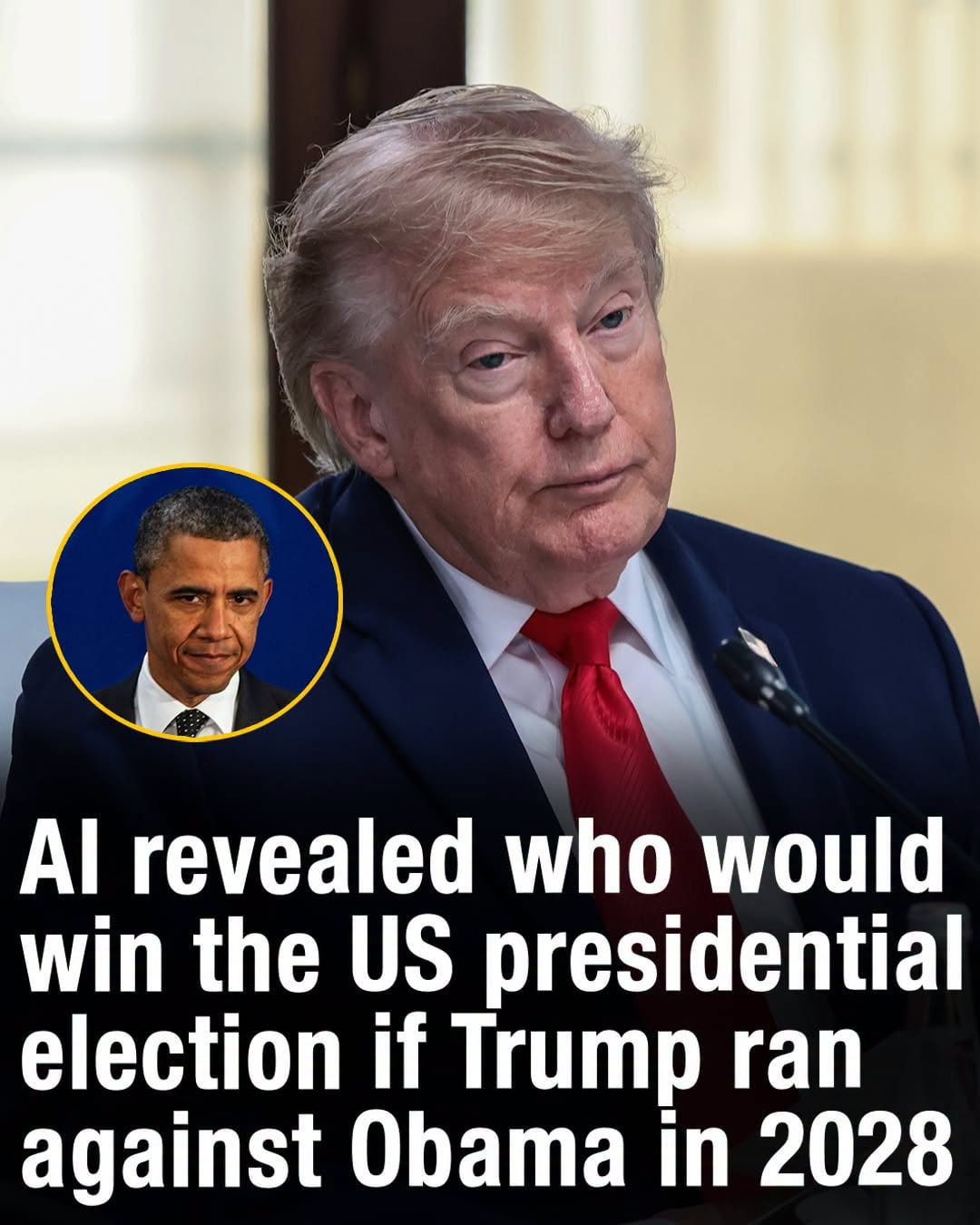
In a fictional 2028 matchup that could never legally take place, artificial intelligence models imagining a Trump versus Obama presidential race describe a country already running on political exhaustion.
Rather than a conventional campaign focused on detailed policy proposals, the scenario unfolds as a symbolic clash between two contrasting eras of American leadership.
In this imagined environment, the AI envisions Barack Obama positioning himself as a figure of restoration, framing his message around stability, institutional repair, and a return to political norms. His hypothetical campaign is described as one centered on undoing long-standing divisions and presenting himself as a steady hand capable of calming a nation worn down by years of political turbulence and public distrust.
Donald Trump, by contrast, is portrayed as continuing his established political identity built on disruption, populist messaging, and direct confrontation with established institutions. In the simulation, his appeal remains rooted in challenging traditional political structures and mobilizing supporters who view the system itself as broken or unresponsive.
According to the AI-generated scenario, the race becomes less about specific policies and more about competing interpretations of America’s direction. One vision emphasizes order, institutional trust, and gradual recovery, while the other leans into upheaval, confrontation, and structural change. The result is described not as a typical election, but as a referendum on political identity itself.
Within this hypothetical framework, the AI leans cautiously toward an Obama victory, suggesting that in a climate defined by fatigue and instability, voters may gravitate toward perceived calm and predictability. The analysis assumes that public desire for relief from prolonged political conflict could outweigh the momentum typically associated with high-intensity populist movements.
However, the scenario quickly runs into an unavoidable reality: it is constitutionally impossible. The United States’ 22nd Amendment strictly limits presidents to two elected terms, meaning neither Donald Trump nor Barack Obama could legally run for a third term under current law. This legal barrier renders the entire simulation purely speculative, regardless of predicted outcomes.
Even so, the thought experiment has drawn attention because it reflects something deeper than electoral mechanics. It highlights how political forecasting especially when powered by artificial intelligence often becomes a mirror for public sentiment rather than a literal prediction of future events. The imagined result reveals more about perceived national moods than about any real-world political trajectory.
Supporters of Trump, Obama, or neither can interpret the scenario in dramatically different ways. For some, it reinforces the belief that stability and institutional restoration remain powerful political forces. For others, it underscores the enduring appeal of anti-establishment rhetoric and the emotional energy it generates among voters. In both cases, the simulation becomes less about accuracy and more about interpretation.
Political analysts often caution that AI-generated election outcomes should be understood as reflective models rather than forecasts. These systems draw on historical data, polling trends, and narrative patterns, but they cannot account for unpredictable real-world shifts, legal constraints, or entirely hypothetical candidacies. As a result, their outputs tend to amplify existing assumptions rather than produce definitive answers.
Still, the fascination with a Trump versus Obama matchup speaks to the enduring influence both figures hold over American political imagination. Even years after their respective presidencies, they remain central reference points in discussions about leadership style, national identity, and the direction of the country.
In the end, the most striking element of the AI scenario is not the predicted outcome, but the question it raises about public sentiment. It reflects a nation often portrayed as divided between continuity and change, between institutional trust and disruptive reinvention, and between competing visions of what leadership should look like in uncertain times.
And while the 2028 matchup itself will never happen, the conversation it generates continues to reveal something very real about how Americans view power, politics, and the fragile boundaries that define their democracy.