It was supposed to be another night of celebration, another stop on a decades-long career defined by energy, charisma, and unmistakable voice.
Instead, it became a moment no one in the Utah audience will forget.
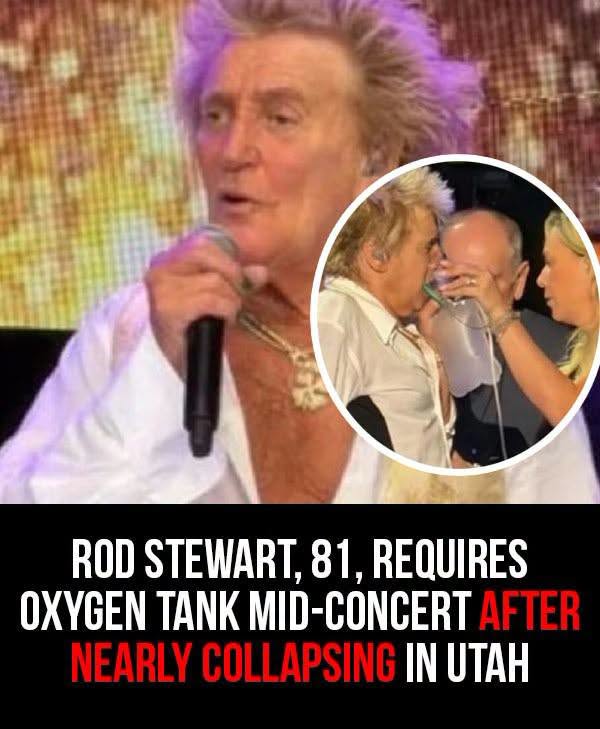
Rod Stewart, at 81 years old, found himself battling altitude, illness, and exhaustion mid-performance, briefly relying on an oxygen tank after appearing to struggle physically on stage. The atmosphere inside the venue shifted almost instantly—from excitement to concern, from cheering to silence, as fans realized something was wrong.
Yet even in that fragile moment, the legendary performer did not immediately step away.
He stayed.
He sang.
And in doing so, he transformed a health scare into an unexpectedly emotional connection with the audience that has followed him for generations.
The incident unfolded as Stewart moved through one of his most iconic songs, “Young Turks,” a track that once symbolized youthful rebellion and unstoppable energy. On this night, however, the meaning felt different. The contrast between the song’s title and the reality of an aging performer fighting for breath created a moment heavy with irony and empathy.
At approximately 4,300 feet above sea level, the physical strain became visible. Stewart appeared unsteady, pausing between lines, his movements less fluid than fans are used to seeing. For a brief moment, concern rippled through the crowd as staff and band members assessed the situation.
An oxygen tank was brought out.
The sight alone was enough to silence parts of the venue.
For many performers, this would have marked the end of the show. A pause, an apology, an exit followed by medical attention backstage. But Stewart made a different decision. Rather than abandon the performance entirely, he chose to continue in a modified form, adapting his presence on stage rather than disappearing from it.
He sat for portions of the set.
He paced carefully when he could.
And he continued to sing, even as the circumstances around him made every note more difficult than the last.
For fans watching, the moment was not defined by spectacle, but by vulnerability. The polished image of a rock star who once dominated stadiums around the world gave way to something more human: a man confronting the limits of his own body in real time, refusing to surrender the stage he has inhabited for more than half a century.
In the aftermath, attention quickly turned to his recent health challenges.
Stewart has faced a series of illnesses and physical setbacks in recent weeks, leading to canceled performances and growing speculation about whether he should slow down. Some critics argue that continuing to tour at this pace places unnecessary strain on his health. Others insist that he remains capable of deciding for himself how and when to perform, especially given the decades he has already dedicated to his craft.
That tension—between concern and autonomy has become part of the broader conversation surrounding aging performers in the modern music industry.
For artists who built their lives on stage, stepping away is rarely simple.
Performance is not just a job; it becomes identity, rhythm, and purpose. The stage is not merely a place of work but a place of existence, where decades of memory and emotion are continuously replayed in front of audiences who still want more.
Stewart’s decision to continue, even briefly under oxygen support, reflects that complexity. It is not simply a question of health. It is a question of legacy, pride, and connection.
For the audience in Utah, the experience was deeply personal.
What they witnessed was not a perfectly rehearsed show, but something unplanned and unfiltered. The vulnerability of the moment erased distance between performer and crowd. The usual barrier between stage and seats seemed to disappear, replaced by shared concern and quiet admiration.
Fans described the atmosphere as emotional rather than alarming.
Some held their breath.
Others quietly cheered him on, not for hitting perfect notes, but for staying present at all.
In many ways, the night became less about music and more about endurance.
The symbolism was unavoidable. A performer known for his youthful energy and timeless hits now standing under stage lights while physically dependent on oxygen underscored a reality that applies to all artists eventually: time is undefeated, even against legends.
Yet Stewart’s refusal to immediately end the show also added another layer to the narrative.
It was not denial.
It was determination.
Rather than disappearing from view, he chose visibility, even in a diminished state. That decision turned what could have been a troubling exit into a shared moment of respect between artist and audience.
In the days following the concert, discussions continued across media and fan communities.
Some focused on concern for his well-being, urging rest and recovery.
Others reflected on what it means for performers to age in public, watched by audiences who remember them not as they are now, but as they once were.
Still others praised his resilience, pointing out that very few artists continue performing at such a level into their eighties.
What remains clear is that the Utah performance will not be remembered simply as an incident involving medical equipment or physical strain.
It will be remembered as a moment where fragility and fame collided on stage.
A moment where a global icon, facing the limits of his body, still chose to sing.
Rod Stewart has built a career on energy, charm, and an unmistakable voice that has carried through generations of music lovers. On that night in Utah, even as his body struggled, those qualities did not vanish—they simply appeared in a different form.
Less about power.
More about presence.
Less about perfection.
More about perseverance.
And for the fans who witnessed it, the memory is unlikely to fade: not because of what went wrong, but because of what endured.