For most people, ordering food at McDonald’s follows the same familiar routine.
You step up to the counter, place your order, pay for your meal, and wait for your number to be called. When the food arrives, many customers grab their tray or bag and head straight for a table, the drive-thru, or the car without giving a second thought to one small detail.
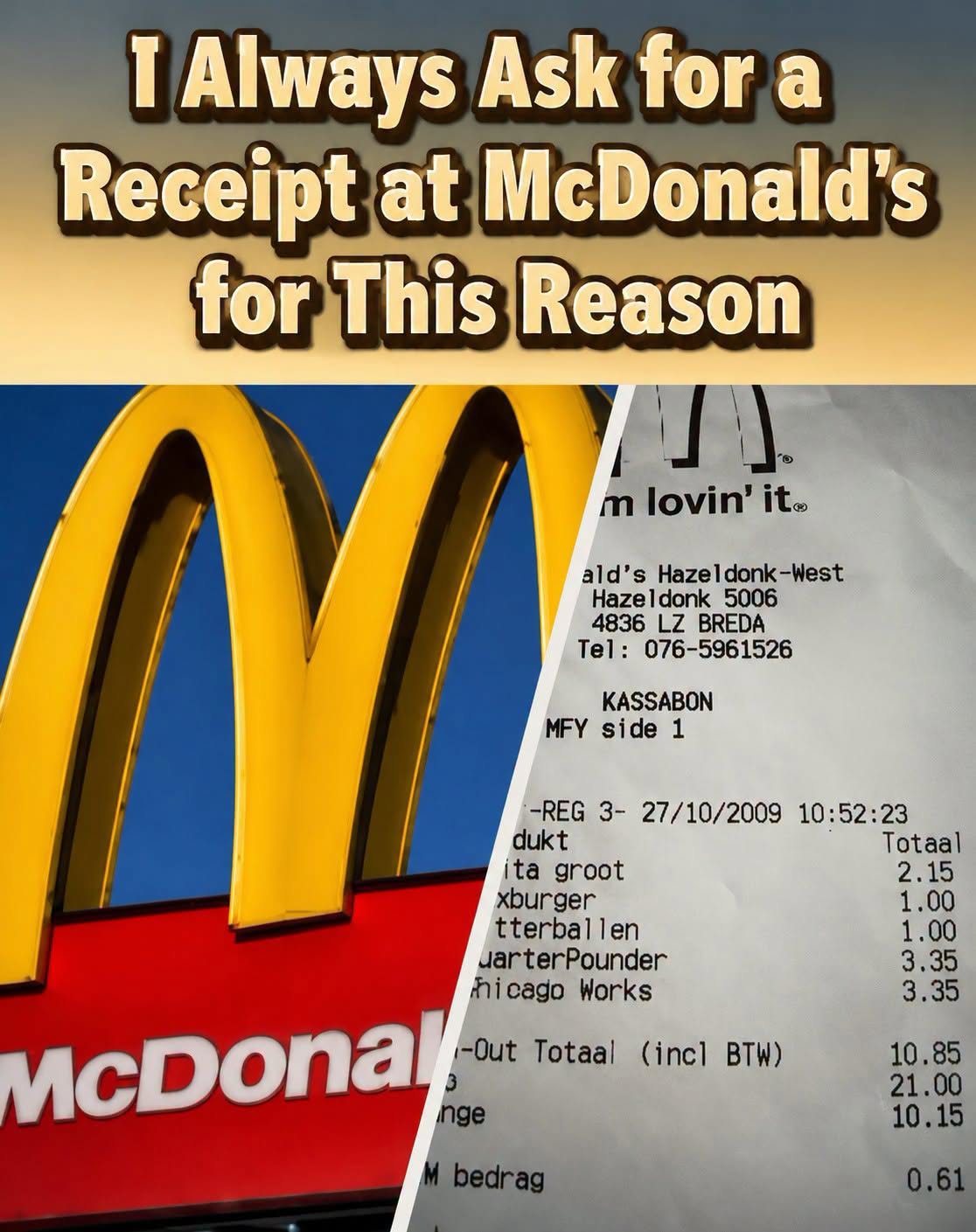
The receipt.
Some people decline it automatically.
Others leave it sitting beside the register.
Many never even think to ask for one.
Yet a surprisingly large number of experienced customers have developed a simple habit that they believe quietly improves their entire restaurant experience. It costs nothing, takes only a few seconds, and may influence everything from food quality to customer service.
The secret is remarkably simple.
Always ask for the receipt.
At first, the idea sounds almost too ordinary to matter.
After all, what difference could a small piece of paper possibly make?
But according to former fast-food employees and longtime customers, that simple request can sometimes change the way an order is handled from the moment it is placed.
The explanation begins with something many customers never realize exists.
Large restaurant chains have long used mystery shoppers and customer evaluation programs to measure service quality. These individuals visit restaurants anonymously and evaluate everything from cleanliness and speed to employee friendliness and food quality.
Their job is to experience the restaurant exactly as an ordinary customer would.
They observe.
They order.
They evaluate.
And in many cases, they keep their receipts as proof of their visit.
Because employees often know that mystery shoppers exist but cannot identify them, a customer requesting a receipt can occasionally create uncertainty. Staff members may wonder whether the customer is simply keeping track of an order or participating in a service evaluation.
That uncertainty can encourage extra attention.
Orders may be checked more carefully.
Food may be prepared with greater precision.
Employees may become slightly more attentive and focused.
Whether or not a customer is actually evaluating the restaurant becomes irrelevant. The possibility alone may encourage staff to deliver the very best version of their service.
For customers, the difference can sometimes be noticeable.
A burger arrives hotter.
Fries seem fresher.
Special requests are followed more carefully.
The overall experience feels slightly more polished.
Of course, no employee intentionally wants to provide poor service. Most workers genuinely try to do their jobs well regardless of who walks through the door.
But busy restaurants operate under pressure.
Rush periods become hectic.
Orders pile up.
Mistakes happen.
In those moments, extra attention to detail can make a meaningful difference.
Imagine stopping for lunch after a long morning.
You have been thinking about a fresh burger and hot fries for hours. You place your order, ask politely for the receipt, and take a seat.
A few minutes later, your food arrives.
The fries are crisp.
The sandwich is hot.
Everything appears freshly prepared.
Perhaps it is coincidence.
Perhaps it is simply excellent service.
Or perhaps that tiny request encouraged everyone involved to double-check that your experience met the highest standards.
Even if the effect is subtle, many customers believe it is worthwhile.
Beyond the discussion about mystery shoppers, there is an even more practical reason to keep your receipt.
Restaurants are busy places.
Thousands of orders move through kitchens every day.
No matter how efficient the system becomes, mistakes occasionally occur.
A cheeseburger may become a chicken sandwich.
A large order may become a small one.
A missing item may not be noticed until you arrive home.
Without a receipt, solving those problems can sometimes become more difficult.
The receipt provides clarity.
It shows exactly what was ordered.
It confirms what was paid for.
It helps employees quickly identify errors.
For families managing several meals, the receipt becomes especially useful. Parents ordering for children, grandparents treating grandchildren, or groups sharing multiple items can easily verify that every order was prepared correctly.
For older customers, the receipt may offer additional peace of mind.
It eliminates uncertainty.
It removes confusion.
It provides a simple record that can be referenced if necessary.
Many people who developed this habit years ago continue to request receipts everywhere they go, not only at fast-food restaurants but also at coffee shops, grocery stores, and retail stores.
The habit requires almost no effort.
The benefits, however, can be surprisingly practical.
There is also something important about the psychology involved.
Asking for a receipt is neither demanding nor confrontational.
It does not require complaints.
It does not involve special treatment.
It simply signals that the customer is paying attention.
Employees may naturally respond by paying attention as well.
The interaction remains polite and respectful for both sides.
Customers receive the reassurance they want.
Employees have an opportunity to demonstrate the quality of their work.
Everyone benefits.
Many longtime customers describe the habit as similar to checking a hotel room before unpacking or reviewing a grocery receipt before leaving the store. It is not based on distrust.
It is simply a small step that encourages accuracy.
Over time, those small habits often create better experiences.
The story of the McDonald’s receipt has spread widely because it feels almost too simple to be true.
Can one small piece of paper really influence an entire meal?
Perhaps not every time.
Not every employee will notice.
Not every order will change.
Not every restaurant will respond differently.
But countless customers continue asking for receipts because they believe the practice encourages better service, greater accuracy, and a more satisfying meal.
At the very least, the receipt provides protection against mistakes.
At best, it may quietly improve the entire experience.
The next time you visit McDonald’s for breakfast, lunch, dinner, or simply a cup of coffee, try making one small request before stepping away from the counter.
Can I have my receipt please?
It takes only a few seconds.
Yet many people believe those few seconds can make the difference between an ordinary meal and one prepared with just a little extra care.
Sometimes the smallest habits produce the biggest results.
And sometimes the most valuable secret is hiding in plain sight, printed on a simple piece of paper that most people never bother to keep.