What began as a seemingly innocent social media post quickly turned into a nationwide debate, drawing millions of views and fueling fresh discussions about politics, perception, and the power of online media.
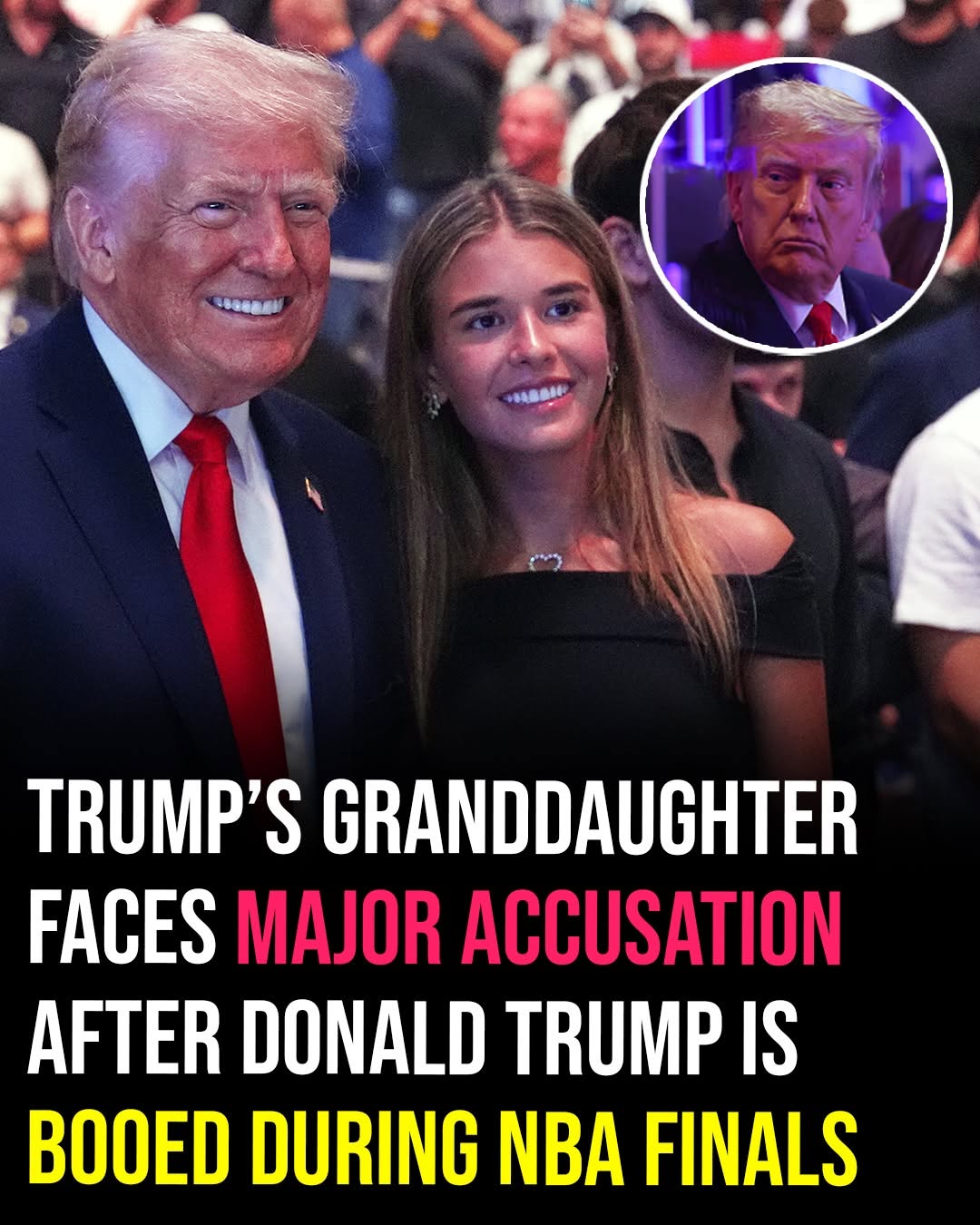
At the center of the controversy was 19-year-old Kai Trump, granddaughter of President Donald Trump, whose video from a high-profile NBA Finals game unexpectedly became the focus of intense scrutiny.
The moment itself appeared straightforward. Kai attended Game 3 of the NBA Finals alongside members of her family as her grandfather made a highly publicized appearance at Madison Square Garden. Like many young people documenting special moments, she shared a short video online, giving followers a glimpse of the experience from her perspective. The post was meant to capture what she described as a memorable family outing, a rare opportunity to witness one of the biggest sporting events of the year while spending time with relatives.
For a brief period, the video seemed destined to be just another social media update. Then viewers began comparing it to footage from the live television broadcast.
During the nationally televised game, cameras showed Donald Trump on the arena’s giant screen as the crowd reacted. Reports and clips circulating online suggested that portions of the audience booed while others cheered, creating a mixed and politically charged atmosphere. The moment quickly became one of the most discussed aspects of the evening, extending far beyond basketball itself.
When users examined Kai’s video more closely, many noticed what they believed were significant differences between her recording and the broadcast footage. In her version, the atmosphere appeared noticeably calmer. The crowd noise sounded different, and some viewers claimed that reactions heard during the live broadcast seemed absent or significantly reduced.
Within hours, social media platforms were flooded with side-by-side comparisons. Users dissected every detail, comparing audio levels, crowd sounds, camera angles, and timing. What started as a family memory suddenly transformed into a broader conversation about authenticity and digital presentation.
Critics quickly accused the video of presenting a version of events that felt more favorable than what had been shown during the live broadcast. Some suggested the audio had been altered, edited, or replaced. Others questioned whether certain crowd reactions had been intentionally minimized before the clip was shared online.
These allegations spread rapidly, fueled by the speed and reach of modern social media. Videos highlighting supposed inconsistencies accumulated millions of views as commentators from across the political spectrum weighed in. Supporters and critics of Trump interpreted the footage through very different lenses, each side seeing evidence that supported its existing beliefs.
However, not everyone accepted the accusations at face value.
Many media observers and technology experts pointed out that differences between social media videos and live broadcasts are often common and can occur for a variety of reasons. Smartphone recordings capture sound differently than television production equipment. Audio may be compressed when uploaded to social media platforms. Camera locations within large arenas can dramatically affect what is heard and recorded.
Others noted that videos posted online frequently use alternate audio feeds, arena sound systems, or edited clips that focus on specific moments rather than providing a complete representation of an event. In some cases, copyright restrictions related to music, broadcasts, or arena content can also result in altered audio.
These explanations led some observers to urge caution before drawing conclusions.
They argued that differences between recordings do not automatically prove deliberate manipulation. Instead, they may simply reflect the technical realities of capturing and sharing video in a crowded arena filled with tens of thousands of people.
Still, skepticism persisted.
For many critics, the controversy extended beyond a single video. They viewed the incident through the lens of larger debates surrounding media trust, political messaging, and public image management. To them, the questions raised by the clip reflected broader concerns about how public figures present themselves online and how carefully curated content can influence perception.
In today’s digital environment, nearly every public moment exists in multiple versions simultaneously. Television networks broadcast one perspective. Spectators record another. Social media users share clips from countless angles. Each version can emphasize different details, creating competing narratives around the same event.
The reaction to Kai Trump’s video demonstrated how quickly those narratives can collide.
What may once have remained a simple family keepsake became the subject of forensic-level analysis by thousands of strangers. Every frame was examined. Every sound was questioned. Every omission became potential evidence in a larger argument.
Lost amid the controversy was the reality that Kai herself has increasingly become a public figure in her own right. Over recent years, she has attracted significant attention through social media, golf tournaments, public appearances, and family events. As the granddaughter of one of the most recognizable political figures in the world, nearly everything she posts receives heightened scrutiny.
That reality presents unique challenges. Ordinary moments that would pass unnoticed for most young adults often become national talking points when connected to a famous family. A photo, a video, or even a brief comment can quickly generate headlines and spark debates far beyond the original intent.
As criticism mounted, many people waited for a response from Kai. Some expected clarification regarding the video. Others anticipated an explanation about the recording process or the audio differences that had generated so much discussion.
But no public response immediately followed.
Her silence only intensified speculation. Supporters argued that she had no obligation to address internet theories. Critics interpreted the lack of explanation as evidence that questions remained unanswered. In the absence of definitive information, online conversations continued to grow.
The incident highlights a broader truth about modern public life. Technology has made it possible for millions of people to witness events simultaneously, yet it has also made it easier than ever for those same events to be interpreted in radically different ways. Every camera captures only part of a story. Every recording reflects a specific perspective. Every viewer brings personal assumptions to what they see and hear.
As political divisions remain deeply entrenched, even seemingly ordinary moments can become symbols of larger cultural battles. A basketball game becomes political. A family video becomes controversial. A social media post becomes a national conversation.
Whether the differences between Kai Trump’s video and the live broadcast were the result of technical factors, editing choices, or simple perspective may never be fully settled in the minds of everyone who watched. What is certain is that the clip became far more than a personal memory.
Instead, it evolved into a case study in how digital media shapes perception in the modern era. It showed how quickly public opinion forms, how intensely online audiences investigate details, and how difficult it can be to separate fact from assumption once a narrative begins to take hold.
In the end, the debate was never just about crowd noise or a few seconds of video. It was about trust, perception, and the increasingly blurred line between documenting a moment and defining how that moment will be remembered. For some, Kai Trump’s post remains a harmless snapshot from a special night. For others, it represents a carefully curated version of reality. And somewhere between those competing interpretations lies the reason the controversy continues to capture attention long after the final buzzer sounded.