Every parent wants to protect their child from pain. Whether it is a scraped knee, a broken heart, or the harsh judgments of strangers, mothers and fathers often spend their lives trying to shield their children from the difficulties of the world.
For one mother, that instinct led to a decision that sparked intense discussion, emotional reactions, and overwhelming support from people around the globe.
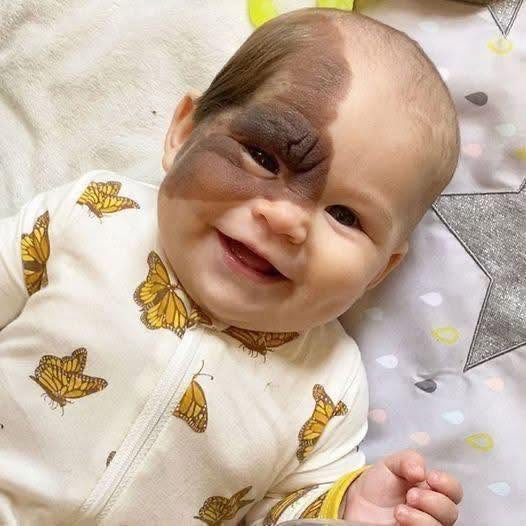
When little Vienna was born, her parents were immediately captivated by her. Like any newborn, she brought excitement, joy, and hope into their lives. But she was also born with a noticeable birthmark on her forehead, a condition that would eventually become the focus of a difficult family journey.
The birthmark, known as a congenital melanocytic nevus, appeared as a dark mark across a prominent area of Vienna’s face. While medically harmless in many cases, it was impossible to ignore. As Vienna grew, her parents found themselves wondering how the mark might affect her future. They worried about how other children might react, how strangers might stare, and whether their daughter would one day struggle with confidence because of something completely beyond her control.
For Vienna’s mother, Celine, those concerns became increasingly difficult to ignore. Like many parents, she understood that children can be incredibly kind, but she also knew they could sometimes be unintentionally cruel. She feared that her daughter might face teasing, questions, or unwanted attention simply because she looked different.
The concern was never about creating a perfect appearance. It was about protecting a child from unnecessary emotional pain. Celine often found herself imagining future school days, playground interactions, and social situations where Vienna might feel isolated or self-conscious. Those thoughts stayed with her and eventually pushed her to explore possible treatment options.
After consulting medical professionals, the family learned that removing the birthmark would require specialized procedures. However, because the condition was not considered an immediate medical threat, public healthcare authorities classified the surgery as cosmetic rather than medically necessary.
That decision left the family facing a difficult reality.
The surgery would come with a significant financial cost, one that was beyond what they could comfortably afford. Suddenly, the path they believed might help their daughter seemed blocked by circumstances they could not control.
Many parents in similar situations might have quietly accepted the decision and moved on. But Celine could not shake the feeling that she needed to do everything possible for her daughter. Determined to explore every option, she made a deeply personal choice: she shared Vienna’s story publicly.
Opening up to strangers on the internet was not easy. It meant exposing her family’s private fears to public scrutiny. She knew there would be people who disagreed with her decision. She knew some might accuse her of focusing too much on appearance or making choices on behalf of a child too young to decide for herself.
Despite those concerns, she launched a fundraising campaign and explained her hopes for Vienna’s future.
What happened next surprised her.
Instead of criticism, thousands of people responded with compassion. Donations began arriving from individuals who had never met Vienna. Parents shared their own stories of difficult decisions made out of love. Others spoke about their experiences growing up with visible differences and the challenges they faced.
The campaign quickly gained attention, and support poured in from around the world. What had started as a mother’s private struggle became a collective effort fueled by empathy and generosity.
For many contributors, the issue extended beyond the birthmark itself. They saw a parent trying to do what she believed was best for her child. Whether they agreed with the decision or not, they recognized the sincerity behind it.
Eventually, enough funds were raised to move forward with treatment.
The procedures required patience and courage from both Vienna and her family. Medical appointments, consultations, and surgeries became part of their lives. Through every step, Celine continued sharing updates with supporters who had become invested in Vienna’s journey.
As time passed, the transformation became visible.
The large dark mark that had once covered a portion of Vienna’s forehead gradually disappeared. In its place remained a small scar, a reminder of the journey she had undergone at such a young age. Doctors explained that the scar would likely continue fading as she grew older.
Today, Vienna is a happy and energetic child. She runs, plays, laughs, and explores the world with the boundless curiosity that defines childhood. To those who meet her, she appears like any other toddler discovering life one adventure at a time.
For her parents, seeing her smile brings a sense of relief and gratitude.
Yet Celine has often emphasized that the story is not about beauty standards or achieving perfection. Instead, she views it as a story about parental love, difficult decisions, and the lengths families will go to when they believe they are acting in a child’s best interest.
The debate surrounding visible differences and cosmetic procedures remains complex. Some people believe children should be allowed to decide for themselves when they are older. Others understand why parents might choose intervention early, particularly when they fear social or emotional consequences.
There are no easy answers.
What makes Vienna’s story resonate with so many people is that it reflects a universal truth about parenting. Every mother and father eventually faces choices that involve uncertainty. They must weigh risks against benefits, hopes against fears, and present realities against future possibilities.
No parent can perfectly predict how a child’s life will unfold. They can only make decisions based on the information, circumstances, and love they have in the moment.
For Celine, the choice came from a desire to give her daughter every opportunity to move through life without carrying an unnecessary burden. Whether others would have made the same decision is ultimately beside the point. What mattered to her was acting according to her convictions as a mother.
As Vienna grows older, she will one day learn the full story of what happened during her earliest years. She will discover how her parents wrestled with difficult questions, sought medical advice, and reached a decision they believed was right for her. She will also learn that thousands of strangers cared enough to support a family they had never met.
Most importantly, she will have the chance to form her own opinions about the journey.
Until then, her story remains a powerful reminder of the complicated nature of love. Parenthood often requires making choices before certainty exists. It demands courage, sacrifice, and a willingness to accept criticism when acting on behalf of a child.
Vienna’s journey is not simply about a birthmark or a surgery. It is about the extraordinary lengths parents will go to protect their children, the kindness strangers can show when moved by compassion, and the hope that every child deserves the chance to grow up feeling accepted, confident, and loved.
In the end, the scar on Vienna’s forehead may continue to fade, but the story behind it will remain. It is a story of determination, generosity, and a mother’s unwavering belief that her daughter deserved every opportunity to face the future with confidence. Whether one agrees with the decision or not, few can doubt the powerful force that inspired it: a parent’s love.