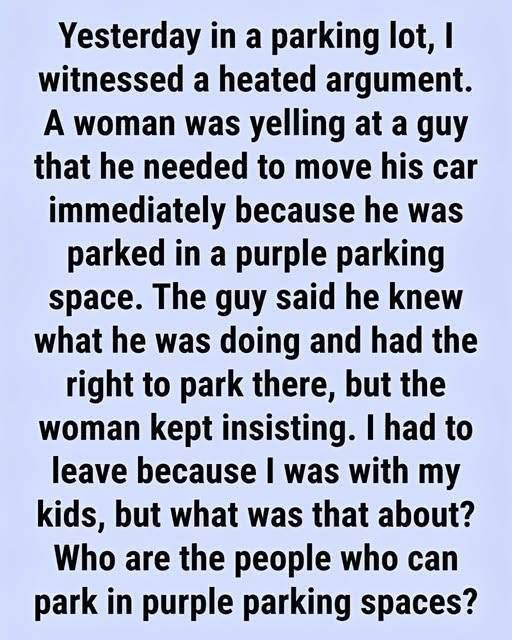
Most people have seen them without giving them much thought. Tucked between rows of ordinary parking spaces outside grocery stores, restaurants, shopping centers, and community buildings, these unusual spots stand out because of their striking color.
Painted bright purple and often marked with a special sign, they immediately catch the eye. Yet many drivers pass them every day without understanding what they represent.
At first glance, a purple parking space may seem like a marketing campaign, a decorative choice, or simply another reserved area. But the truth is far more meaningful. These spaces are not about convenience, branding, or aesthetics. They are powerful symbols of gratitude, sacrifice, and remembrance. Behind every purple parking space lies a story connected to military service, courage, and the lasting impact of war.
The significance of these spaces is rooted in one of the most respected military decorations in the United States: the Purple Heart.
The Purple Heart is awarded to members of the U.S. Armed Forces who have been wounded, injured, or killed while serving in combat. It is one of the oldest military honors in American history and carries a unique emotional weight. Unlike medals awarded for achievement or leadership, the Purple Heart recognizes those who have paid a physical price in service to their country.
For many recipients, the medal represents injuries that changed their lives forever. Some returned home carrying visible scars. Others faced lifelong physical challenges or emotional burdens that would never fully disappear. Many never had the chance to come home at all.
Because of that history, the Purple Heart has become a symbol not only of bravery but also of sacrifice.
In recent years, communities, businesses, and veterans’ organizations across the country have looked for ways to honor Purple Heart recipients in everyday life. One of the most visible efforts has been the creation of designated Purple Heart parking spaces.
These spaces are typically reserved for Purple Heart recipients and, in some cases, their families. They are often located close to building entrances, similar to other reserved parking areas, and are marked with signs explaining their purpose.
For veterans who have earned the Purple Heart, the reserved space serves as a small but meaningful acknowledgment of what they endured.
While a parking spot may seem insignificant compared to the magnitude of military service, supporters of the program argue that recognition matters. For many veterans, the transition from military life back into civilian society can be challenging. Public acknowledgment helps ensure that sacrifices made in distant conflicts are not forgotten once the uniforms come off.
The idea behind Purple Heart parking spaces is simple: create a visible reminder that freedom often comes at a cost.
Unlike monuments or memorials that people may visit only occasionally, these parking spaces become part of daily life. They place remembrance in front of ordinary people going about ordinary routines.
A person may stop and wonder why the space exists. A child may ask a parent about the meaning of the sign. A conversation may begin about military service, sacrifice, and gratitude.
In that way, the space accomplishes something larger than providing parking.
It keeps stories alive.
Many veterans have expressed appreciation for the gesture because it acknowledges sacrifices that often remain unseen. Not all combat wounds are immediately visible. Some veterans live with chronic pain, mobility limitations, traumatic injuries, or emotional scars that outsiders may never notice.
The reserved parking space does not erase those challenges, but it serves as a reminder that their experiences matter.
Families of fallen service members often view these spaces with similar emotions.
For them, the color purple can symbolize loved ones who never returned home. Seeing public recognition of military sacrifice helps affirm that those losses have not been forgotten by the communities they served.
Businesses that establish Purple Heart parking spaces frequently do so in partnership with veterans’ organizations. These initiatives are often accompanied by ceremonies, community events, or educational efforts designed to raise awareness about military service.
Local leaders, veterans, and residents gather to dedicate the spaces, transforming what might otherwise appear to be a simple parking spot into a meaningful public tribute.
The movement has steadily expanded over the years as more organizations embrace opportunities to honor veterans in visible ways.
Yet despite their growing presence, many people remain unaware of what the spaces actually mean.
This lack of awareness occasionally leads to confusion. Some drivers mistakenly assume the spaces function like handicapped parking, while others simply do not recognize the significance of the signs.
In most locations, parking regulations surrounding Purple Heart spaces vary. Unlike handicapped parking, which is protected by law and subject to enforcement, Purple Heart parking spaces are often voluntary designations created by private businesses.
That means unauthorized use may not always result in a fine or citation.
However, many veterans and supporters argue that the issue extends beyond legal enforcement.
To them, the question is not whether someone can use the space, but whether they should.
A person who occupies a Purple Heart parking spot without qualifying may not break a law, but they risk overlooking the purpose behind the designation. The space exists as a gesture of respect toward individuals who endured extraordinary hardships while serving their country.
For that reason, many people choose to leave those spaces available even when no formal restrictions exist.
The extra walk from another parking spot is a small inconvenience compared to the sacrifices represented by the Purple Heart itself.
The broader popularity of Purple Heart parking spaces also reflects a growing desire to recognize military service in everyday settings. While national holidays and formal ceremonies remain important, many communities have sought additional ways to express appreciation throughout the year.
Simple gestures often have powerful effects.
A reserved parking space may seem modest compared to monuments, parades, or memorials, but its visibility ensures that recognition becomes part of daily life rather than an occasional event.
Every time someone notices the purple paint, they are reminded that behind the comfort and security of ordinary life stand individuals who accepted extraordinary risks.
The color itself carries deep symbolism.
Purple has long been associated with the Purple Heart medal, whose distinctive design dates back to military traditions stretching across generations. Today, that same color instantly signals honor, sacrifice, and remembrance.
What appears to be just another parking space is actually something much larger.
It represents soldiers who returned home carrying scars.
It honors service members who faced dangers most people will never experience.
It remembers those who made sacrifices that extended far beyond the battlefield.
Most importantly, it serves as a visible promise that their service will not be forgotten.
The next time you see a purple parking space outside a store, restaurant, or community center, take a moment to look beyond the paint. What stands before you is not merely a reserved spot. It is a quiet tribute to courage, sacrifice, and the men and women who gave more than most of us can ever fully understand.
Sometimes the most meaningful memorials are not towering monuments or grand ceremonies. Sometimes they are simple reminders woven into everyday life, asking only that we remember those who gave so much and respect the space reserved in their honor.