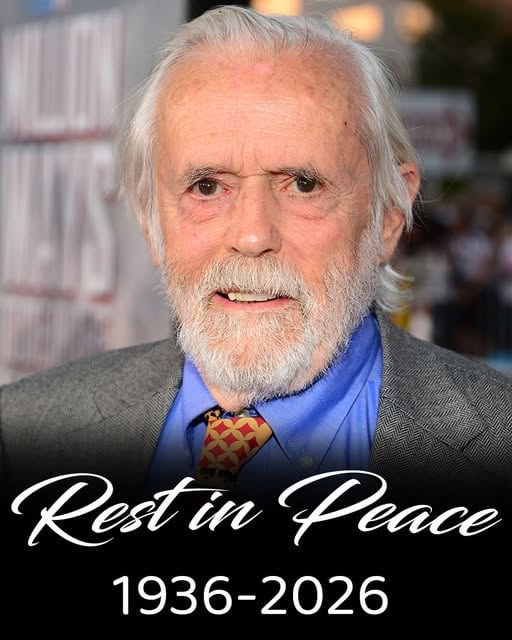
Matt Clark’s death at the age of 89 feels less like a breaking news moment and more like the closing of a long, steady film reel one that never needed spectacle to matter.
In an industry often driven by noise, visibility, and constant reinvention, Clark represented something increasingly rare: an actor who believed that presence mattered more than promotion, and that truth on screen was worth more than fame off it.
He was never the kind of performer who dominated headlines or chased celebrity status. Instead, he built a career on reliability, depth, and an almost old-fashioned commitment to craft. Directors didn’t cast him to steal scenes; they cast him to ground them. He had a way of entering a moment quietly and making it feel heavier, more lived-in, more real. A glance, a pause, a single line delivered without excess these were his tools, and he used them with precision that came from decades of discipline rather than ego.
Across more than 120 film and television credits, Matt Clark became one of those faces audiences recognized even if they couldn’t always place the name. That kind of familiarity is its own form of success in Hollywood, built not on publicity but on consistency. When he appeared on screen, something subtle shifted. Scenes felt anchored. Stories felt older than the script suggested. His characters often carried a sense of history, as if they had been living long before the camera arrived and would continue existing after it left.
Although many audiences remember him from his wide-ranging television work and appearances in popular films, including his connection to the world of Back to the Future, it was his work in Westerns that truly defined his artistic identity. Films like The Outlaw Josey Wales and Pat Garrett and Billy the Kid showcased the kind of storytelling where silence mattered as much as dialogue, where landscapes carried emotional weight, and where characters were shaped as much by what they had endured as by what they said.
In those films, Clark often embodied the rugged, weathered figures of American frontier storytelling. But what made his performances memorable wasn’t just toughness it was restraint. He played men shaped by hardship without turning them into caricatures of it. There was always something human underneath, something unspoken but felt. A kind of quiet vulnerability that softened the edges of otherwise hard characters.
That balance between strength and sensitivity became one of his defining traits as an actor. It allowed him to move effortlessly between genres, from Westerns to dramas to contemporary television roles. No matter the setting, he brought the same grounded approach: observe, listen, respond honestly, and let the moment carry its own weight.
Off camera, Matt Clark lived a life that mirrored the steadiness of his performances. He wasn’t drawn to excess or spectacle. Instead, he built something more enduring stability. He maintained friendships that lasted decades, relationships that survived the turbulence of an industry known for forgetting people as quickly as it celebrates them. Those who knew him often described him as dependable in a way that felt almost old-world, someone who showed up when he said he would and stayed when it mattered.
His home life reflected the same values. Away from sets and scripts, he prioritized simplicity and loyalty. Family, for him, was not an accessory to his career but the foundation beneath it. He was known as someone who could be both tough and deeply affectionate, someone whose presence carried authority but never lost warmth. In private, as in public, he seemed guided by a personal code that didn’t shift with trends or industry pressure.
In a profession where reinvention is often necessary for survival, Clark chose consistency. That choice may have kept him out of the constant spotlight, but it also gave his career a different kind of weight. He didn’t vanish into fame; he accumulated respect over time. Each role added another layer, another fragment of trust between him and the audience.
For viewers, even those who didn’t know his name, his face became a kind of cinematic anchor. You saw him, and you believed the world he was in. That is a rare quality, one that cannot be manufactured or forced. It comes from understanding the rhythm of storytelling at a deep level and trusting that even small moments can carry emotional truth.
As years passed and Hollywood evolved, actors like Matt Clark became less common. The industry shifted toward visibility, branding, and constant presence. But Clark’s career stands as a reminder that there was once and still can be a different kind of success, measured not in followers or headlines but in longevity, integrity, and the respect of peers.
His passing at 89 marks the end of that presence in a physical sense, but not in the cultural one. Films do not forget the people who give them texture. Performances do not disappear simply because the performer is gone. Each role he played remains embedded in the stories he helped shape, quietly continuing their work every time they are watched again.
For those who worked alongside him, he leaves behind memories of professionalism and quiet strength. For audiences, he leaves behind a catalogue of moments that feel authentic in a way that never ages. And for the industry itself, he represents a version of Hollywood that is fading but not entirely lost the version where craft mattered as much as recognition, and where an actor could build a lifetime of work without ever needing to be the loudest voice in the room.
Matt Clark did not seek to define an era. He simply lived within it, contributed to it, and strengthened it in ways that only become fully visible in hindsight. His legacy is not built on spectacle, but on something far more enduring: the ability to make stories feel real.
And long after the credits of his final performance have rolled, the imprint of his work remains quietly, firmly in place.