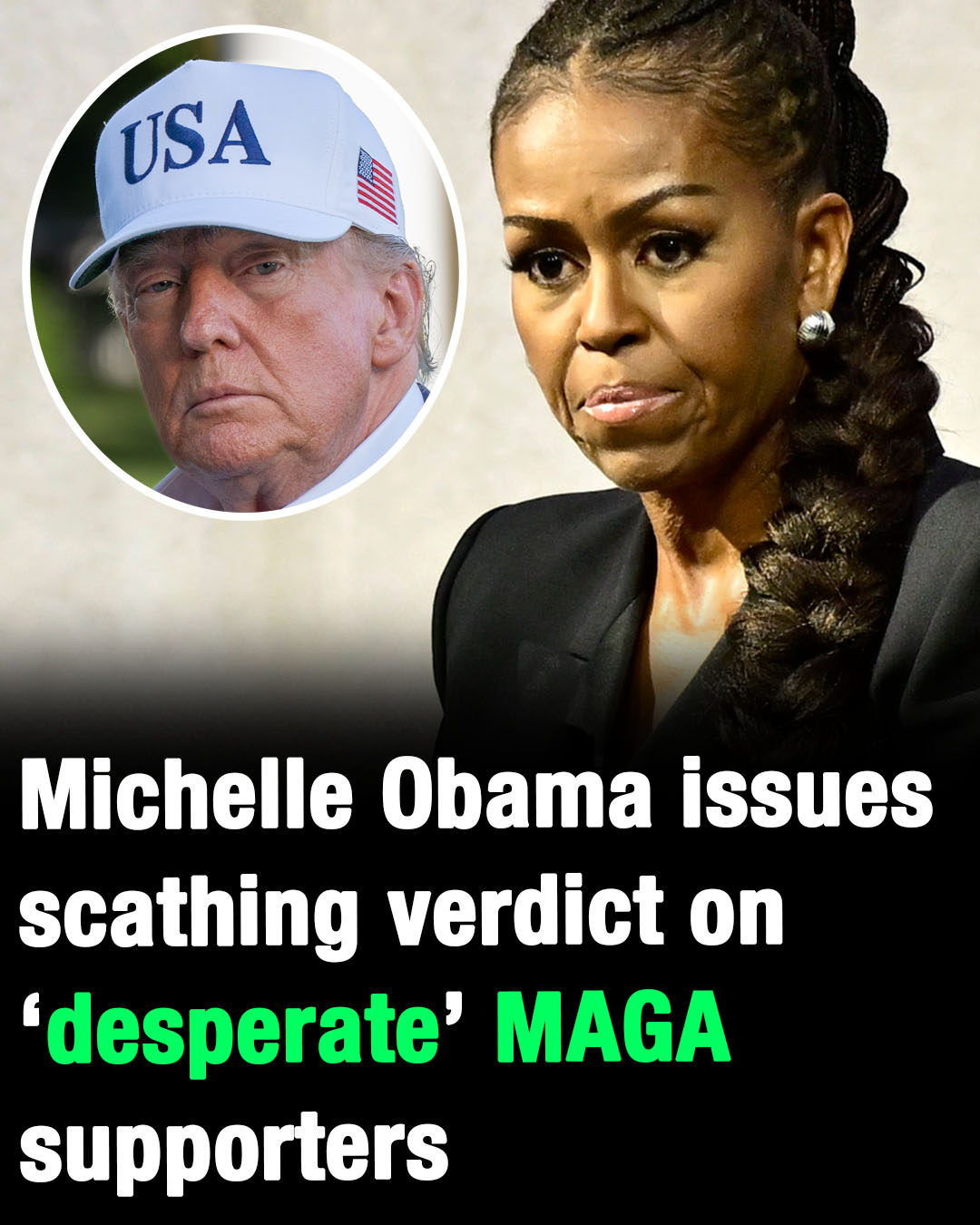
In a political era defined by outrage, division, and constant conflict, Michelle Obama offered a perspective that surprised many observers.
Rather than responding to political opponents with anger or sweeping condemnation, the former First Lady focused on something she believes is often missing from modern political conversations: understanding why people make the choices they do.
Her remarks arrived during a period when political tensions remain high across the United States. Public trust in institutions continues to be challenged, economic uncertainty weighs heavily on many families, and debates over leadership, identity, and the future of the country dominate headlines on a daily basis.
Against that backdrop, Obama’s comments resonated far beyond the usual political audience.
For years, Michelle Obama and her family have faced intense public scrutiny. During Barack Obama’s presidency and afterward, they were frequently targeted by political criticism, conspiracy theories, and personal attacks. Some of those attacks crossed lines that many observers viewed as deeply offensive and inappropriate.
Among the incidents that attracted widespread condemnation were racist portrayals and digitally manipulated content aimed at the former president and his family. Such material generated outrage from supporters and critics alike, with many arguing that political disagreement should never descend into personal or racist attacks.
Yet despite having experienced those attacks firsthand, Michelle Obama chose a response that focused less on retaliation and more on examining the deeper forces shaping American politics.
According to her view, many voters who supported Donald Trump should not automatically be reduced to simplistic labels or assumptions.
That position immediately attracted attention.
In a political climate where opponents are often portrayed in the harshest possible terms, her comments stood out because they challenged both sides to think differently.
Rather than describing millions of voters as motivated solely by prejudice or hostility, she suggested that many were responding to frustrations they felt had gone unheard for years.
Economic pressures.
Job insecurity.
Rising costs.
A feeling of being overlooked by political leaders.
A sense that traditional institutions were no longer working for ordinary people.
These concerns, she argued, can create fertile ground for political movements that promise dramatic change.
Whether people agree with those movements or not, understanding the underlying frustrations remains important.
For Obama, that distinction matters.
She has repeatedly emphasized that disagreement does not require dehumanization.
People can support different candidates, hold different political views, and interpret events differently without being reduced to caricatures.
Her message was not necessarily an endorsement of any particular political position.
Instead, it was a warning about the consequences of abandoning entire groups of voters.
According to this perspective, dismissing people outright can deepen divisions rather than solve them.
When individuals feel ignored, unheard, or ridiculed, they often become even more receptive to voices promising to challenge the status quo.
That dynamic has played a significant role in politics around the world.
Periods of economic uncertainty and social change frequently create opportunities for leaders who present themselves as outsiders capable of disrupting established systems.
Such leaders often gain support not because every voter agrees with every policy proposal, but because they represent an alternative to what many people view as a failing status quo.
Obama’s comments touched on this reality.
She suggested that political leaders must pay closer attention to the struggles facing middle-class and working-class families.
These groups often find themselves at the center of election campaigns, yet many voters continue to feel disconnected from the political process.
The issues they face are often practical rather than ideological.
Paying bills.
Affording housing.
Managing healthcare costs.
Supporting families.
Planning for retirement.
Finding stable employment.
When those concerns remain unresolved, frustration can grow.
Over time, that frustration may evolve into anger.
And anger, if left unaddressed, tends to search for explanations and targets.
Throughout history, periods of widespread dissatisfaction have often produced political upheaval.
People looking for solutions may gravitate toward leaders who offer certainty, clear answers, or someone to blame.
Sometimes those promises lead to meaningful reforms.
Other times they deepen existing divisions.
Obama’s warning centered on the importance of addressing problems before they reach that point.
She argued that democratic societies function best when citizens feel represented, heard, and included in the political conversation.
When large groups of people feel abandoned, trust in institutions begins to weaken.
That weakening trust can have consequences far beyond any single election cycle.
The message also carried an implicit challenge for political leaders across the spectrum.
Winning elections is important.
But maintaining public confidence requires more than campaign slogans or temporary promises.
It requires addressing the everyday concerns that shape people’s lives.
For many Americans, those concerns are not abstract.
They are immediate and personal.
The cost of groceries.
Monthly rent or mortgage payments.
Healthcare expenses.
Education costs.
Job opportunities.
Economic stability.
These issues often influence voting decisions more than political commentators realize.
People frequently cast ballots based on what they believe will improve their lives and protect their families.
Understanding that motivation, Obama suggested, is essential for anyone hoping to bridge political divides.
Her comments also highlighted a broader challenge facing modern democracies.
Social media and partisan media environments often encourage simplified narratives.
Complex issues become reduced to slogans.
Political opponents become enemies rather than fellow citizens.
Nuance disappears.
In that environment, it becomes easier to assume the worst about those who disagree.
Obama pushed back against that tendency.
She argued that reducing millions of people to a single stereotype not only misrepresents reality but also makes meaningful dialogue nearly impossible.
Democratic societies depend on the ability of people with different views to coexist, debate, and work toward common goals.
That process becomes far more difficult when entire groups are dismissed or written off.
The response to her remarks reflected the very divisions she was discussing.
Supporters praised her emphasis on empathy and understanding.
Critics questioned aspects of her analysis or argued that certain political movements deserve stronger criticism.
Yet regardless of perspective, her comments succeeded in sparking conversation.
At a time when political discourse often rewards outrage, she offered a different approach.
One focused on listening rather than labeling.
Understanding rather than assuming.
Addressing underlying problems rather than simply condemning their symptoms.
Whether Americans agree with her conclusions or not, the issues she highlighted remain central to the country’s political future.
Economic anxiety continues to affect millions of households.
Political polarization remains intense.
Trust in institutions faces ongoing challenges.
And leaders across the political spectrum continue searching for ways to connect with voters who feel disconnected from traditional politics.
In the end, Michelle Obama’s message was not primarily about one politician or one election.
It was about a larger question facing the nation.
How can a deeply divided society move forward without abandoning the people who feel left behind?
Her answer was neither simple nor partisan.
It was a reminder that democracy depends not only on winning arguments, but also on understanding why those arguments exist in the first place.
And unless the concerns driving frustration are addressed, the divisions shaping modern politics may continue to grow, leaving both leaders and voters searching for solutions in an increasingly polarized landscape.