For most of my life, I barely noticed it.
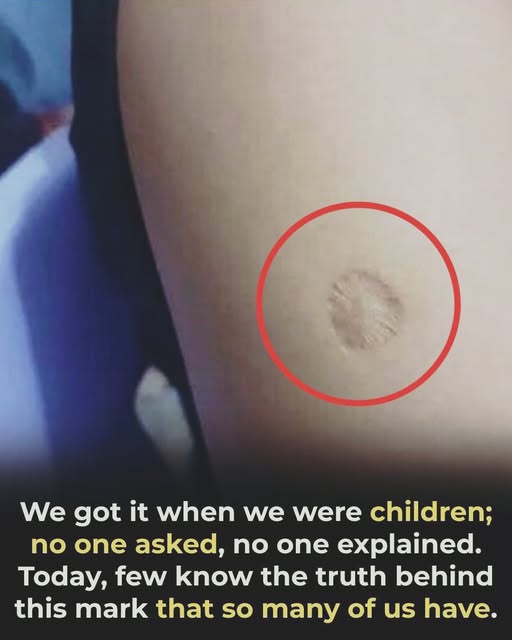
A small, round mark resting quietly on the upper arm of my mother. It wasn’t particularly large or dramatic. It didn’t stand out like a noticeable injury or an obvious birthmark. It was simply there, blending into the background of everyday life, so familiar that I eventually stopped seeing it altogether.
Like many childhood details, it became part of the scenery.
Something that existed without ever demanding attention.
Years later, however, a chance encounter brought that forgotten mark back into focus.
I was helping an elderly woman step off a train when her sleeve shifted slightly. For only a moment, I noticed a small circular scar on her upper arm.
The shape looked instantly familiar.
Same size.
Same location.
Same unmistakable appearance.
For reasons I couldn’t explain, it immediately reminded me of my mother.
The encounter lasted only seconds, and I never asked the woman about the mark. But the image stayed with me throughout the day. Later that evening, curiosity finally got the better of me, and I called my mother.
For years, I had ignored that tiny scar without ever wondering where it came from.
Now I wanted to know.
Her answer arrived without hesitation.
“It’s from the smallpox vaccine.”
A simple response.
Yet behind those five words was a story that stretched across generations, continents, and one of humanity’s greatest public health achievements.
A Mark Shared By Millions
For countless people born before the early 1970s in the United States and during similar periods in many other countries that small circular scar carries a very specific origin.
It came from the smallpox vaccination.
Unlike many modern vaccines that leave little or no visible trace, the smallpox vaccine often produced a permanent mark that remained visible for decades.
Some scars faded with time until they became barely noticeable.
Others remained clear and distinct throughout a person’s life.
Many people carry them today without giving them much thought.
Yet those tiny marks represent far more than a routine medical procedure.
They are reminders of a time when one of the world’s most feared diseases threatened communities everywhere.
A Disease That Once Terrified The World
Today, younger generations often know smallpox only through history books.
For previous generations, however, it was a terrifying reality.
Smallpox was not a distant threat.
It was immediate.
It was deadly.
And it inspired fear across entire societies.
The disease typically began with symptoms that appeared similar to many common illnesses.
Victims often experienced fever, exhaustion, headaches, and body aches.
But what followed was far more serious.
A painful rash would emerge and spread across the body.
Blisters and lesions developed on the skin, leaving many survivors permanently scarred.
For countless families, the disease brought unimaginable suffering.
Entire communities dreaded outbreaks.
Parents worried constantly about their children.
Hospitals struggled to contain infections.
Before effective vaccination campaigns became widespread, smallpox killed millions of people around the world.
Even those who survived often carried lifelong reminders of their illness.
Physical scars became common.
Emotional scars frequently lasted even longer.
For centuries, humanity searched for a way to stop it.
The Unusual Vaccine That Left A Lasting Impression
One reason the smallpox vaccine became so recognizable was because of the unique method used to administer it.
Unlike most injections given today, the vaccine was not delivered through a single shot.
Instead, healthcare workers used a specialized two-pronged needle.
The process involved making a series of tiny punctures in a small area of skin.
The body’s response followed a predictable pattern.
First, a small bump appeared.
Then the area developed into a blister.
Over time, the blister formed a scab.
Eventually, the scab healed and often left behind a round scar.
Because the upper arm was commonly chosen as the injection site, millions of people ended up with nearly identical marks in nearly identical locations.
For decades, the scar became an instantly recognizable sign that someone had received protection against one of history’s deadliest diseases.
What looked like a minor imperfection was actually evidence of a major medical achievement.
The Campaign That Changed History
The battle against smallpox became one of the most ambitious public health efforts ever attempted.
Governments, healthcare workers, scientists, and international organizations worked together to expand vaccination programs across the globe.
The mission was enormous.
Communities in remote villages.
Large urban centers.
Developing nations.
Industrialized countries.
The goal remained the same everywhere: stop transmission before the disease could spread further.
It was not an easy task.
Reaching millions of people required extraordinary coordination.
Healthcare teams traveled to isolated regions.
Vaccination campaigns operated under difficult conditions.
Countless workers dedicated years of their lives to the effort.
Yet gradually, the strategy began to succeed.
Cases declined.
Outbreaks became less frequent.
Entire regions eliminated transmission.
Then came a moment that once seemed impossible.
Smallpox disappeared.
In 1980, the World Health Organization officially declared smallpox eradicated worldwide.
The announcement marked a historic milestone.
For the first time in human history, a disease that had once devastated civilizations had been completely eliminated through coordinated global action.
The achievement remains one of medicine’s greatest successes.
A virus that once killed millions was gone.
Not controlled.
Not reduced.
Gone.
The Legacy Left Behind
Today, the smallpox scar serves as a quiet reminder of that extraordinary accomplishment.
Many younger people no longer recognize it.
Some have never heard of it at all.
Yet for older generations, it remains a familiar symbol.
A tiny circle carrying an enormous story.
It represents scientific innovation.
It represents public cooperation.
It represents the determination of countless individuals who believed a deadly disease could be defeated.
Most importantly, it represents lives saved.
Millions upon millions of lives.
When people notice these scars today, they are often surprised to learn their origin.
What appears to be an ordinary mark on the skin is actually connected to one of the greatest victories in human history.
More Than Just A Scar
The older I get, the more that small mark on my mother’s arm seems to mean.
When I was younger, I saw only a scar.
Now I see something else.
I see a connection to a generation that experienced challenges many of us can barely imagine.
I see evidence of scientific progress.
I see resilience.
I see history carried quietly beneath the surface of everyday life.
Most people think history exists in museums, textbooks, and documentaries.
Sometimes it does.
But sometimes history travels with us.
Sometimes it appears in old photographs.
Sometimes it lives in family stories.
And sometimes it rests silently on an upper arm, unnoticed for years until one day someone finally asks about it.
That tiny circular scar may seem insignificant at first glance.
Yet behind it lies a remarkable story of fear, determination, discovery, and triumph.
A story that helped change the world forever.
And for millions of people, that little mark remains one of the last visible reminders of a battle humanity actually won.