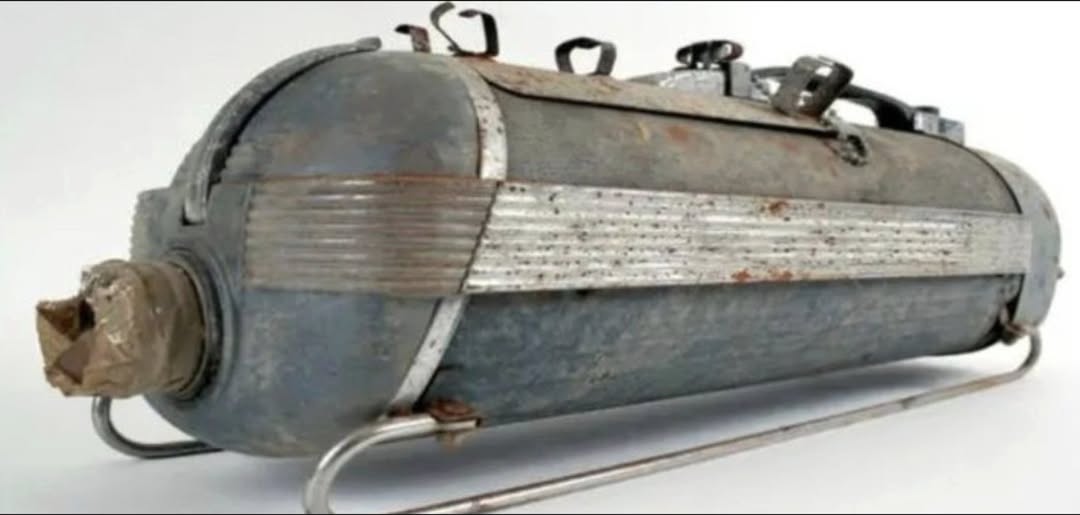
When an old metal machine was discovered tucked away in a dusty attic, people immediately began speculating about what it could be.
The object looked mysterious enough to belong in a museum, a science-fiction film, or perhaps even a forgotten military warehouse. Covered in age and built from heavy metal components, it featured an unusual shape that seemed difficult to identify at first glance. Its pipes, handles, chambers, and mechanical parts sparked endless debate among those who saw photographs of it online.
Some guessed it was a weapon.
Others believed it was a scientific experiment.
A few even suggested it might be a rare industrial device from a factory long since demolished.
The truth turned out to be far less dramatic and far more fascinating.
The strange machine was actually an early vacuum cleaner.
Yet calling it a vacuum cleaner hardly captures the reality of what these remarkable inventions once represented. Unlike the lightweight appliances found in modern homes, these early cleaning machines were massive, awkward, and physically demanding. They belonged to a time when cleanliness was not simply a matter of pressing a button.
It was hard work.
Very hard work.
To understand why machines like this existed, it helps to imagine life during the late nineteenth century.
Industrialization was transforming cities across Europe and North America. Factories operated around the clock. Coal powered homes, businesses, trains, and manufacturing plants. Smoke drifted continuously from chimneys, filling urban skies with dark clouds that often blocked sunlight.
Dust was everywhere.
Coal soot settled onto furniture.
Dirt entered homes through streets crowded with horses, carts, and pedestrians.
Factories released particles that coated windows, walls, and floors.
Keeping a house clean became an endless struggle.
For many families, dirt was not merely an inconvenience.
It was viewed as a serious threat.
Medical understanding was evolving, and concerns about hygiene were becoming increasingly important. People feared disease, contamination, and unhealthy living conditions. Cleanliness began to symbolize safety, respectability, and progress.
Inventors saw an opportunity.
If dirt was becoming one of society’s greatest frustrations, perhaps technology could offer a solution.
The challenge was enormous.
Today, vacuum cleaners seem simple. Plug them in, switch them on, and powerful motors do the work.
In the nineteenth century, electric motors were not yet practical household tools.
Inventors therefore had to rely on mechanical ingenuity.
The result was a series of strange and ambitious machines that now appear almost unbelievable.
Among the most famous early examples was the “Whirlwind,” patented in 1869 by inventor Ives W. McGaffey.
To modern eyes, the device looked more like laboratory equipment than a household appliance.
Operating it was no easy task.
Users had to crank mechanisms manually while simultaneously maneuvering the machine across the floor. The process demanded coordination, strength, and patience.
Cleaning a room often felt like a workout.
Rather than eliminating labor, these early machines simply transformed one form of labor into another.
Owners pumped handles, turned cranks, and worked bellows in hopes of removing dust from carpets and floors. Progress came slowly, accompanied by squeaks, rattles, and mechanical resistance.
Yet despite their limitations, people were fascinated.
These inventions represented possibility.
For the first time, technology promised a way to fight back against the dirt that seemed to invade every corner of daily life.
That promise mattered.
Homes during this period required constant maintenance. Dusting, sweeping, beating rugs, and cleaning floors consumed enormous amounts of time and energy.
Any invention offering even a small improvement attracted attention.
Early vacuum cleaners embodied the optimism of an era obsessed with innovation.
Inventors believed machines could solve almost anything.
Transportation.
Communication.
Manufacturing.
And now, cleanliness.
Many of these devices looked futuristic to those who encountered them.
Heavy metal canisters, complex mechanical systems, and unfamiliar designs gave them an almost magical quality.
For homeowners accustomed to brooms and brushes, the idea of a machine capable of sucking dirt from carpets seemed revolutionary.
Of course, reality often failed to match expectations.
Many early vacuum cleaners were expensive.
Some were unreliable.
Others required so much physical effort that users questioned whether they were truly saving time.
Yet inventors continued experimenting.
Each new design attempted to improve upon previous shortcomings.
Gradually, technology advanced.
Mechanical systems became more efficient.
Materials improved.
Engineering solutions became more sophisticated.
Then came a breakthrough that would change everything.
In 1901, British engineer Hubert Cecil Booth introduced a motorized vacuum-cleaning system that moved the concept closer to practical reality.
Unlike earlier manually operated designs, Booth’s machine relied on powered suction rather than human muscle.
The difference was enormous.
For the first time, vacuum cleaning began evolving from an exhausting physical task into a genuinely effective technological solution.
Booth’s machines were still far larger than modern household vacuums.
In some cases, equipment remained outside buildings while hoses were extended through windows to clean interiors.
Even so, the direction of progress was clear.
Technology was finally catching up with ambition.
The dream that had inspired inventors for decades was becoming achievable.
Over the following years, improvements accelerated.
Motors became smaller.
Machines became lighter.
Performance improved dramatically.
What once required considerable strength gradually became accessible to ordinary households.
Eventually, vacuum cleaners transformed from rare curiosities into everyday appliances.
The evolution happened so gradually that people barely noticed the extraordinary change taking place.
Generation after generation inherited increasingly efficient machines.
Tasks that once demanded hours could be completed in minutes.
The exhausting routines familiar to earlier homeowners slowly disappeared.
Today, many people vacuum their homes without giving the process a second thought.
A button is pressed.
The machine hums quietly.
Dust disappears.
The task is completed.
Convenience feels normal because it has become ordinary.
That is what makes discoveries like the forgotten attic machine so fascinating.
They offer a glimpse into a world where ordinary conveniences did not exist.
A world where cleanliness required determination.
A world where inventors battled enormous challenges with limited technology.
A world where progress arrived one awkward prototype at a time.
The mysterious machine hidden in the attic was more than an old vacuum cleaner.
It was a reminder of an age defined by experimentation and hope.
Every dented metal surface reflected the ambitions of people determined to improve daily life.
Every crank and lever represented an attempt to solve a problem millions faced.
And every cumbersome design brought society one step closer to the effortless technology now taken for granted.
What looked at first like a forgotten relic turned out to be a symbol of human ingenuity.
It survived long enough to tell a story that modern households rarely consider.
The quiet appliance sitting in a closet today exists because generations of inventors refused to accept dust, dirt, and inconvenience as permanent facts of life.
Their machines may have been clumsy.
They may have been noisy.
They may have demanded far more effort than they saved.
But they represented something powerful: the belief that tomorrow could be easier than today.
Hidden beneath decades of dust in an attic, that strange metal machine still carries the spirit of that belief.
And perhaps that is what makes it so remarkable.