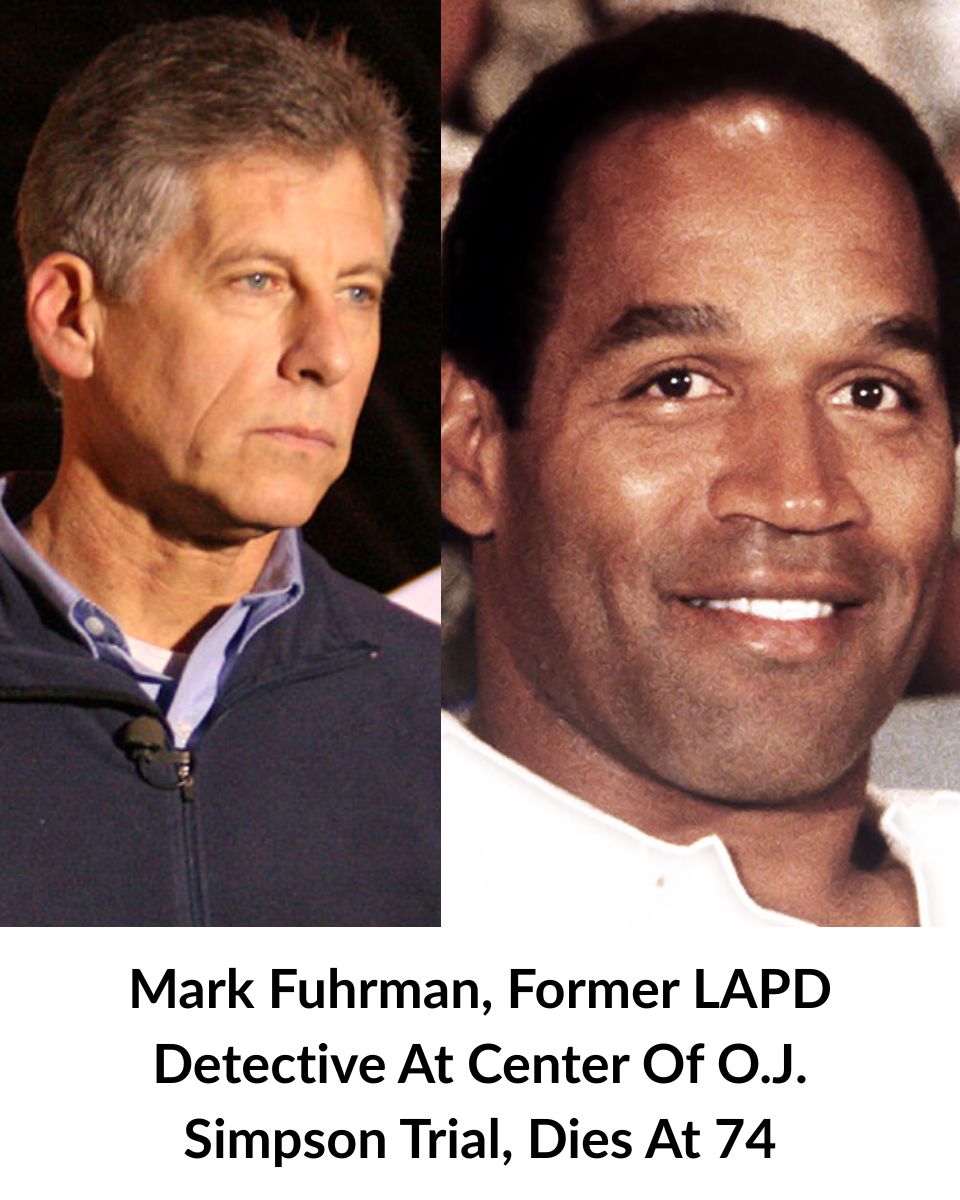
The death of former Los Angeles Police Department detective Mark Fuhrman at the age of 74 closes the chapter on one of the most controversial and heavily scrutinized figures connected to the O.J. Simpson murder trial, a case that transformed American media, exposed deep racial tensions, and forever changed public trust in the criminal justice system.
Decades after the televised courtroom battle captivated millions around the world, Fuhrman’s name still remains inseparable from the scandal, not simply because of the evidence he uncovered, but because of the explosive revelations that followed and the national debate they ignited.
Fuhrman died quietly at his home in Idaho after reportedly battling throat cancer, a stark contrast to the global spotlight that once surrounded nearly every word he spoke. According to reports, he chose to stop treatment in his final months, spending his remaining time away from the cameras and courtroom chaos that had once defined his public identity. There was no major public farewell, no final press conference, and no dramatic closing statement. Instead, his passing leaves behind something far more complicated: an unresolved argument about race, policing, truth, and the enormous consequences one witness can have on the course of history.
For many Americans, Mark Fuhrman became one of the central faces of the O.J. Simpson trial almost overnight. In June 1994, the murders of Nicole Brown Simpson and Ronald Goldman shocked the nation and triggered what would become one of the most watched criminal cases in modern history. Fuhrman was among the detectives assigned to investigate the killings, and it was he who discovered one of the most important pieces of evidence in the case: the bloody glove found at Simpson’s estate.
At first, the discovery appeared devastating for the defense. Prosecutors relied heavily on Fuhrman’s testimony and investigative work to connect Simpson to the crime scene. But as the trial unfolded, the detective himself gradually became one of the most controversial and damaging figures for the prosecution.
The turning point came when taped recordings surfaced in which Fuhrman repeatedly used racist slurs during interviews conducted years earlier. Those tapes directly contradicted his sworn testimony in court, where he denied using such language. The revelation detonated inside the courtroom and beyond it, instantly shifting public perception of the detective and raising larger questions about racial bias inside the LAPD.
The damage was enormous. What had begun as a murder trial increasingly evolved into a broader referendum on race relations, police misconduct, and institutional trust in America. Fuhrman’s credibility collapsed under the weight of the tapes, and the defense skillfully used the scandal to argue that evidence may have been mishandled or even planted. For many jurors and viewers, the issue was no longer just whether Simpson committed murder, but whether the police department investigating him could be trusted at all.
The O.J. Simpson trial was already unfolding during a volatile period in American history. Los Angeles was still carrying the scars of the Rodney King beating and the riots that followed the acquittal of the officers involved. Public trust in law enforcement, especially among Black communities, had already been deeply shaken. Against that backdrop, Fuhrman’s recordings did not feel like an isolated embarrassment. To many people, they symbolized something larger and darker about policing in America.
When Simpson was ultimately acquitted in 1995, reactions across the country reflected profound racial and cultural divisions. Some viewed the verdict as a failure of justice for the victims. Others saw it as a rare instance where systemic police misconduct had finally been challenged publicly. In both interpretations, Fuhrman became central to the story.
Years later, even people too young to remember the trial firsthand would come to recognize his name through documentaries, books, dramatizations, and endless debates about what truly happened in that courtroom. His image became frozen in American memory as both detective and controversy, investigator and liability.
Yet Fuhrman’s life did not end with the Simpson trial. After leaving the LAPD, he reinvented himself in unexpected ways. He became an author, writing true crime books and detective novels that found commercial success. He also appeared regularly as a television commentator, particularly on Fox News, where he discussed criminal investigations and law enforcement issues with the authority of someone who had once stood at the center of the most famous trial in America.
To his supporters, Fuhrman remained a skilled detective whose investigative instincts had been overshadowed by political and racial controversy. Some argued that he became a scapegoat for broader institutional failures and a prosecution team that struggled to manage the enormous pressure surrounding the Simpson case. Others maintained that his racist remarks permanently destroyed his credibility and exposed dangerous attitudes within law enforcement.
That divide never truly disappeared. Even decades later, discussions about Mark Fuhrman still provoke intense emotional reactions because they touch on unresolved national wounds involving race, power, policing, and accountability. Few public figures connected to criminal justice have remained so polarizing for so long.
Friends and former colleagues described Fuhrman in his later years as more private and withdrawn from the public spotlight than many people expected. Though he continued making occasional media appearances, he largely lived far from Hollywood and the intense media culture that once consumed his life. Idaho offered distance from the chaos, though not necessarily from the legacy attached to his name.
His reported struggle with throat cancer introduced another layer of tragedy and irony to a man whose public life was defined by words, testimony, and recordings. The same voice that once commanded national headlines ultimately became weakened by illness. According to reports, he eventually chose comfort over aggressive treatment, stepping away from medical intervention during his final chapter.
The absence of a large public memorial feels fitting in some ways. Fuhrman’s legacy was never simple enough for universal celebration or universal condemnation. He occupies a strange place in American history: neither fully villain nor fully victim, but rather a deeply flawed figure whose actions influenced one of the most consequential criminal trials ever televised.
His death also arrives at a time when debates surrounding policing, institutional trust, racial bias, and criminal justice remain intensely relevant across the United States. The questions raised during the Simpson trial never truly disappeared. If anything, they evolved into even larger national conversations over the following decades.
For some Americans, Fuhrman’s story stands as a warning about the destructive impact of prejudice and dishonesty within law enforcement. For others, it represents the dangers of media sensationalism and the way a single controversy can eclipse an entire career. Both interpretations continue to exist simultaneously, ensuring that his legacy remains unsettled.
In the end, Mark Fuhrman leaves behind far more than a record of police work or television appearances. He leaves behind a complicated symbol of an era when one courtroom seemed to expose every fracture running through American society all at once. The murders, the trial, the verdict, and the fallout became more than a legal proceeding. They became a mirror reflecting fear, distrust, anger, and division across the country.
Now, with Fuhrman’s death, one of the last major living figures from that extraordinary chapter is gone. But the arguments surrounding his role, his credibility, and his impact on the justice system are unlikely to disappear anytime soon. Long after the cameras stopped rolling and the courtroom emptied, the questions raised by his testimony continue to echo through American culture, reminding the nation that some trials never truly end.