
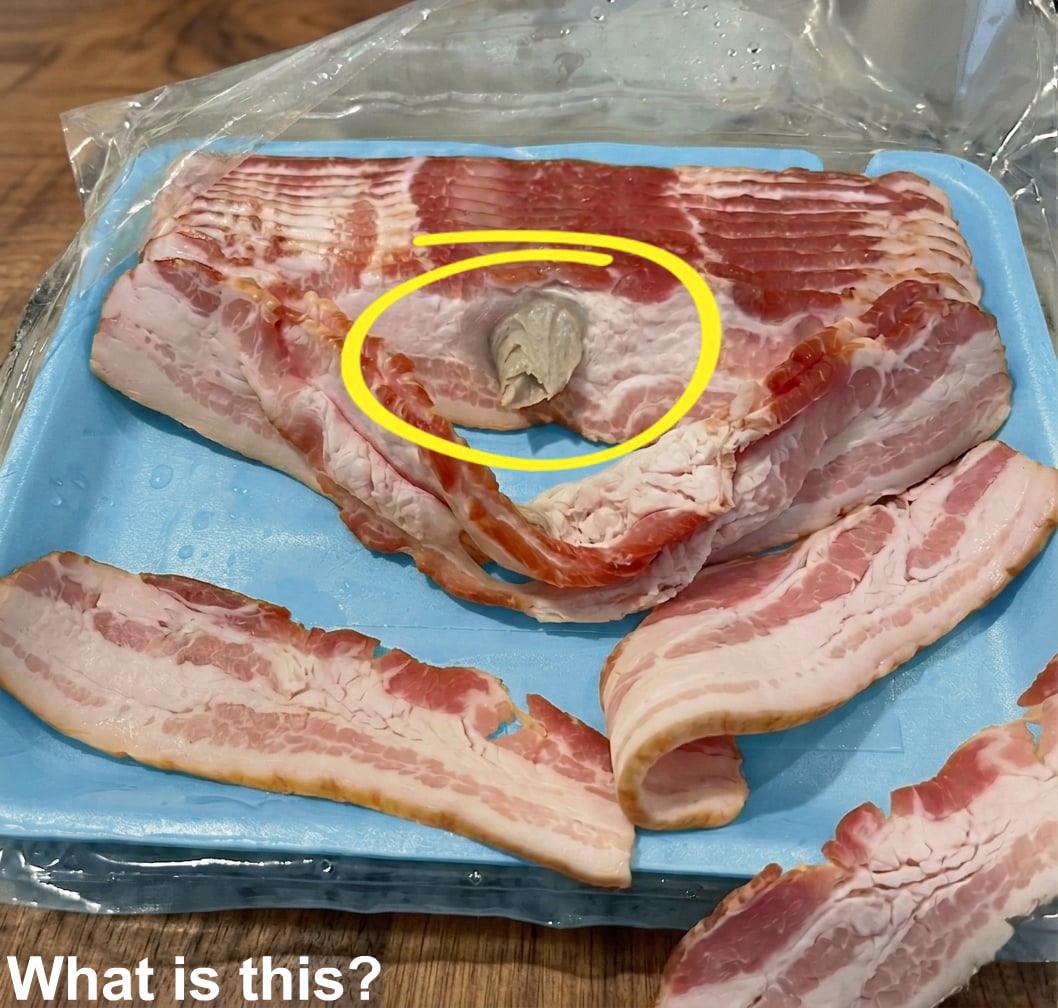
It started as something ordinary, almost forgettable. A quick stop at the store, a routine purchase, a familiar craving. Bacon was on the list, nothing unusual about that.
It’s the kind of food people reach for without thinking twice salty, comforting, predictable. I brought it home the same way I always did, expecting nothing more than a simple meal and a moment of satisfaction at the end of the day.
But standing there in the kitchen, packaging in hand, something felt off.
At first, it was subtle. A hesitation I couldn’t quite explain. The slices didn’t look the way I expected them to. Bacon, in my mind, had a certain appearance thin layers of fat and meat, slightly irregular, a natural kind of imperfection. What I was looking at instead felt different. The texture seemed too dense, almost rubbery. The shape looked strangely precise, as if it had been molded rather than cut. It didn’t trigger immediate alarm, but it planted a seed of doubt.
And that doubt grew quickly.
Within seconds, my thoughts spiraled into places I didn’t anticipate. What if this wasn’t even meat? The question arrived uninvited but refused to leave. I turned the slices over, examining them more closely, as if staring long enough might reveal an answer. The more I looked, the less certain I became. The surface had a firmness that didn’t match my expectations. The edges looked too clean, too defined. It was the kind of detail that shouldn’t matter, but suddenly it mattered a lot.
I set it down, then picked it up again.
The kitchen, once a place of routine and comfort, felt different now. There was a quiet tension in the air, as though something had shifted without warning. My mind began pulling in every unsettling story I had ever heard about food processing. Headlines about contamination, rumors about artificial fillers, exaggerated tales that usually felt distant and exaggerated all of them rushed forward at once, demanding attention.
What if something had gone wrong during production? What if this wasn’t just unusual, but unsafe? The possibilities multiplied the longer I stood there, each one more unsettling than the last.
I didn’t cook it.
Instead, I reached for my phone.
What followed was hours of searching, scrolling, comparing. I looked up images, read through forums, scanned articles written by both experts and everyday people who had experienced something similar. I zoomed in on photos, trying to match what I had in front of me with something anything that could explain it.
The internet, as it often does, offered both clarity and confusion.
Some posts described harmless irregularities in meat, natural variations that occur during processing. Others told far more alarming stories, the kind that feed into fear rather than resolve it. I moved between reassurance and anxiety, never quite settling on one or the other. Each new piece of information seemed to open another question instead of answering the first.
Time passed without me noticing.
The bacon remained untouched on the counter, no longer just food but a kind of puzzle I felt compelled to solve. It was strange how something so small could take over my attention so completely. But it wasn’t just about the bacon anymore. It was about trust about the assumptions we make every day without thinking.
Eventually, after enough searching and second-guessing, a clearer picture began to form.
What I was seeing wasn’t plastic, or something foreign, or anything deliberately added. It was cartilage a piece of connective tissue from the pig that had made its way through the processing stage and ended up in the final product. Not dangerous, not unusual in a technical sense, but certainly not what most people expect to see.
The realization was both relieving and disappointing.
Relief came first. The worst possibilities I had imagined faded away. There was no hidden threat, no contamination, no mystery that required urgent concern. It was simply a natural part of the animal, something that had slipped through where it normally wouldn’t.
But the relief was quickly followed by something else.
Discomfort.
Because while it wasn’t dangerous, it was still unsettling. Not because of what it was, but because of what it represented. It was a reminder of something we rarely confront directly the reality of where our food comes from and what it actually looks like before it is trimmed, shaped, and presented in a way that feels familiar.
We are used to food being predictable.
We expect consistency, uniformity, a certain appearance that aligns with our mental image of what it should be. When something breaks that pattern, even slightly, it can feel wrong in a way that’s hard to explain. It challenges the quiet agreement we have with the systems that provide our food: that what we see will match what we expect.
Standing there in the kitchen, I realized how little I had ever thought about that agreement.
The bacon I had bought was not fundamentally different from any other. It hadn’t been altered in some unusual way. It simply revealed something that is usually hidden. And that was enough to make it feel unfamiliar, even disturbing.
The experience lingered long after the initial fear had passed.
It changed the way I looked at food, not in a dramatic or life-altering way, but in a quieter, more reflective sense. It made me aware of how much of our comfort comes from not seeing certain details. From not thinking too deeply about processes that are designed to remain out of sight.
There is a certain distance we maintain, often without realizing it.
We prefer our food to arrive in forms that are easy to understand, easy to accept. When that distance is reduced even slightly it can create a moment of discomfort that feels disproportionate to the reality. But that discomfort is revealing. It shows us where our assumptions lie, and how quickly they can be unsettled.
In the end, nothing extraordinary had happened.
I had gone to the store, bought bacon, and brought it home. The product was safe, the explanation simple. And yet, the experience stayed with me, not because of what I found, but because of what it made me realize.
Sometimes, the most unsettling part of a situation isn’t the thing itself.
It’s the sudden awareness of how little we actually want to know.