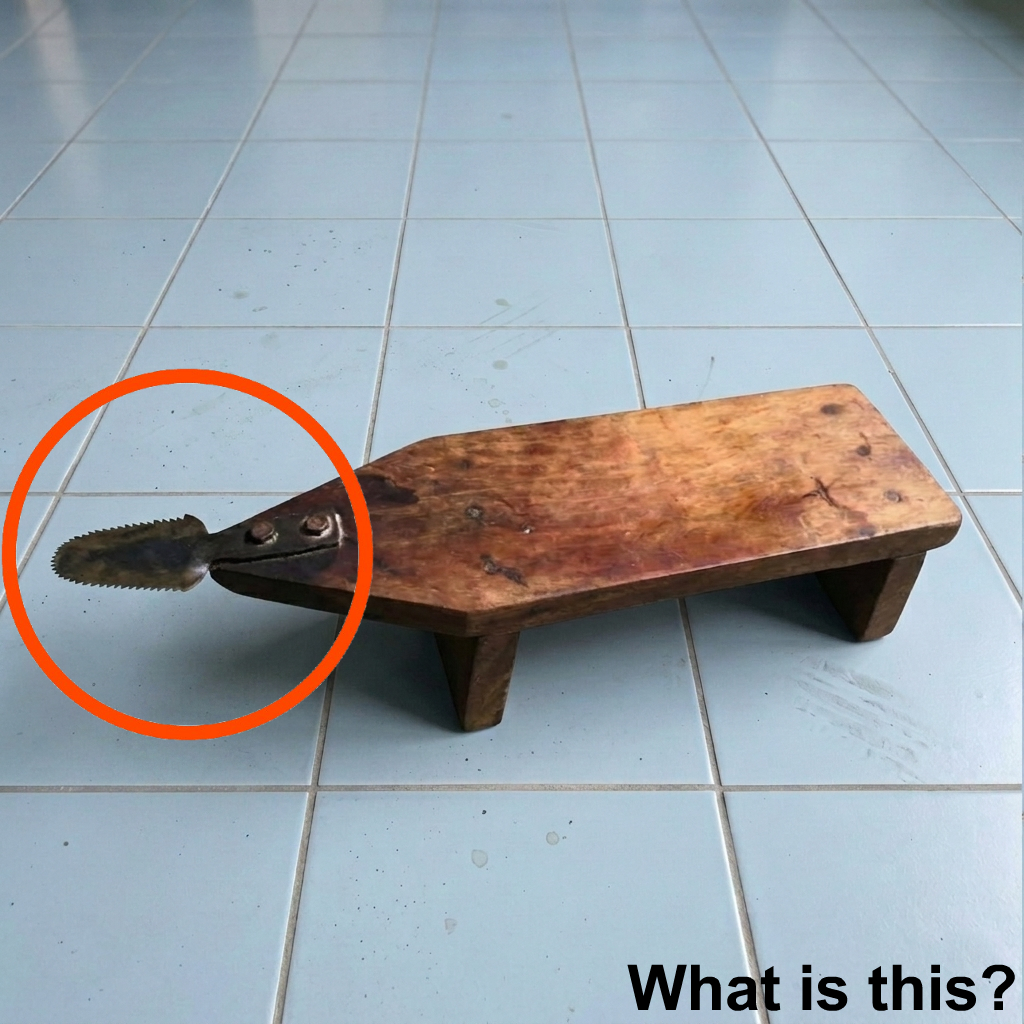
We almost left it where it was. Tucked into a dim corner of the garage, half-hidden behind boxes that hadn’t been opened in years, it looked like just another forgotten piece of clutter something too odd to recognize and too worn to seem valuable.
But curiosity has a way of pulling you closer, especially when an object refuses to explain itself. So we dragged it into the light, brushing away a thin layer of dust and the delicate threads of spiderwebs that had claimed it over time.
At first glance, it made no sense. The base was made of wood, solid but aged, with a low platform supported by short, sturdy legs. It looked like something you might sit on, though not comfortably. The shape was simple, almost crude, as if it had been built for function rather than appearance. But it was the metal piece attached to one end that truly caught our attention and unsettled us.
It jutted outward at just the right angle to demand caution. Small, jagged teeth lined its edge, sharp enough to catch the light in a way that made you instinctively pull your hand back. It resembled a miniature saw, but not one designed for cutting wood or metal. The teeth were too fine, too irregularly spaced, and the blade itself was too compact. It didn’t belong to any tool we recognized, and that unfamiliarity made it feel more dangerous than it probably was.
We turned it over, examined every joint, every worn edge, searching for clues. There were no labels, no markings, nothing to suggest its origin or purpose. It felt handmade, or at least handcrafted in a way that spoke of a different time, when tools were built to last rather than to impress. The wood was smooth in places where hands had likely rested, polished not by design but by years of use. That detail alone hinted at something important: this wasn’t just an object. It had been part of someone’s routine, something used often enough to leave its mark.
Still, the question remained what was it for?
Speculation came easily. One of us joked that it looked like some kind of medieval device, the kind you’d expect to see in a museum with a warning sign beside it. Another suggested it might be part of an old machine, something that had long since been dismantled or forgotten. The more we guessed, the further we seemed to drift from any real answer. The object resisted easy classification, sitting there in silence as if it knew something we didn’t.
Then the memories began to surface.
Our grandfather had always been a collector of stories as much as things. He traveled when he could, and when he couldn’t, he brought the world back with him in smaller pieces objects picked up from markets, gifts from friends, items that carried with them a sense of place and history. He had a habit of demonstrating how things worked, turning even the simplest tool into a kind of performance. We remembered watching him explain unfamiliar gadgets with a kind of quiet pride, as if he were sharing a secret.
That thought shifted something. This object wasn’t random. It wasn’t a leftover from some forgotten repair project or an abandoned experiment. It was something he had chosen to keep.
One of us recalled an old photograph, faded and slightly curled at the edges, taken in the village where he had spent part of his life. In the background, barely noticeable at the time, was a similar shape a low wooden seat with something protruding from the front. At the time, it had meant nothing. Now, it felt like a clue.
We went looking for that photo, digging through boxes that held fragments of the past letters, postcards, images that captured moments we had never lived but somehow felt connected to. When we found it, the resemblance was unmistakable. The object in the picture matched the one in front of us, down to the angle of the metal piece and the shape of the base.
The realization came slowly, then all at once.
It wasn’t a weapon. It wasn’t part of a machine. It was something far more ordinary and far more meaningful.
A coconut scraper.
The design suddenly made perfect sense. You sit on the wooden base, steadying yourself as you hold a halved coconut in your hands. Then you press the white flesh against the jagged metal teeth, pulling it back and forth until it breaks away in fine, soft shavings. What had looked sharp and intimidating was actually precise, designed to do its job efficiently without wasting anything. The spacing of the teeth, which had seemed so strange before, was exactly what made the tool effective.
In that moment, the object transformed.
What had once felt mysterious, even slightly threatening, now seemed almost elegant in its simplicity. It was a tool built for a specific purpose, shaped by the needs of a culture where coconuts were not just food but a staple of daily life. It spoke of kitchens filled with the sound of scraping, of meals prepared by hand, of traditions passed down through generations.
Holding it now, we could almost imagine our grandfather using it, or at least showing it to someone with the same enthusiasm he brought to everything he shared. It wasn’t just an item he had stored away. It was a piece of his story, a connection to places he had known and experiences he had carried with him.
The garage, once just a space for forgotten things, felt different after that. It was no longer a place where objects went to disappear. It was a kind of archive, filled with items that only seemed ordinary until you looked closely enough to understand them. Each one had the potential to reveal something unexpected, to turn confusion into recognition.
We placed the scraper back down, but not in the same careless way we might have before. There was a sense of respect now, an awareness that even the simplest objects can hold layers of meaning. What had once been dismissed as strange or useless had become something else entirely a reminder that the past often hides in plain sight, waiting for someone to take the time to see it clearly.
And perhaps that is the real discovery. Not just what the object was, but what it represented. A small, practical tool that carried within it a world of memory, culture, and quiet craftsmanship. Something that once belonged to everyday life, now standing as a bridge between then and now.
We went into the garage expecting to sort through old things. Instead, we found a story.