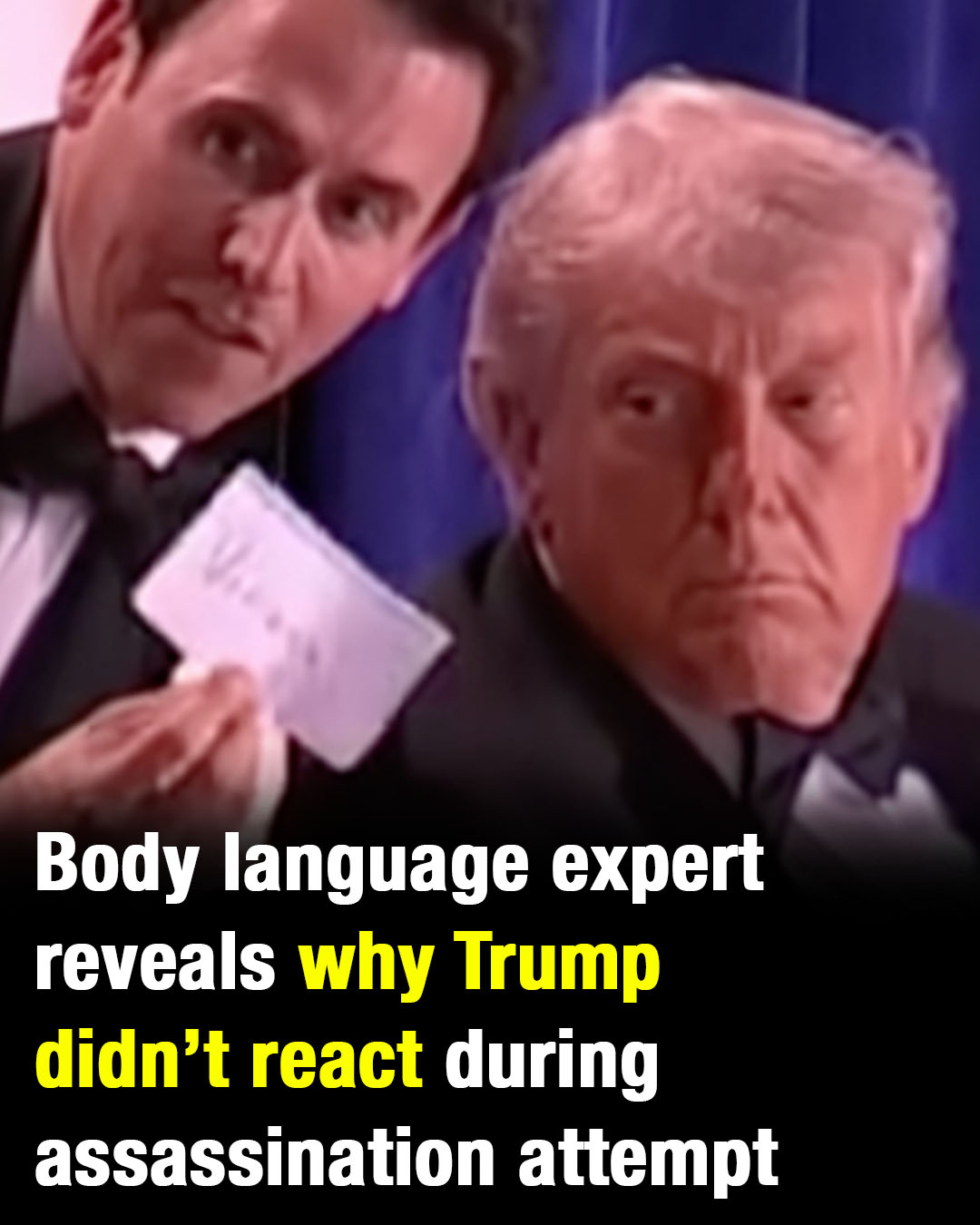
When the first sharp cracks of gunfire shattered the polished rhythm of the White House Correspondents’ Dinner, the room reacted exactly as instinct predicts.
Conversations snapped into silence, chairs scraped violently across the floor, and hundreds of guests dropped beneath tables as if pulled there by an invisible force. Fear moved faster than thought, rippling through the ballroom in a wave of reflex. But in the middle of that surge of panic, one figure appeared strangely out of sync with everyone else. Donald Trump did not mirror the reactions unfolding around him. He did not immediately duck, flinch, or scramble. Instead, he seemed to pause still, composed, almost detached as the chaos erupted.
To many watching the footage afterward, that moment stood out more than the gunfire itself. In a room defined by sudden motion, his stillness became the focal point. It looked, at first glance, like composure taken to an extreme, the kind of unshakable calm that leaders are often expected to display under pressure. But according to body language experts who later analyzed the scene, the explanation may be far more complex, and far more human, than it initially appears.
Their interpretation centers on a well-documented psychological reaction known as the “freeze” response. When confronted with sudden danger, the human brain does not always trigger immediate action. Instead, it can enter a brief state of suspended processing a moment where the body holds still as the mind struggles to interpret what is happening. This response sits alongside the more familiar fight-or-flight reactions, but it is often less understood because it looks, from the outside, like inaction.
In the case of the dinner, those surrounding Trump seemed to move through that sequence rapidly. There was a split-second freeze, followed by instinctive movement leaning away, ducking, seeking cover. Their bodies caught up with the reality of the situation almost as quickly as it unfolded. Trump’s response, however, appeared to linger in that initial phase. His posture remained upright, his expression largely unchanged, as though the signal to move had not yet fully translated into physical action.
Experts caution against interpreting that delay too simply. It is not necessarily a sign of fearlessness, nor is it evidence of indifference. Instead, it may reflect how differently individuals process sudden threats. Some people react instantly, their bodies moving before conscious thought has time to catch up. Others experience a longer pause, a moment where perception and reaction are temporarily out of sync. In high-stakes environments, those differences can become highly visible.
There is also the possibility that Trump’s response has been shaped by experience. Years spent in the public eye, often under intense scrutiny and frequent security concerns, may have altered how he perceives and prioritizes threats. Repeated exposure to potential danger can, over time, recalibrate the brain’s internal alarm system. What triggers immediate panic in one person might register differently in someone who has grown accustomed to operating under constant risk.
Another layer to consider is the role of belief specifically, the perception of protection. As a high-profile political figure, Trump is surrounded by security measures designed to respond instantly to danger. That environment can create a sense, whether conscious or not, that threats will be intercepted before they reach him. If that perception is strong enough, it can influence how quickly the brain interprets a situation as requiring personal action.
To supporters, the image of Trump remaining still in the face of sudden danger reinforces a familiar narrative. It suggests control, confidence, and a refusal to be rattled. In their view, the absence of visible panic is not a delay but a demonstration of leadership a sign that he does not react impulsively, even when others do. It fits into a broader perception of resilience, where composure is equated with strength.
Critics, however, read the same moment differently. For them, the lack of immediate reaction raises questions rather than admiration. They see a disconnect, a hesitation that feels out of place in a situation demanding rapid awareness. Instead of calm, they interpret it as a failure to register the urgency of the moment, a gap between reality and response that could carry implications beyond that single incident.
What makes the moment so compelling is that both interpretations draw from the same visual evidence. The footage does not change, but the meaning assigned to it does. This reflects a broader reality in how public behavior is perceived, especially in highly polarized environments. Actions are rarely viewed in isolation; they are filtered through existing beliefs, expectations, and narratives.
Body language analysis itself operates within that space of interpretation. While it can offer insights into patterns of behavior and common responses, it cannot provide definitive conclusions about internal states. A frozen posture might indicate delayed processing, but it does not reveal exactly what a person is thinking or feeling in that moment. It highlights possibilities, not certainties.
The dinner incident, in this sense, becomes more than a snapshot of a single reaction. It becomes a case study in how humans respond to sudden danger and how those responses are understood by others. It also underscores the gap between appearance and experience. What looks like calm from the outside may feel like confusion on the inside. What appears as hesitation may, in reality, be the brain’s attempt to make sense of an unexpected event.
There is also an important reminder in how quickly such moments are analyzed and judged. In the aftermath of a crisis, attention often shifts from what happened to how individuals behaved during it. Every movement is replayed, every expression scrutinized, as though meaning can be extracted from each frame. While that process can reveal patterns, it can also oversimplify the complexity of human reaction.
Ultimately, the question raised by Trump’s stillness does not have a single, definitive answer. It sits at the intersection of psychology, perception, and interpretation. Was it composure, a freeze response, or something shaped by experience and environment? The available evidence allows for multiple readings, each shaped by the perspective of the observer.
What remains undeniable is the power of the moment itself. In a room filled with motion and noise, stillness became the most striking detail. It drew attention not because it was loud or dramatic, but because it contrasted so sharply with everything else. And in that contrast, it opened a window however brief into the complex, often unpredictable ways humans respond when the world shifts without warning.