The house had been quiet for a long time before we stepped inside. Dust settled where voices once echoed, and every room seemed to hold its breath, as if waiting for someone who would never return.
We had come with a simple purpose: to sort through the belongings of a family friend who had passed away. It was the kind of task that feels practical on the surface but quickly becomes something more complicated. Every drawer opened, every box lifted, carried not just objects, but fragments of a life paused in place.
At first, we approached it methodically. Papers were stacked, clothes folded, items set aside to keep, donate, or discard. The rhythm of sorting created a kind of distance, a way to avoid thinking too deeply about what each item might have meant. But that distance didn’t last long. It rarely does in a house filled with someone else’s memories.
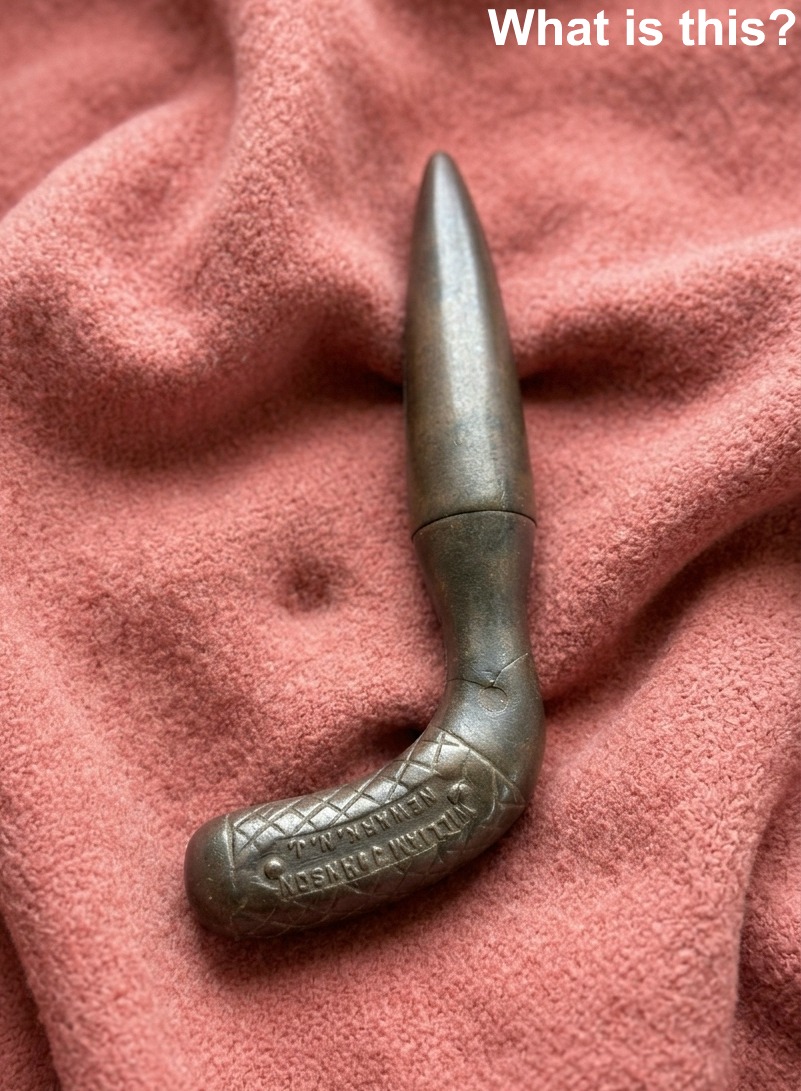
In one of the back rooms, tucked among old storage boxes and forgotten belongings, we came across something that didn’t seem to belong anywhere in particular. It was small, solid, and oddly shaped smooth in some places, worn in others. At a glance, it looked like nothing more than a piece of carved wood or bone, perhaps part of a broken tool or something incomplete. There was no label, no obvious purpose, no immediate story attached to it.
We passed it between us, turning it over in our hands, trying to make sense of it. Someone suggested it might be a decorative object. Another thought it could be part of an old handle or a fragment of something larger. But none of the guesses felt convincing. It didn’t look decorative, and it didn’t seem broken in the way discarded objects usually are. Instead, it had a kind of quiet completeness, as if it had once been exactly what it needed to be.
For a while, it sat on the table while we continued sorting through other things. But it kept drawing our attention back. There was something about its shape, its weight, the way it had been worn down in specific places. It didn’t feel random. It felt used, intentionally and repeatedly, by hands that had known exactly what to do with it.
Curiosity eventually won. We paused our work and started looking for answers, comparing it to images, descriptions, anything that might match what we were holding. It didn’t take long before a possibility emerged one that, at first, seemed unlikely, almost too specific to be true. But the more we looked, the more it made sense.
It was a fid.
The word itself felt unfamiliar, almost strange, but the explanation that followed changed everything. A fid, we learned, was a traditional maritime tool, once essential aboard sailing ships. Sailors used it to separate the strands of rope, to splice lines together, to loosen knots that had tightened under pressure and strain. In a world where ropes held sails, secured cargo, and ensured stability, this small tool played a critical role.
Suddenly, the object in our hands was no longer mysterious. It was something very real, something that had once been part of a working environment far removed from the quiet room we stood in. Its worn edges were no longer abstract marks they were evidence of use, of repetition, of purpose. Each smooth curve, each subtle indentation, told a story of tension, effort, and precision.
It was impossible not to imagine the life that had surrounded it. Not the stillness of a house, but the constant motion of the sea. The creak of wooden decks, the snap of sails catching wind, the sharp scent of salt in the air. Hands gripping ropes, tightening lines, adjusting and readjusting as conditions changed. And somewhere in that rhythm, this small tool, passed from pocket to hand, used again and again without ceremony.
It may have belonged to a sailor. Or perhaps it had been kept as a keepsake, a reminder of a past life or a connection to someone else’s experience. The house, after all, had held many stories we would never fully know. But the presence of the fid suggested a link to something larger than the rooms around us. It hinted at journeys, at distances crossed, at work done in environments where mistakes carried real consequences.
What struck us most was how easily it could have been overlooked. Without that moment of curiosity, it might have been dismissed as nothing more than an odd piece of scrap. It had no obvious value, no shine or decoration to draw attention. And yet, once understood, it carried a weight that far exceeded its size.
It changed the way we looked at everything else in the house. Objects we had been sorting without much thought suddenly felt different. Each one had a history, even if we couldn’t fully uncover it. A chipped mug, a stack of letters, an old photograph each held something beyond its physical form. The fid had simply made that truth impossible to ignore.
We kept it.
Not because it was rare or valuable in any traditional sense, but because it represented something we didn’t want to lose. It became a quiet reminder that stories don’t always announce themselves. Sometimes they sit unnoticed, waiting for someone to ask the right question or take a second look.
Now, it rests in a different place, far from the life it was originally part of. It no longer separates rope fibers or loosens knots under tension. But it still carries its history, even in stillness. It connects two worlds that would otherwise never meet the harsh, unpredictable environment of the sea and the calm, contained space of a home.
And more than anything, it changed how we see the ordinary. What once looked like forgotten clutter now feels like a collection of hidden narratives. It taught us that the most unremarkable objects can hold the deepest stories, if only we take the time to notice them.
We went into that house expecting to sort through belongings. We left with something else entirely a new way of looking at the past, and a small, worn object that quietly bridges the distance between someone else’s life and our own.