In the immediate aftermath of gunfire erupting near the White House Correspondents’ Dinner, the shock was not confined to the ballroom.
It spread outward, moving through phones, timelines, and conversations at a speed that rivaled the event itself. Within hours, what began as a security crisis had transformed into something more complex and more volatile: a battle over interpretation.
At the center of that shift was a single remark. Earlier in the evening, Karoline Leavitt had made what appeared to be a light, familiar joke about the tone of the night, suggesting there would be “some shots fired” in the room. In the context of the event, it was a phrase that had long belonged to the language of political humor sharp lines, verbal jabs, the kind of rhetorical sparring the dinner is known for.
But context is fragile, especially after something real interrupts it.
When actual gunfire was reported, the meaning of that earlier comment shifted almost instantly. What had once sounded playful began to feel, to some, unsettling. For a public already trying to process fear and confusion, the remark became something to revisit, replay, and reinterpret. It moved from background noise to foreground suspicion.
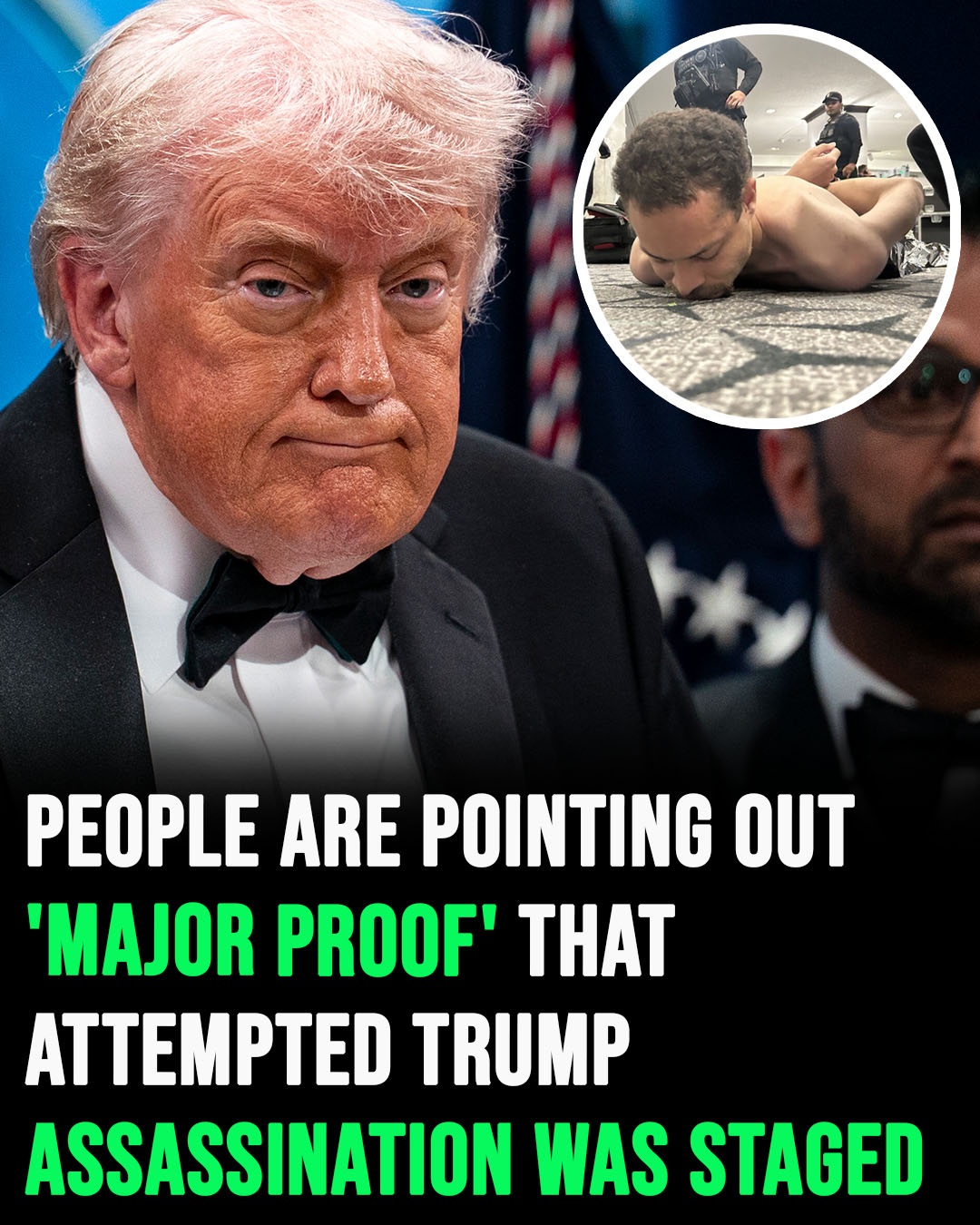
Social media accelerated that transformation. Clips were shared, captions reframed, and speculation layered onto speculation. Within a matter of hours, a narrative began to take shape in certain corners of the internet: the idea that the incident involving Donald Trump had not been entirely spontaneous, but orchestrated. The phrase “staged” appeared again and again, attached to fragments of video, screenshots, and interpretations that often relied more on inference than evidence.
For those advancing this theory, Leavitt’s comment became a focal point a detail elevated into what they described as “proof.” The logic was less about direct causation and more about perceived coincidence. In a moment defined by uncertainty, even small overlaps between words and events began to feel significant.
Yet outside that rapidly expanding online discourse, investigators were working within a very different framework.
According to early accounts from law enforcement, the incident involved a suspect who was armed, mobile, and acting with clear intent. Security protocols were activated within seconds. A confrontation followed, during which a member of the protective detail was struck but shielded by body armor. The suspect was subdued, and the immediate threat was contained. Evidence collection began almost immediately, focusing on weapons, digital materials, and any documentation that could clarify motive.
Those details point toward a scenario that is chaotic but familiar to investigators: an individual acting alone, executing a plan that was disrupted by rapid response. It is a narrative grounded in physical evidence, witness accounts, and procedural analysis.
Between that account and the online theories lies a widening gap not just of information, but of trust.
The speed with which speculation spread is not accidental. It reflects a broader shift in how people engage with events, particularly those involving politics and power. In an environment where skepticism has become the default, official explanations are often met with immediate doubt. Alternative interpretations, especially those that challenge authority, can gain traction precisely because they feel like acts of resistance.
This dynamic is amplified by the structure of digital platforms. Content that provokes strong emotional reactions shock, anger, disbelief tends to travel further and faster than content that emphasizes caution or uncertainty. A theory does not need to be verified to be shared; it only needs to be compelling enough to hold attention.
As a result, moments like this do not produce a single narrative. They produce many, each competing for visibility, each shaped by the assumptions and perspectives of those who engage with it.
For some, the idea of a staged event fits into a broader belief that public life is more constructed than it appears. For others, the same idea feels implausible, even dismissive of the real risks and responses involved. These positions are not just disagreements about facts; they are reflections of deeper divides in how reality itself is interpreted.
Meanwhile, the original incident continues to be examined through more traditional means. Investigators are reviewing evidence, conducting interviews, and working to establish a timeline that can withstand scrutiny. Their process is methodical, often slow, and guided by standards that prioritize accuracy over immediacy.
That difference in pace matters. While official findings take time to develop, speculation fills the space in between. By the time a clear account emerges, many people have already formed conclusions based on partial or misleading information.
The result is a kind of informational overlap, where verified facts and unverified claims coexist, often indistinguishable to those encountering them in fragmented form. In that environment, certainty becomes harder to achieve, and doubt becomes easier to sustain.
The remark that sparked so much attention remains, in many ways, a symbol of that tension. On its own, it was a routine piece of political language, shaped by the traditions of an event known for its sharp humor. Placed alongside a real act of violence, it took on a different weight not because its meaning changed, but because its context did.
That shift reveals something important about how meaning is constructed. Words are not fixed; they are interpreted through the lens of what happens before and after them. When circumstances change dramatically, even ordinary language can be recast as something else entirely.
As the story continues to unfold, the challenge will not only be to understand what happened, but to navigate how it is understood. In a landscape where information moves quickly and trust moves slowly, clarity requires effort from investigators, from journalists, and from the public itself.
What remains undeniable is the impact of the moment. A formal evening meant to balance critique and ceremony was interrupted by fear. A single comment became a catalyst for widespread speculation. And a nation already divided in its perspectives found itself once again confronting the question of what to believe.
In the end, the distance between fact and interpretation may prove just as significant as the event itself. One is grounded in evidence, the other in perception. And in the space between them, the story continues to evolve, shaped not only by what is discovered, but by how it is received.