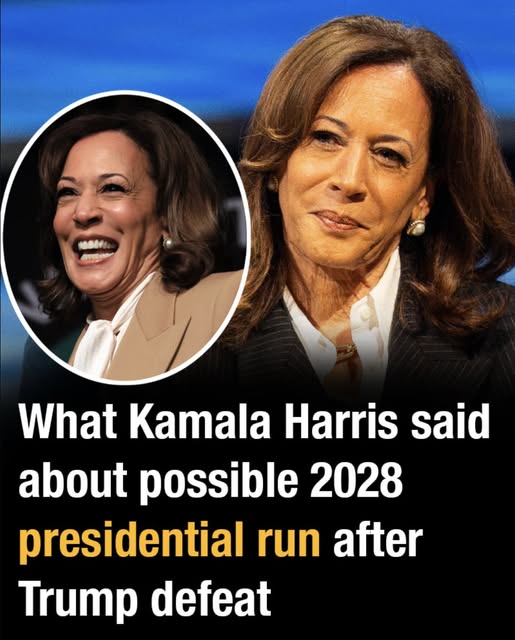
Kamala Harris s careful admission that she is weighing a 2028 presidential run is more than idle chatter. It is the opening move in a long, high stakes game. She speaks like someone who has seen the Oval Office from just inches away and refuses to pretend the country is fine. Her travels through the South and beyond have given her a potent message. The old way is breaking people, and they know it. She has spent months in communities that feel forgotten, listening to factory workers, single mothers, and young people who have never known a functional political system. Those conversations have shaped her into a different kind of candidate than the one who ran before. Her tone has shifted. There is less caution in her voice and more urgency. She no longer speaks about what is possible. She speaks about what is necessary.
The Democratic Party, still reeling from the last election, is searching for an identity. Harris believes she can provide one. Not by moving to the center or the left, but by rejecting the framework entirely. She argues that the old political categories no longer apply. People are not looking for liberal or conservative solutions. They are looking for solutions that work. That message has resonated in focus groups and early polling, though her advisors caution that the landscape remains volatile. The road to 2028 is long, and Harris knows that announcing too early could backfire. She has watched other candidates peak before their time, only to fade when the actual voting began. Her strategy, according to sources close to her, is to build slowly. Town halls in early primary states. Quiet fundraising. Relationship building with local officials who can deliver votes when it matters. She is not flooding the zone with media appearances. She is letting the demand for her grow organically.
At the same time, her sharp criticism of what she calls a war of choice involving Iran signals how she would draw a contrast with Trump era foreign policy. She is casting herself as tough, but not reckless with American lives. Her foreign policy team has been drafting position papers, consulting with former military leaders, and testing language that balances strength with restraint. She believes that the previous administration s approach to Iran was impulsive and dangerous, driven by ego rather than strategy. She wants voters to see her as someone who can be trusted with the nuclear codes, someone who will not start a war just to prove a point. That message is aimed at moderate Republicans and independents who were uncomfortable with the chaos of the last administration but may not be ready to embrace the progressive wing of the Democratic Party.
Her potential rivals are already circling. Governors with stronger approval ratings. Senators with more fundraising networks. A few wild cards who could upend the race entirely. Harris is not underestimating any of them. She has been underestimated herself and knows how dangerous that can be. Her allies point to her resilience, her ability to absorb attacks and keep moving forward. They argue that she has been tested in ways that other candidates have not. The scrutiny she faced as vice president prepared her for the brutal reality of a national campaign. The question is whether voters have moved on or whether they see her as part of a past they would rather forget.
The biggest unknown is the political environment in 2028. Will the country have moved left or right. Will economic conditions favor change or stability. Will foreign policy dominate the conversation or domestic issues. Harris is preparing for multiple scenarios. Her team is running simulations, testing messages, and identifying vulnerabilities. They know that the next election will not be won on policy alone. It will be won on trust, on authenticity, on the ability to convince voters that the person asking for their vote actually understands their lives. Harris believes she has that ability. She points to her town halls, her unscripted moments, her willingness to answer tough questions without a teleprompter. She is not a natural retail politician, but she has improved. Her advisors say she is more relaxed now, more willing to show her sense of humor, more comfortable in her own skin.
Whether voters are ready to trust her again after the last election is the unresolved question. Her approval ratings have been sluggish. Many Democrats blame her for the loss, fair or not. She carries the baggage of an administration that many voters rejected. Her team argues that time heals those wounds. By 2028, the last election will be four years in the rearview mirror. A new generation of voters will have come of age. The issues will have shifted. Harris is betting that she can define herself on her own terms, not as a continuation of the past, but as a bridge to the future. It is a risky bet, but she has made risky bets before and won.
For now, Harris leaves the country hanging on a promise and a tease. She is thinking about it, and she will keep everyone posted. That is not a declaration of candidacy. It is a warning to potential rivals. It is a signal to donors. It is a test balloon to see how the political winds are blowing. She is not ready to jump, but she is standing at the edge, looking down, measuring the distance. The next few months will determine whether she takes the leap. Her advisors are watching the same indicators as everyone else. Fundraising numbers. Polling trends. Media coverage. Endorsements from key figures. If the conditions are right, she will move. If not, she will wait. But the door is open, and she has made sure everyone knows it. That alone makes 2028 more interesting. And in politics, interesting is often the first step toward inevitable.