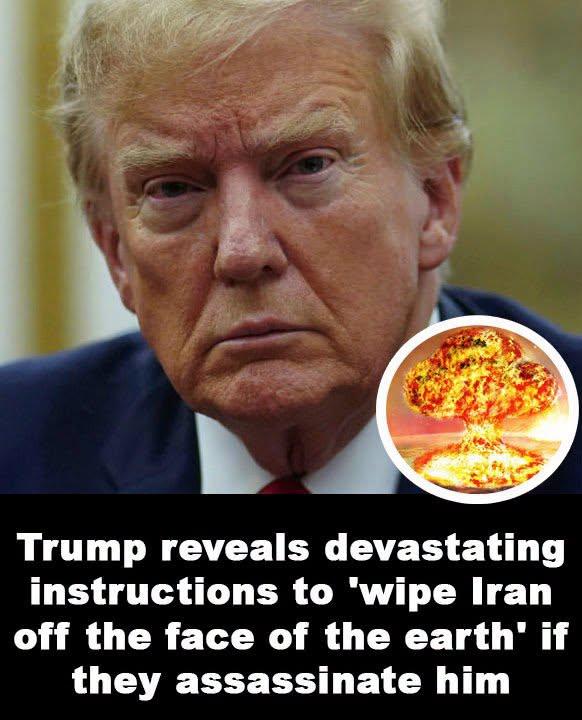
A dramatic warning from Donald Trump has intensified an already tense confrontation with Iran, after the former president claimed he had left instructions for a devastating response if he were ever assassinated by Iranian forces. His remarks, delivered during a period of heightened military tensions, immediately sparked debate over the limits of presidential retaliation, the dangers of personal threats becoming national policy, and the fragile balance between deterrence and escalation.
Trump’s statement was not framed as a traditional warning aimed only at Iran’s leadership. Instead, it suggested that any attempt on his life would trigger consequences reaching far beyond those directly responsible. The idea of a response designed to strike an entire nation raised alarm among critics, while supporters argued that the message was intended to send a powerful signal that attacks against American leaders would carry severe consequences.
The comments came at a moment when relations between Washington and Tehran were already deeply strained. Years of hostility between the two countries have been marked by military confrontations, sanctions, political accusations, and repeated fears that a larger conflict could erupt. Every new statement from either side carries the potential to shift the situation closer to confrontation or back toward negotiation.
Trump’s warning reflected his long-standing approach of using aggressive rhetoric as a tool of pressure. Throughout his political career, he has often argued that projecting strength prevents enemies from taking action. Supporters describe this strategy as a form of deterrence, believing that clear threats can discourage attacks by making the potential cost too high.
However, opponents see a different danger.
They argue that linking a country’s fate to an attack against one individual creates a troubling scenario where personal retaliation could overshadow broader national interests. Critics warn that such statements risk narrowing the space for diplomacy and increasing the possibility of miscalculations during an already volatile period.
The controversy surrounding Trump’s remarks is connected to wider tensions involving Iran’s government, its military forces, and American security concerns. For years, officials in Washington and Tehran have accused each other of hostile actions, while regional allies and civilians have often been caught in the middle.
The fear among analysts is not only about what leaders intend to do, but about how quickly events can move once threats are exchanged publicly.
History has shown that international crises can escalate through a series of decisions that each side believes are defensive. One government strengthens its position because it fears weakness. Another responds because it feels threatened. Eventually, actions that were meant to prevent conflict can become the very steps that push countries toward it.
That concern has become central to discussions surrounding Trump’s comments.
By suggesting that future negotiations may be impossible and accusing Iran’s leadership of dishonesty, Trump presented the relationship as one defined by mistrust rather than compromise. Supporters argue that skepticism toward Tehran is justified after years of conflict and broken agreements. They believe a tougher stance is necessary to prevent Iran from exploiting moments of weakness.
Others argue that eliminating diplomatic options can create greater risks. Even between hostile governments, communication channels can sometimes prevent misunderstandings from turning into military disasters.
The timing of Trump’s remarks has also drawn attention because they come amid reports of continued military pressure and clashes involving U.S. and Iranian interests. Any military activity in the region carries significant consequences, particularly because the Middle East contains multiple competing powers, armed groups, and strategic interests.
A conflict between the United States and Iran would not affect only the two countries involved. It could influence global energy markets, regional stability, and millions of civilians living far from the decisions made by political leaders.
For ordinary people, the language of retaliation and military power often feels distant until the consequences become real. Families living in affected areas have little control over international disputes, yet they are frequently the ones who experience the greatest impact when tensions turn into violence.
That reality has fueled calls for restraint from some foreign policy experts, who argue that strong leadership requires not only the ability to respond but also the wisdom to prevent unnecessary escalation.
At the same time, Trump’s supporters argue that failing to respond forcefully to threats against American leaders could encourage future attacks. They point to previous incidents involving threats from foreign adversaries as evidence that a serious response is necessary to protect national security.
The debate highlights a fundamental disagreement over what creates safety in a dangerous world.
Some believe peace comes from demonstrating overwhelming strength and making potential enemies afraid of the consequences. Others believe lasting security depends on keeping communication open and avoiding language that makes compromise impossible.
Trump’s remarks have become a symbol of that larger debate.
To his supporters, they represent a leader unwilling to tolerate threats and determined to make adversaries think twice before acting. To critics, they represent a dangerous escalation in which emotional reactions and political rivalries could influence decisions with global consequences.
As tensions continue, the most important question may not be what one side says in a moment of anger, but whether leaders can maintain control when pressure reaches its highest point.
The history of international conflicts is filled with moments when warnings, threats, and acts of retaliation created chains of events that nobody fully intended. Preventing those moments requires careful judgment, especially when powerful nations are involved.
For now, Trump’s warning has added another layer of uncertainty to an already fragile relationship between the United States and Iran. Whether it serves as a deterrent or increases the risk of further confrontation remains at the center of a heated global debate.
One statement has once again pushed the world’s attention toward a difficult question: when does a warning meant to prevent an attack become a threat that brings everyone closer to the edge?