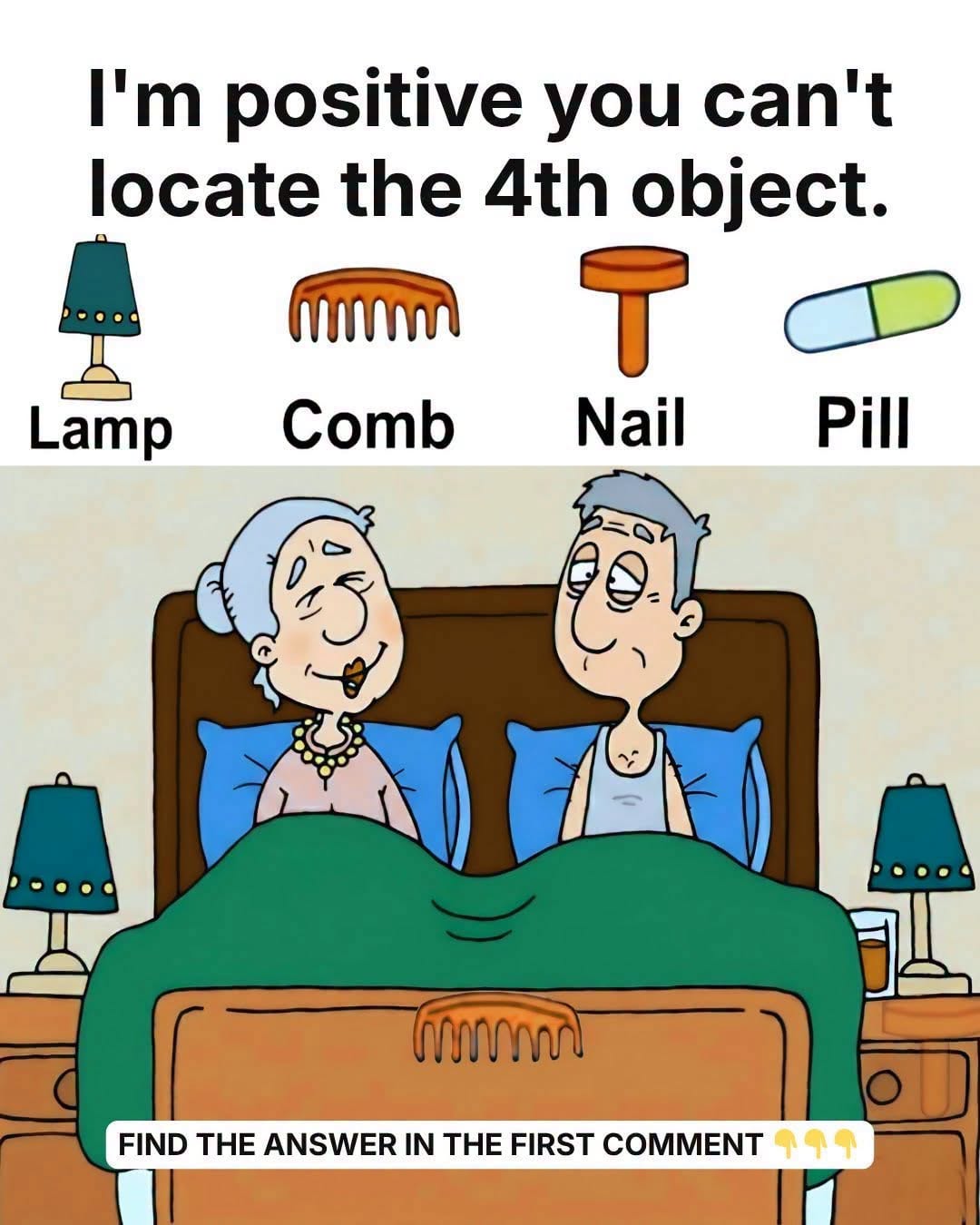
At first glance, the image looks like a simple and peaceful scene.
An elderly couple is relaxing comfortably in bed, surrounded by familiar household items and a quiet bedroom atmosphere. Nothing about the picture seems unusual. There are no obvious surprises, no strange details that immediately catch your attention, and no reason to believe the image contains a challenge.
But hidden within the ordinary-looking scene are four cleverly disguised objects that many people struggle to find.
Some viewers spot the first few within seconds.
Others stare at the image for several minutes and still miss one important detail.
The hidden objects are:
A lamp
A comb
A nail
A pill
It sounds like a simple task.
After all, how difficult can it be to find four small objects in one picture?
The answer is much harder than most people expect.
These puzzles are not only tests of eyesight. They are tests of attention, patience, and the way the human brain interprets the world around us.
The reason so many people fail to find all the objects is not because they are unable to see them.
The objects are usually right in front of them.
The problem is that the brain decides what information is important and what information can be ignored.
In everyday life, this ability is extremely useful. Our brains constantly filter out unnecessary details so we can focus on what matters most.
When walking down a street, for example, you notice cars, people, and obstacles. You usually do not pay attention to every crack in the sidewalk, every shadow, or every tiny object nearby.
Hidden-object puzzles take advantage of this natural habit.
They place important details in areas where the brain does not expect to find them.
A shape becomes part of a pattern.
An object blends into furniture.
A small item hides inside a larger image.
Before you realize it, your brain has already decided that the object is not worth noticing.
That is what makes these puzzles so frustrating and so addictive.
The Four Hidden Objects Revealed
The Lamp
The lamp is usually the first object people discover.
Compared with the other hidden items, it stands out more clearly because its shape and purpose are easier for the brain to recognize.
The lamps are positioned near the bed, where viewers naturally expect a light source to be located.
Because lamps are common objects found in bedrooms, your brain quickly identifies the familiar shape.
Most people who solve the puzzle begin here.
The Comb
The second hidden object is the comb.
This one requires a little more attention because it does not immediately separate itself from the surrounding details.
The comb is cleverly placed near the lower section of the image, close to the foot of the bed.
Many people spend most of their time looking at the couple’s faces, the pillows, and the central area of the picture. Because of this, they completely overlook the lower portion of the scene.
The trick is to stop looking at the picture as one large image and start examining it piece by piece.
When you carefully scan the bottom area, the shape of the comb becomes easier to recognize.
The Nail
The nail is where the challenge becomes much more difficult.
Unlike the lamp and comb, this object does not immediately appear to belong in the scene.
It has been blended into the background, making it appear like a normal part of the environment rather than a separate item.
This is a common technique used by puzzle creators.
They hide objects by matching their color, shape, or position with surrounding details.
Your brain sees the object but does not register it as something important.
Finding the nail requires slowing down and searching for unusual shapes.
Instead of asking yourself, “Where is the object?”
Ask yourself:
“Is there anything here that looks slightly out of place?”
That small change in thinking often makes the hidden object suddenly appear.
The Pill
The final object is the one that defeats the majority of people.
The pill.
It is hidden in a location where almost nobody expects to search.
Rather than being placed on a table, beside the bed, or among the household items, the pill is hidden inside the elderly woman’s mouth.
Because it is extremely small and positioned in such an unexpected location, many viewers completely miss it.
The brain naturally focuses on larger details, such as faces, expressions, and clothing. It rarely searches inside a person’s mouth for a hidden object unless specifically told to do so.
This is what makes the final discovery so satisfying.
Once you notice it, the answer feels obvious.
You wonder how you could have missed it the first time.
Why Hidden Object Puzzles Are So Difficult
These challenges work because they exploit something called selective attention.
Selective attention is the brain’s ability to focus on certain information while ignoring everything else.
This helps us function efficiently, but it also creates blind spots.
Puzzle designers use several methods to take advantage of this:
They hide objects inside patterns.
They place items near similar colors.
They disguise objects as part of furniture.
They put important details in unexpected locations.
They use size differences to distract your attention.
The result is a picture that seems simple but requires much deeper observation.
How To Become Better At Finding Hidden Objects
If you struggled with this puzzle, there are a few techniques that can improve your chances next time.
First, slow down.
Many people fail because they look at the entire image too quickly. Your eyes move across the picture, but your brain does not truly process every detail.
Second, search systematically.
Divide the image into sections.
Look at the top.
Then the bottom.
Move from left to right.
Do not randomly jump around.
Third, search for unusual shapes.
Hidden objects often create small interruptions in the normal patterns of the picture.
A strange line.
An unexpected curve.
A shape that does not quite belong.
Those small clues often reveal the answer.
Finally, take a short break if you feel stuck.
Looking away for a few moments can reset your visual focus. When you return, your brain may notice details it ignored before.
The Benefits Behind The Fun
Hidden-object puzzles are entertaining, but they also provide mental benefits.
They encourage concentration.
They improve attention to detail.
They strengthen visual memory.
They train pattern recognition skills.
They require patience and careful observation.
In many ways, these puzzles are small exercises for the brain.
They challenge you without feeling like traditional mental training.
The satisfaction comes from that moment when everything suddenly becomes clear.
A hidden object that seemed impossible to find becomes completely obvious.
Final Thoughts
This puzzle proves that seeing and noticing are two different things.
The four hidden objects were always there.
Nothing changed.
The image did not become clearer.
Your eyes simply learned where to look.
That is the magic of hidden-object challenges.
They remind us that sometimes the biggest discoveries are hiding in plain sight.
You just have to slow down, pay attention, and look a little closer.