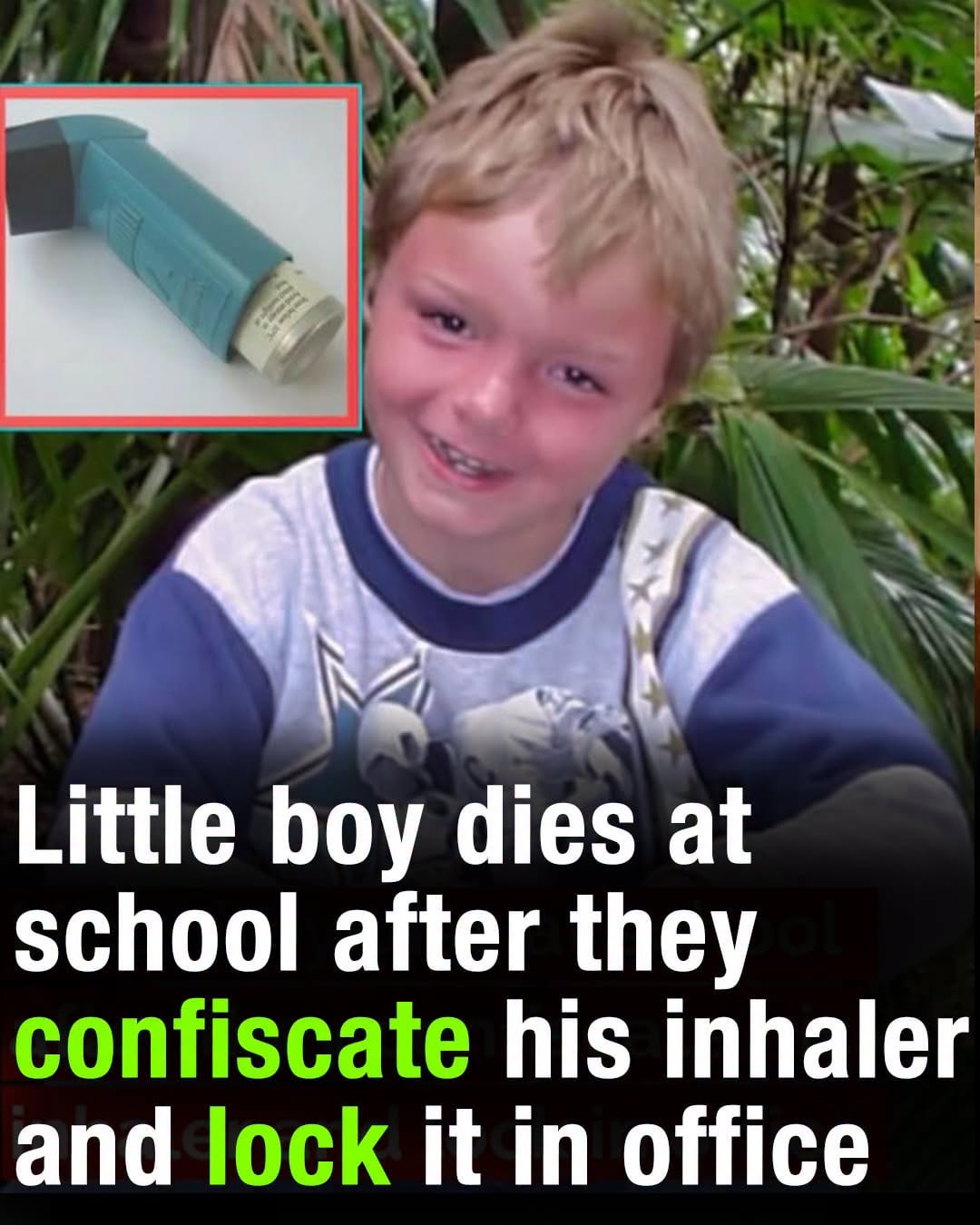
Ryan Gibbons should have come home from school that afternoon.
Instead, his family received the kind of phone call every parent fears.
The energetic 12-year-old had suffered a severe asthma attack while playing soccer during recess. His classmates watched in panic as he struggled to breathe, desperately needing the rescue inhaler that could have opened his airways within seconds.
But the medication that might have saved his life wasn’t in his pocket.
It wasn’t in his backpack.
It wasn’t even nearby.
It was locked inside the school office.
By the time adults reached it, Ryan was unconscious.
Despite emergency efforts, he never recovered.
His death stunned families across Canada, not only because of its heartbreaking nature, but because many believed it never should have happened.
Ryan wasn’t an unusually fragile child.
Those who knew him remember a boy full of curiosity and energy.
He loved riding dirt bikes.
He enjoyed hiking through the woods.
He laughed easily, played sports with friends, and embraced the adventures that filled most childhood weekends.
Like millions of children around the world, he also lived with asthma.
For Ryan, carrying a rescue inhaler wasn’t optional.
It was essential.
Asthma is a chronic condition that causes inflammation and narrowing of the airways.
For many people, symptoms can remain mild for long periods before suddenly becoming severe.
An asthma attack can develop quickly.
Within minutes, breathing becomes increasingly difficult as air struggles to move through swollen airways.
A rescue inhaler delivers medication designed to relax those muscles rapidly, often reversing symptoms before they become life-threatening.
Timing matters enormously.
Every minute without treatment increases the danger.
Ryan and his family understood this reality well.
His mother, Sandra Gibbons, worked hard to make sure her son always had access to the medication he depended on.
She provided inhalers.
She communicated with the school.
She even obtained medical documentation explaining why Ryan needed immediate access to his medication.
Yet school policy repeatedly stood in the way.
At the time, Ryan’s school required prescribed medications to be stored in the principal’s office.
Students were generally not allowed to carry inhalers themselves.
Administrators believed centralized storage would improve safety and oversight.
In practice, however, it created dangerous delays.
Ryan understood those risks.
Determined to protect himself, he sometimes brought an additional inhaler to school without permission.
Again and again, staff discovered it.
Again and again, the inhaler was confiscated.
His mother later recalled receiving repeated phone calls asking her to collect the medication.
Each time, she questioned why her son couldn’t simply keep the device that might save his life.
The answer remained the same.
School policy.
Looking back, Sandra described those conversations with deep frustration.
She couldn’t understand why a child with asthma would be prevented from carrying prescribed medication recommended by his physician.
At the time, she never imagined the consequences would become irreversible.
Everything changed on October 9, 2012.
While playing soccer at Elgin County School in Ontario, Ryan began experiencing an asthma attack.
Initially, those around him may not have realized how quickly the situation was worsening.
As his breathing became more labored, his classmates understood he needed help immediately.
Several boys attempted to support him as they hurried toward the school office where his inhaler had been stored.
The distance wasn’t great.
But during an asthma emergency, even a short delay can prove catastrophic.
Ryan collapsed before they could reach the medication.
Emergency responders arrived quickly.
Medical personnel worked desperately to revive him.
Nothing worked.
Ryan died that day at only twelve years old.
News of his death spread rapidly across Canada.
Parents living with asthmatic children immediately recognized the terrifying implications.
Many wondered whether similar policies existed in their own schools.
Medical professionals expressed concern that life-saving medication had not remained immediately available.
Public attention soon turned toward prevention.
Sandra Gibbons faced unimaginable grief.
She had lost her son.
Yet even while mourning, another thought refused to leave her mind.
Ryan’s death had been preventable.
Instead of retreating from public life, she decided to speak.
She wanted people to understand exactly what had happened.
She wanted schools to reconsider policies that placed administrative rules above emergency medical access.
Most importantly, she wanted no other parent to experience what her family had endured.
Sandra began sharing Ryan’s story with lawmakers, advocacy groups, educators, and the media.
She launched petitions calling for standardized asthma management policies across Ontario schools.
Her message remained remarkably consistent.
Children capable of responsibly carrying their rescue inhalers should be allowed to do so.
Asthma attacks cannot be scheduled.
They cannot always be predicted.
A locked office provides little protection during a medical emergency unfolding somewhere else in the building or outside on the playground.
Medical organizations supported those concerns.
Experts explained that rescue inhalers work best when used at the very first signs of an asthma attack.
Even small delays may allow symptoms to escalate beyond the point where medication alone can reverse them.
Rapid access saves lives.
The growing public attention eventually reached provincial lawmakers.
Progressive Conservative Member of Provincial Parliament Jeff Yurek introduced legislation inspired directly by Ryan’s story.
The proposal became known as Ryan’s Law.
Its purpose was straightforward.
Schools would be required to permit students diagnosed with asthma to carry their own inhalers if authorized by both parents and a physician.
The legislation also encouraged schools to establish asthma education and management policies that emphasized awareness rather than restriction.
In 2015, Ryan’s Law passed unanimously.
For Sandra, the victory brought deeply mixed emotions.
Nothing could return her son.
No legislation could erase the years of birthdays, graduations, and family moments that Ryan would never experience.
Yet knowing that future children might survive because of changes inspired by his story offered some measure of comfort.
Speaking after the bill’s passage, Sandra admitted feeling overwhelmed.
She described experiencing both profound sadness and hope simultaneously.
Ryan’s legacy would now protect others.
Medical organizations welcomed the new law.
Asthma specialists emphasized that allowing responsible students immediate access to rescue medication aligned with modern clinical recommendations.
Rather than increasing risk, personal access significantly improves safety during emergencies.
Ryan’s story also sparked broader conversations beyond Ontario.
Many schools across North America reviewed their medication policies.
Parents became more aware of their children’s rights regarding asthma treatment.
Teachers received additional education about recognizing respiratory emergencies.
The discussion highlighted an important truth.
Policies designed with good intentions sometimes produce unintended consequences.
Rules must remain flexible enough to account for genuine medical needs.
Asthma remains one of the most common chronic illnesses affecting children worldwide.
While many people successfully manage the condition through medication and careful monitoring, severe attacks can still occur unexpectedly.
Health experts consistently stress the importance of individualized asthma action plans, proper education, and immediate access to prescribed rescue medication.
Ryan’s story reminds us that emergencies rarely wait for perfect circumstances.
Today, his name lives on not only in legislation but in countless conversations among parents, educators, physicians, and lawmakers.
His life became the catalyst for changes that continue protecting children throughout Ontario.
Sandra Gibbons has often said she would trade every law, every headline, and every public recognition for one more day with her son.
That opportunity will never come.
But because she transformed unimaginable grief into determined advocacy, thousands of children now attend school with the reassurance that the medication keeping them alive can remain within reach.
Ryan Gibbons never intended to become the face of legislative reform.
He was simply a boy who loved soccer, motorcycles, and exploring the outdoors.
Yet his story continues reminding the world that sometimes the smallest object a simple inhaler carried in a child’s pocket can mean the difference between an ordinary school day and an irreversible tragedy.
His legacy lives not in the way he died, but in the lives that continue because others learned from what happened to him.