Under draped white fabric and soft, diffused lighting, Madison Square Garden was transformed into something closer to a private dream than a public arena.
The familiar roar of concerts and sporting events was replaced by an almost reverent silence as Taylor Swift and Travis Kelce stepped into a reimagined space lined with grass, floral installations, and delicate canopies. What was once a stage built for spectacle had been reshaped into a setting designed for something more restrained, more intentional, and far more personal.
Swift, dressed in a Dior gown paired with Louboutins that caught the glow of the lights, walked alongside Kelce as the atmosphere shifted between Hollywood elegance and sports-world grandeur. In a surprising twist that immediately fueled headlines, Adam Sandler reportedly served as officiant, adding an unexpected layer of humor and warmth to a ceremony already defined by its refusal to follow traditional celebrity wedding rules.
Around them, the guest list read like a cross-section of entertainment, sports, and cultural influence. Yet despite the scale of the moment, observers described an unusual quietness. Phones were reportedly set aside, social media instincts suspended, and the usual pressure to capture and broadcast every second was replaced by a rare sense of presence. In an era where even private moments are often filtered through screens, the decision stood out as deliberate and almost defiant.
But while the ceremony inside unfolded in near silence and carefully controlled intimacy, the world outside was anything but calm.
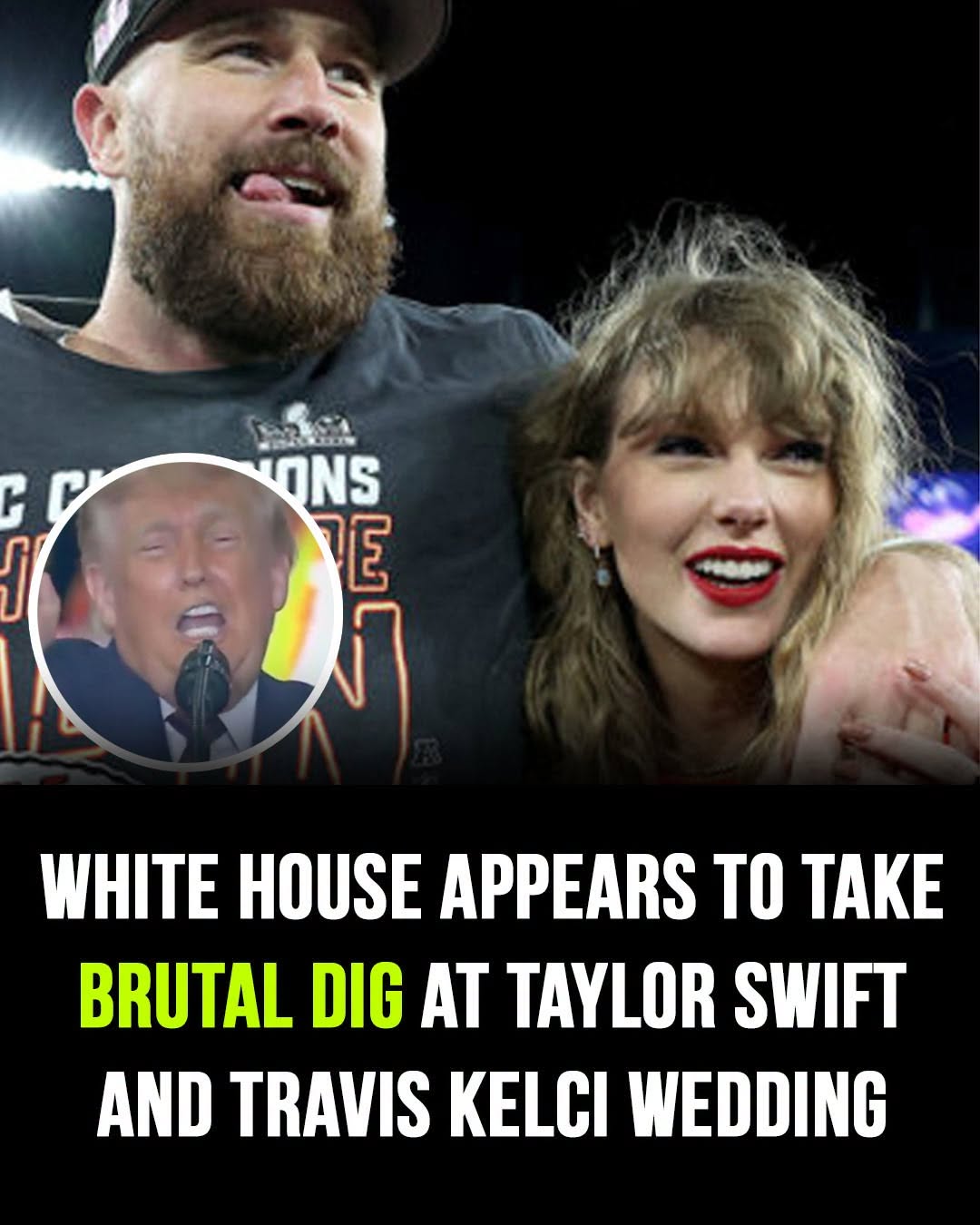
Almost immediately, political commentary and online reactions began to swirl, including what appeared to be subtle mockery from White House-linked social media accounts referencing the couple’s high-profile status and the spectacle surrounding their relationship. Screenshots and edited images circulated rapidly, turning what was intended as a private celebration into another entry in the ongoing culture war landscape where celebrity, politics, and public perception constantly collide.
The reaction underscored a familiar pattern: in today’s media environment, no moment involving figures as globally recognized as Swift and Kelce exists in isolation. Every image becomes commentary, every celebration becomes debate, and every personal milestone risks being reframed as symbolic of something far larger than itself.
Inside the venue, however, the tone reportedly remained unchanged. One of the most discussed aspects of the event was the couple’s “no-gifts” policy, a decision that redirected attention away from material exchange and toward shared experience. Even more striking were reports that approximately $26 million tied to the event and surrounding initiatives was quietly directed toward charitable causes, including food banks, animal shelters, children’s literacy programs, and pediatric cancer support.
For supporters, these choices reinforced a narrative of intentionality an effort to strip away excess and redirect focus toward meaning rather than display. In a cultural landscape often criticized for overproduction and performative generosity, the gesture stood out precisely because it was not framed as spectacle within the moment itself.
Yet even that restraint became part of the larger public conversation.
Online, the contrast between the ceremony’s carefully curated intimacy and the political noise erupting outside fueled competing interpretations. To some, the wedding represented a rare moment of sincerity from two figures often defined by public visibility. To others, it became another flashpoint in a broader debate about celebrity influence, wealth, and cultural attention.
The juxtaposition only intensified when reports of political commentary and meme-driven criticism from White House-associated channels entered the discourse. What might once have remained separate spheres celebrity weddings and political messaging now overlap in real time, each amplifying the other in a cycle of reaction and counterreaction.
Through it all, Swift and Kelce remained at the center of a story they could not fully control, yet appeared determined to define on their own terms. The ceremony, at least according to those present, did not lean into excess or chaos, but instead into restraint, connection, and carefully chosen simplicity.
And that may be what made it so compelling.
Because beneath the headlines, the edits, the commentary, and the political noise, a quieter reality persisted: two people made a public commitment in a world that rarely allows anything to remain purely personal.
For a brief window, inside a transformed arena, that commitment was allowed to exist without interruption.
Outside, the interpretation never stopped.