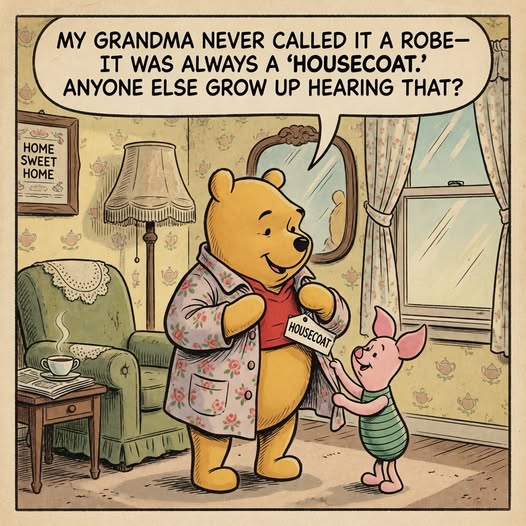
We do not just lose objects over time. We lose the language that once wrapped around them. Words fade. Meanings shift.
And with them, entire worlds slip quietly out of reach. Housecoat lived in the soft space between sleep and daylight, between the clink of a spoon in a mug and the slow shuffle across a kitchen floor. It was never just a garment. It was the uniform of unhurried mornings, of grandparents at the table, of a home that creaked and breathed and welcomed you exactly as you were. You did not dress to impress in a housecoat. You dressed to be comfortable. To be yourself. To be at home.
The word itself sounds different. Housecoat. It lands softer than robe. It carries the weight of a house, of a home, of the walls that held your family together. It suggests a coat meant for inside, for the living room, for the kitchen, for the chair by the window where the morning light came through just right. You wore it over your nightgown or your pajamas. You wore it while you made coffee, while you read the paper, while you sat with someone you loved without needing to say a word. It was not about fashion. It was about feeling. And that feeling is harder to name now because the word has almost disappeared.
When we say robe, we are not wrong. But we are a little farther away. Robe is generic. It could be a bathrobe, a spa robe, something you put on after a shower or before a swim. It does not carry the same intimacy. It does not evoke the same images. Robe could belong to anyone, anywhere. Housecoat belonged to your grandmother. To your mother. To the neighbor lady who used to bring over extra casserole. It belonged to a specific time, a specific place, a specific way of living that has largely faded. But not entirely. The word housecoat sits quietly in memory, ready to unlock an entire scene with a single syllable.
Say it to yourself. Housecoat. What do you see. Perhaps a chipped mug, the one with the faded flower pattern that no one was allowed to throw away because it was still perfectly good. Perhaps a radio humming in the corner, tuned to the station that played old standards and gentle news. Perhaps the smell of toast, just slightly burned, because someone always got distracted. Perhaps the comfort of knowing who would be sitting in that chair every morning, wrapped in the same faded fabric, holding the day gently before it began. That is what housecoat means. That is what we lose when we stop using the word.
The mornings of the housecoat era were slower. Not because people had less to do, but because they had not yet learned to rush. The day did not start with a phone in your hand or a screen in your face. It started with a stretch, a yawn, a shuffle to the kitchen. The kettle whistled. The coffee percolated. The toaster popped. And somewhere in between, you pulled your housecoat tighter against the morning chill and sat down at the table. You were not ready for the world yet. You were just ready for the day. There is a difference.
That difference is hard to explain to someone who has never known it. The world now demands that we be on, always on, from the moment we wake. Emails. Notifications. News alerts. The morning is no longer a sanctuary. It is a starting line. And we have traded the housecoat for the robe, which is fine, but not the same. The robe is practical. The housecoat was personal. It had been washed so many times that the fabric was soft, almost threadbare in places. It smelled like you. It smelled like home. You could not buy that feeling. You could only inherit it, or grow into it, or remember it from someone who had it.
The housecoat did not judge. It did not expect. It did not ask you to be anything other than who you were at that moment. Half asleep. Hair messy. Face bare. Voice still scratchy. That was acceptable. That was welcome. That was the point. The housecoat was permission. Permission to be human. Permission to be slow. Permission to be unpolished. And that permission is harder to find now, in a culture that values productivity over presence, performance over peace.
Still, the word lingers. It lives in the back of the dictionary, in the memories of those who remember, in the stories we tell about the way things used to be. It may never come back into common use. Language moves forward, not backward. But knowing the word, remembering it, using it when we can, is a small act of resistance. A refusal to let that entire world disappear without a trace. Because the housecoat was never just a piece of fabric. It was a feeling. And feelings, even old ones, still matter.
So the next time you put on your robe, pause for a moment. Think about the word you are not saying. Think about the mornings that word represents. Think about the people who wore housecoats and the lives they lived, slower and softer and maybe, in some ways, richer. Not because they had more, but because they noticed more. They noticed the steam rising from the cup. They noticed the light changing through the window. They noticed the person across the table. And they noticed all of it while wearing a housecoat. That is not nostalgia. That is a reminder. A reminder that how we start the day matters. And what we wear while we start it matters too. Not because of the fabric, but because of the feeling. And some feelings deserve their own word. Housecoat was that word. It still is, for those who remember. And for those who do not, it is never too late to learn. To say it. To sit with it. To let it bring you back, even for a moment, to a morning that felt like home. Because that is what words can do. They can carry us. They can hold us. They can remind us of who we were and who we still might be. All it takes is one word. Housecoat. Say it. Feel it. And maybe, just maybe, let it change your morning. One slow sip at a time. One quiet breath at a time. One old word at a time. That is not nothing. That is everything. That is the housecoat difference. And it is worth remembering.