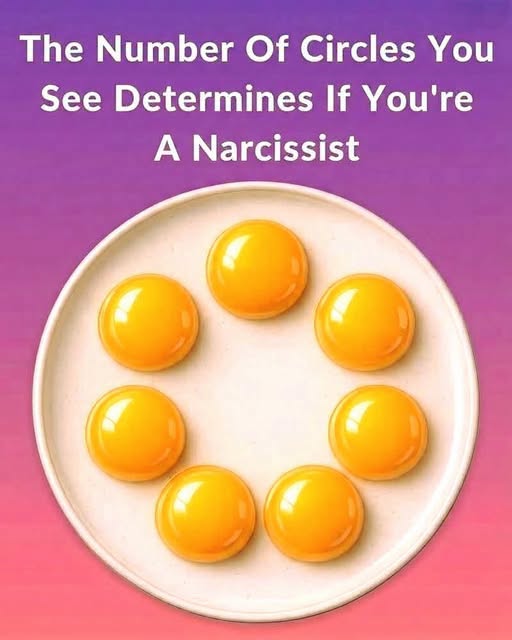
At first glance, it looks like nothing more than a simple visual puzzle. A harmless image. A circle-based illusion. The kind of thing you expect to scroll past in seconds, maybe guess at, maybe share with a friend for a quick laugh. But something subtle happens the longer you stare at it.
The picture stops feeling static. It starts feeling unstable. As if it refuses to behave the way your eyes expect it to.
Most people assume they are simply “looking” at the image. But what actually happens is far more complex. The brain is not a passive camera. It is an active interpreter, constantly rewriting what the eyes deliver. It highlights certain shapes, ignores others, fills in gaps that were never actually there, and quietly constructs a version of reality that feels complete enough to trust.
That is where the illusion begins to work its quiet magic.
Two people can look at the exact same circle puzzle and walk away with completely different interpretations. One may confidently count a set of shapes, convinced the answer is obvious. Another may insist those same shapes form something entirely different. And in a strange way, both experiences feel correct to the person having them. The image itself does not change but the mind behind it does.
This is not a trick in the traditional sense. There is no hidden object waiting to be “found” in the way most people expect. Instead, the illusion exposes something far more uncomfortable: how easily perception can be shaped without permission. How quickly the brain commits to a version of reality before all the information is fully processed.
What makes this particular puzzle so compelling is not its difficulty, but its familiarity. It feels like a game, something light and simple. Yet the moment confusion sets in, it becomes something else entirely a mirror reflecting the limits of attention itself.
When you first engage with the image, your mind tries to categorize it. It searches for patterns it already knows. Circles become groups. Groups become counts. Counts become certainty. The brain prefers efficiency over accuracy, especially when the task appears trivial. It does not want to analyze endlessly; it wants closure.
So it guesses.
And then it defends that guess as truth.
But the illusion resists that instinct. The more you look, the more unstable your initial answer feels. Shapes that once seemed obvious begin to shift slightly. What appeared structured starts to feel ambiguous. And suddenly, you are no longer solving a puzzle—you are negotiating with your own perception.
This is where the experience becomes strangely personal. Because the illusion is not just showing you an image; it is showing you how your mind behaves when it is uncertain. It reveals the shortcuts you rely on every day without realizing it. The assumptions. The expectations. The invisible edits your brain makes to keep the world feeling manageable.
In that sense, the puzzle is less about visual accuracy and more about cognitive honesty.
One of the most unsettling realizations people report after engaging with it is how easily certainty dissolves. A confident answer given in the first few seconds can collapse entirely after a second glance. Not because the image has changed, but because attention has deepened. Details once ignored suddenly matter. Relationships between shapes become more complex. What looked like a simple count transforms into an interpretive challenge.
And with that shift comes a quiet question: how often does this happen in real life without us noticing?
Everyday perception works in much the same way. The brain constantly filters information to avoid overload. It decides what is relevant and what is background noise. Most of the time, this system works so efficiently that we never question it. We trust what we see, hear, and remember as stable. But illusions like this reveal the fragile architecture underneath that trust.
They show that perception is not fixed. It is negotiated in real time.
The most striking part of the circle puzzle is not the answer people eventually arrive at, but the disagreement that emerges along the way. Friends argue. Comments sections divide. Some insist there are fewer elements, others swear there are more. Each person feels equally convinced, equally correct, and equally confused by anyone who sees it differently.
This is where the illusion expands beyond the image itself. It becomes a demonstration of how reality is shared—and how fragile that sharing can be. What you see is not always what someone else sees. And yet both experiences feel equally real to the people living them.
There is no single moment where the illusion “clicks” for everyone in the same way. Instead, there are multiple interpretations competing for attention, each shaped by focus, patience, and expectation.
When you return to the image after stepping away, something often changes again. Not necessarily the picture, but your willingness to rush through it. You slow down. You look more carefully. You hesitate before assigning meaning. And in that hesitation, the illusion loses some of its power.
Not because it becomes easier, but because you become more aware of your own perception shaping it.
That is the quiet lesson hidden inside the puzzle.
It is not designed to test intelligence, or speed, or visual accuracy. It is designed—intentionally or not—to interrupt automatic thinking. To force a pause in a world where attention is constantly fragmented. And in that pause, something subtle becomes visible: the mind is not a transparent window onto reality. It is an active editor, constantly deciding what reality will be.
By the time you think you have solved it, the real shift has already happened. The image is no longer the point. The point is the realization that certainty is often constructed, not discovered. That seeing is not the same as knowing. And that even the simplest visual experience can contain layers your mind will only uncover when it is willing to slow down and look again.
In the end, the circle puzzle does not really ask how many shapes are present. It asks something far more profound without ever saying it directly: how much of what you believe you see is actually there, and how much of it is your mind quietly inventing to make sense of the world.