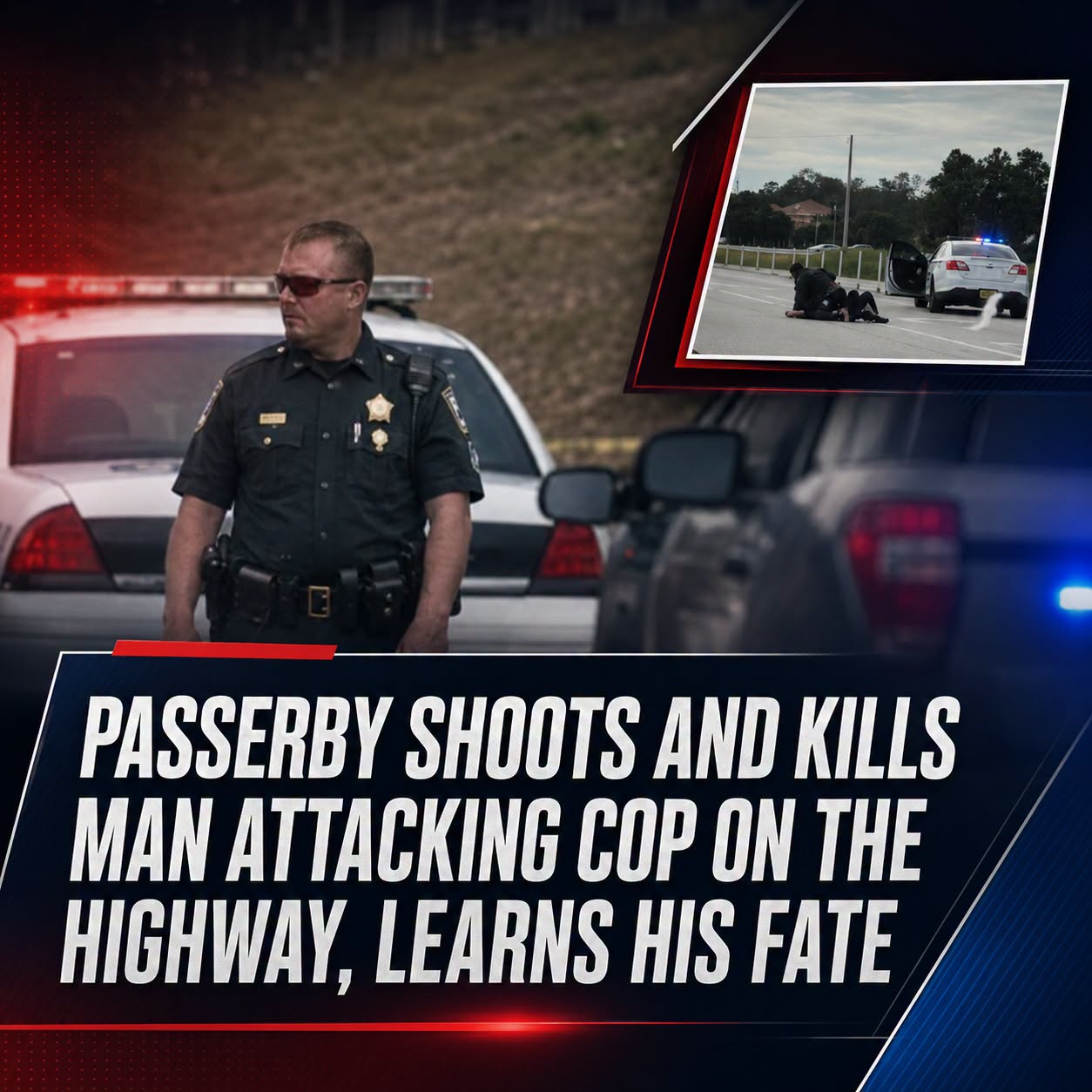
What began as a routine traffic stop on a busy stretch of I-75 quickly escalated into a violent confrontation that would end with one man dead, a deputy injured, and a passerby forced into a split-second decision that would later divide public opinion.
Deputy Dean Bardes had pulled a vehicle over when the situation abruptly turned chaotic. According to witness accounts, 53-year-old Edward Strother suddenly became aggressive during the encounter, moving from verbal resistance to physical violence. Within moments, the deputy was on the ground, struggling to defend himself as Strother allegedly pinned him to the asphalt and struck him repeatedly.
Traffic continued to flow around the scene as stunned drivers realized something far more serious than a standard roadside stop was unfolding. Horns blared, cars slowed, and several witnesses later described the moment as disorienting and surreal, as if a routine afternoon had fractured into something unrecognizable.
Among those caught in the unfolding crisis was 35-year-old Ashad Russell, a licensed concealed-carry holder who happened to be nearby. Russell pulled over when he saw the struggle and stepped out of his vehicle, confronting a situation that had already descended into violence. With the deputy reportedly pinned and unable to regain control, Russell drew his firearm and approached the scene.
In statements later reviewed by investigators, Russell claimed he gave repeated verbal warnings before taking further action. He said he ordered Strother to stop and attempted to assert control over the situation, but that his commands were ignored amid the chaos. At one point, according to reports, the deputy himself also called out during the struggle, adding urgency to an already critical moment.
Faced with what he believed was an imminent threat to the deputy’s life, Russell fired his weapon. Three shots struck Strother in the neck, ending the physical confrontation almost immediately. Emergency responders arrived shortly afterward, but Strother was pronounced dead at the scene.
The incident triggered a full investigation, as is standard in any case involving the use of lethal force. Authorities reviewed body camera footage, witness statements, and forensic evidence to reconstruct the sequence of events. The central question was whether Russell’s intervention met the legal threshold for justified self-defense and defense of another person.
After a detailed review, investigators concluded that Russell’s actions were legally justified under the circumstances. The findings determined that he had reasonably believed the deputy was in imminent danger of death or serious bodily harm at the time he fired. As a result, prosecutors declined to bring charges, and the case was formally closed.
Law enforcement officials publicly acknowledged Russell’s intervention, with the sheriff describing him as someone who acted decisively in a moment of extreme crisis. In remarks following the investigation, the sheriff credited Russell with preventing what could have become a fatal outcome for Deputy Bardes, characterizing the intervention as life-saving.
For many in the law enforcement community, the case reinforced the unpredictability of roadside encounters and the role that armed civilians can sometimes play in rapidly evolving emergencies. Supporters of Russell’s actions framed the incident as a tragic but necessary use of force to stop an ongoing assault.
However, the outcome also left behind a deeply human and painful aftermath. Strother’s family members were left grappling not only with grief but with the official conclusion that his death occurred during a justified intervention. His brother, speaking publicly, questioned how the situation could be resolved so definitively in legal terms while still feeling so devastating on a personal level.
That tension between legal justification and emotional consequence has become a central feature of discussions surrounding the case. While the investigation closed the matter from a prosecutorial standpoint, it did not resolve the broader moral questions raised by the encounter.
The incident has also reignited debate about the role of armed bystanders in violent confrontations. Some argue that Russell’s actions demonstrate the potential value of immediate intervention when law enforcement officers are overwhelmed. Others caution that introducing additional firearms into already volatile situations can escalate danger and create further unpredictability.
Experts note that cases like this often hinge on seconds, perception, and rapidly changing conditions rather than clear, controlled decision-making. In this instance, the combination of a physical struggle, a vulnerable officer, and a civilian armed response created a scenario with no easy outcomes.
Deputy Bardes, who survived the attack, has not publicly provided a detailed account of the event, but officials confirmed he sustained injuries during the struggle. His recovery has been described as ongoing, with support from fellow officers and the department.
As the case closes legally, it continues to echo in public discussion, where interpretations of heroism, necessity, and tragedy often overlap. For some, Russell’s actions represent a life saved in a moment of chaos. For others, the loss of Strother remains a stark reminder of how quickly lethal force can become the final answer in an unfolding confrontation.
In the end, the incident on I-75 leaves behind more than a closed investigation. It leaves a collection of competing truths: a deputy who survived a violent attack, a civilian who intervened under extreme pressure, and a man who lost his life in a matter of seconds. Legally resolved but emotionally unresolved, the case continues to sit at the intersection of law, morality, and the irreversible consequences of split-second decisions.