It started with something so small I almost missed it.
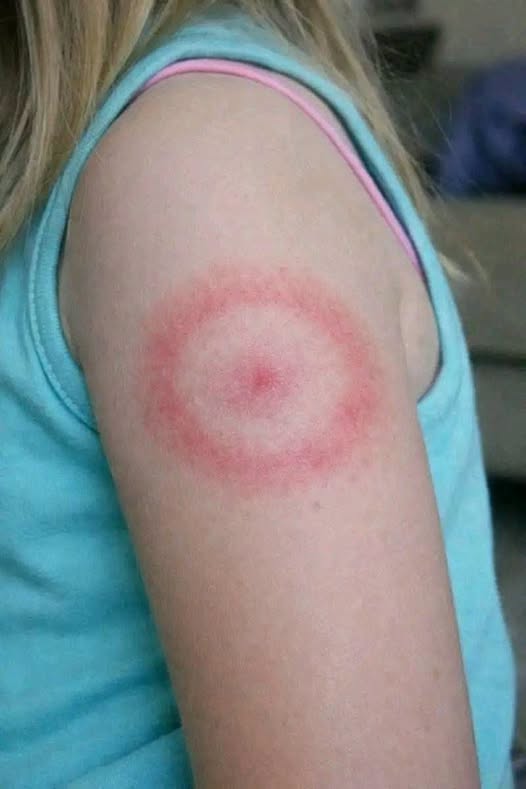
My daughter came into the kitchen rubbing the sleep from her eyes, still wearing her pajamas, asking what was for breakfast. As she reached for a glass of juice, I noticed a faint red circle on the inside of her forearm.
It wasn’t a scrape.
It wasn’t a bruise.
It wasn’t the kind of rash I had seen before.
The mark was almost perfectly round, with a darker red edge surrounding skin that looked slightly lighter in the center.
“What happened to your arm?” I asked.
She looked down, shrugged, and said, “I don’t know.”
“Does it hurt?”
“No.”
“Does it itch?”
“No.”
She acted as though nothing was wrong.
I tried to convince myself it probably wasn’t anything serious.
Maybe she had slept on a wrinkle in her blanket.
Maybe an insect had bitten her during the night.
Maybe it would disappear before lunch.
But throughout the morning, I couldn’t stop looking at it.
Every time she walked past me, my eyes drifted back to the mysterious circle.
Then I made the mistake so many parents make.
I searched the internet.
Within minutes I had convinced myself that everything from a harmless skin irritation to a serious medical condition was possible.
Every article seemed more alarming than the last.
One website suggested it might be a fungal infection.
Another mentioned allergic reactions.
A third discussed tick-borne illnesses.
The more I read, the less certain I became.
Suddenly, every possibility felt terrifying.
I found myself checking the mark every fifteen minutes.
Was it getting larger?
Was the color changing?
Or was my imagination making it seem different each time I looked?
My daughter, meanwhile, continued her day as if nothing had happened.
She played with her toys.
She laughed at cartoons.
She asked for another snack.
She wasn’t acting sick in any way.
That was the strange part.
If something serious was happening, shouldn’t she feel ill?
Shouldn’t she have a fever?
Shouldn’t she be complaining?
Instead, she was completely herself.
That contrast made the uncertainty even harder.
Eventually I stopped searching online and called our pediatrician.
The nurse asked several calm, straightforward questions.
Did she have a fever?
No.
Was the rash painful?
No.
Was it itchy?
No.
Had she recently been hiking, camping, or playing in wooded areas?
Had she been exposed to new soaps, detergents, lotions, or plants?
Each answer helped narrow the possibilities without jumping to conclusions.
The nurse encouraged me to take clear photographs of the rash in good lighting.
She also suggested using a washable marker to gently trace around the outer edge of the ring.
That way, if the redness spread, I would know for certain rather than relying on memory.
It was such simple advice, but it immediately changed my mindset.
Instead of panicking, I had something useful to do.
I took several photos from different angles.
I marked the border.
I wrote down the time.
Then I waited.
Waiting turned out to be the hardest part.
Every parent wants immediate certainty.
We want someone to tell us exactly what’s happening and exactly what to do.
Real life rarely works that way.
Sometimes the safest choice is careful observation while staying in contact with a healthcare professional.
As the day continued, I noticed something surprising.
The rash wasn’t spreading nearly as dramatically as I had feared.
When I compared the new photos with the earlier ones, there was almost no difference.
My imagination had been amplifying every tiny variation.
At our appointment later that day, the pediatrician examined the mark carefully.
She explained that ring-shaped rashes can have many different causes.
Some are caused by fungal infections like ringworm.
Others result from mild skin irritation, eczema, insect bites, allergic reactions, or contact with certain plants.
In some situations, particularly after a tick bite, a slowly expanding ring-shaped rash can be associated with more serious conditions that require prompt medical treatment.
The appearance alone isn’t always enough to know the cause.
Doctors also consider symptoms, medical history, recent activities, and how the rash changes over time.
In our daughter’s case, the doctor determined that the rash appeared consistent with a common, easily treated skin condition.
She prescribed appropriate treatment and explained what changes would require another evaluation.
Most importantly, she reassured us that we had done the right thing.
We hadn’t ignored it.
We also hadn’t allowed panic to replace good judgment.
We observed.
We documented.
We sought medical advice.
Looking back, I realized the biggest challenge wasn’t the rash itself.
It was managing my own fear.
Parenthood creates a strange responsibility.
You constantly balance two competing instincts.
One tells you to treat every unusual symptom as an emergency.
The other reminds you that children experience countless harmless bumps, bruises, bites, and rashes while growing up.
Learning when to worry and when to stay calm is something no parent ever fully masters.
Every unfamiliar mark feels personal.
Every unexplained symptom carries the weight of responsibility.
What if you overlook something important?
What if you overreact?
Those questions never disappear.
But I learned something valuable that day.
Panic rarely produces better decisions.
Observation does.
Taking clear photographs.
Noting changes.
Watching for fever, pain, swelling, or other new symptoms.
Speaking with a qualified healthcare professional.
Those simple actions provide far more clarity than endless internet searches ever will.
The mysterious red ring eventually faded.
Within days it had almost completely disappeared.
Life returned to normal.
My daughter forgot about it long before I did.
But I never forgot the lesson it taught me.
Love isn’t measured only by how fiercely we protect our children.
Sometimes it is measured by our willingness to slow down, gather information, ask for help, and trust the process instead of letting fear take control.
Every strange symptom tells a story.
Most turn out to be far less frightening than our imagination first suggests.
A few require immediate attention.
The challenge is recognizing the difference without allowing anxiety to write the ending before the facts have a chance to speak.
That morning began with a mysterious red ring.
It ended with something much more important.
A reminder that the strongest parents are not the ones who never feel afraid.
They are the ones who keep thinking clearly, even while they are.