It started as a quiet afternoon, the kind where rain taps gently against the window and time seems to move a little slower than usual.
Emma was sitting at her grandmother’s kitchen table when Grandma appeared beside her with a small smile and something folded carefully in her hands.
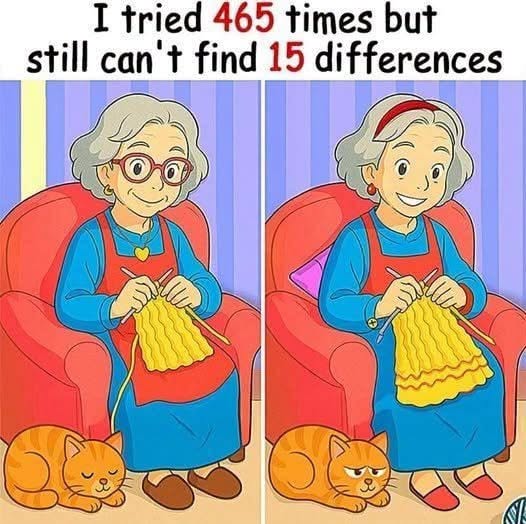
Two pictures.
Almost identical at first glance.
“Can you tell me what’s different?” Grandma asked, placing them side by side.
Emma laughed immediately, confident.
“They look exactly the same,” she said, leaning closer.
Her grandmother didn’t respond right away. Instead, she gave that familiar look she always had when a simple question was not nearly as simple as it seemed.
Emma picked up both images and studied them again.
A cozy living room scene was printed across both sheets.
A red armchair sat near the window.
A sleeping cat curled on a rug.
A set of knitting needles rested beside a basket of yarn.
Everything appeared perfectly ordinary.
Perfectly mirrored.
But Grandma was still smiling.
That alone was enough to make Emma suspicious.
Then she noticed it.
“The necklace,” Emma said suddenly. “It’s different in one picture.”
Grandma nodded once.
“Good. Now find the other fourteen.”
Emma blinked.
“Fourteen?”
Grandma simply pushed the pictures closer and walked away, clearly enjoying the challenge she had just created.
At first, Emma thought it would be easy.
She leaned over the images again, confident that once you spotted one difference, the rest would reveal themselves quickly.
But that assumption disappeared within minutes.
The more she looked, the less certain she became.
A curtain fold looked slightly off.
A shadow seemed a bit darker.
A book on the shelf appeared to tilt in one version but not the other.
She circled a few differences on a notepad.
Then erased them.
Then circled them again.
Nothing felt certain anymore.
By the time ten minutes passed, Emma was no longer confident she had even found the first correct difference.
That’s when her brother walked into the room.
“What’s this?” he asked, grabbing one of the pictures.
Emma explained.
“Fifteen differences,” she said. “I only found one for sure.”
He scoffed immediately.
“Fifteen? That’s easy. I’ll be done in five minutes.”
He sat down confidently, arms crossed like someone about to solve a simple puzzle.
Five minutes passed.
Then ten.
Then twenty.
His confidence slowly drained as he leaned closer and closer to the pages, eyes narrowing in frustration.
“Okay,” he muttered. “This is harder than it looks.”
Soon after, more family members began joining in.
A cousin sat down and immediately pointed out two differences, only to later realize one of them wasn’t actually different at all.
Emma’s parents got involved next, each convinced they would outperform the others.
The kitchen filled with overlapping voices.
“I found nine.”
“No, that’s not different, that’s just lighting.”
“I swear there are only thirteen differences total.”
“Wait, is this chair slightly bigger or am I imagining it?”
Even Grandpa joined in at one point, adjusting his glasses with full confidence.
“I’ve got sharp eyes,” he said. “I don’t miss anything.”
Ten minutes later, he quietly admitted defeat and blamed the lighting in the room.
By evening, the table was covered in scribbled notes, crossed-out guesses, and two slightly wrinkled pictures that had now been stared at from every possible angle.
Yet no one agreed on the final number of differences.
The answers ranged widely.
Nine.
Twelve.
Thirteen.
Fourteen.
No one could reach fifteen with certainty.
Emma sat back in her chair, exhausted but fascinated.
It no longer felt like just a puzzle.
It felt like a trick played on perception itself.
Every time she looked again, she noticed something new.
A cup handle facing the opposite direction.
A pattern on the wallpaper slightly shifted.
A small object appearing in one frame but not the other.
And yet, she could never be fully sure which discoveries were real and which were her eyes playing games on her mind.
That’s when Grandma returned.
She looked at the scattered papers, the frustrated faces, and the intense concentration still lingering in the room.
Then she smiled again.
“You see?” she said softly.
No one answered.
“Sometimes,” she continued, “the smallest differences are the hardest to see because your brain decides what it expects to see before you notice what is actually there.”
Emma looked down at the pictures again, this time more slowly.
Less rushing.
Less guessing.
More observing.
And suddenly, the puzzle felt different.
Not easier exactly.
But clearer in a strange way.
As if the challenge had never been about the pictures at all.
Grandma placed a hand on the table.
“Life is like this too,” she said. “If you rush, you miss things that are right in front of you.”
Emma didn’t respond immediately.
She just kept looking.
And slowly, the chaos in the room quieted.
One by one, family members stopped arguing and started observing instead.
Not guessing.
Not assuming.
Just looking.
And in that silence, more differences began to appear.
Not all at once.
But one by one.
Until the room filled with the quiet satisfaction of discovery instead of frustration.
By the end of the night, no one could say exactly who had found all fifteen first.
But that no longer seemed important.
What mattered was the realization they had all shared without saying it out loud.
Sometimes, the answer isn’t hidden because it’s impossible to find.
It’s hidden because the mind is too busy to see it.
And sometimes, all it takes is slowing down long enough for everything to finally come into focus.