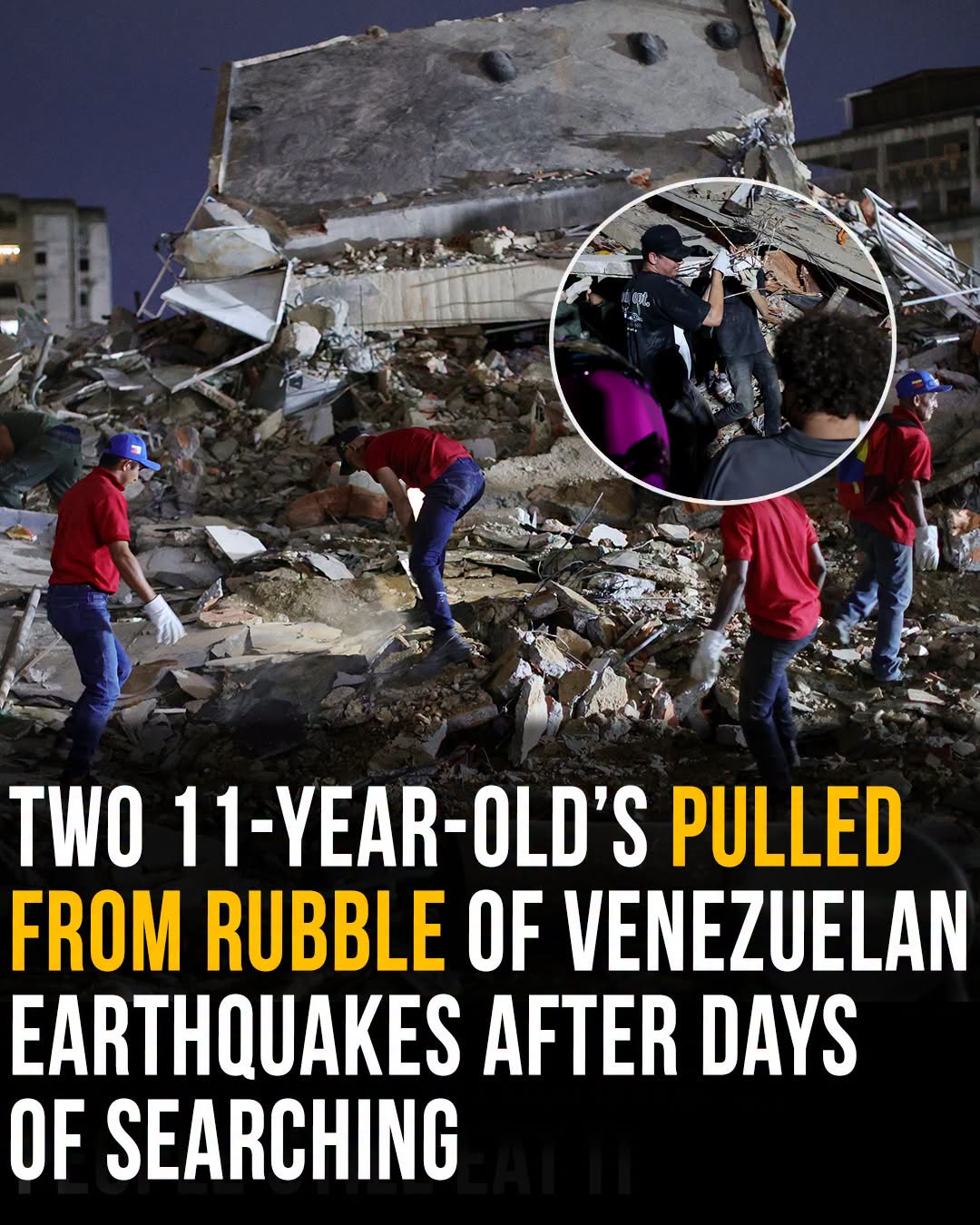
As dawn broke across Venezuela, rescue workers were still digging.
The sounds of heavy machinery mixed with desperate voices calling into collapsed buildings. Dust hung over entire neighborhoods, turning the morning light gray. Streets that once carried school buses and commuters had become fields of broken concrete, twisted metal, and shattered glass.
Days after the devastating earthquakes struck Venezuela, the country remained trapped between hope and heartbreak.
Every pile of rubble held two possibilities.
Someone might still be alive.
Or another family might receive the news they had feared since the ground first began to shake.
Among the countless rescue operations unfolding across the country, two stories came to symbolize both the miracle and the tragedy of the disaster.
The first brought tears of joy.
The second left an entire nation grieving.
After more than 70 hours beneath collapsed concrete, rescue teams managed to pull two 11-year-old boys alive from the ruins.
Their survival seemed almost impossible.
For three days and three nights, emergency workers had continued searching despite fading hopes. Families stood nearby, refusing to leave. Volunteers carried supplies, doctors waited with stretchers, and rescue dogs moved carefully through unstable debris.
When signs of life were finally detected, silence fell over the rescue site.
Workers began digging by hand.
Minutes felt like hours.
Then one child appeared.
Moments later, the second boy was brought to safety.
The crowd erupted.
People cried openly.
Rescue workers embraced one another.
Some fell to their knees.
In a disaster measured by destruction, these two boys became symbols of survival.
Doctors immediately transported them for treatment while officials described their rescue as one of the most remarkable moments of the entire emergency response.
Their survival gave hope to thousands of families still waiting for news.
But elsewhere in Venezuela, hope had already disappeared.
Argentine footballer Lucas Trejo had spent days pleading for information about his wife and two children.
While he remained with his club in Caracas, the earthquakes struck the coastal area where his family lived.
His wife Yanina and their children, Aaron and Ainhoa, were inside their apartment building when it collapsed.
As rescue teams searched through the remains, Trejo used social media to beg for information, refusing to accept the possibility that his family might be gone.
His messages reflected the same fear experienced by thousands of relatives across the country.
He prayed.
He waited.
He hoped.
After nearly four days of searching, rescuers made the discovery everyone had feared.
The bodies of his wife and children were recovered from the rubble.
The football club released a statement expressing its support for the grieving player.
Friends and supporters shared messages online asking for privacy and compassion.
For Lucas Trejo, the disaster became intensely personal.
While stadium lights continued shining and matches continued elsewhere, his entire world had disappeared beneath collapsed concrete.
His story quickly spread throughout the country.
People saw in his loss the suffering of countless other families.
Every official death figure represented someone’s spouse.
Someone’s child.
Someone’s parent.
Someone whose future ended without warning.
Authorities continue working to determine the full scale of the disaster.
Entire neighborhoods remain inaccessible.
Rescue operations continue around the clock.
Many families still wait for answers.
Meanwhile, another tragedy unfolding thousands of miles away has also captured international attention.
In Thailand, a family is mourning the loss of a 17-year-old girl whose body was discovered inside a suitcase near railway tracks.
The shocking case has generated widespread public outrage.
Authorities quickly launched an investigation, eventually identifying a suspect who now faces severe criminal charges.
Reports indicate that prosecutors may seek the harshest possible penalties if a conviction occurs.
The victim’s family has spoken publicly about their grief, describing a young life cut tragically short.
The case has prompted renewed discussions about violence against women and the need for stronger protections for vulnerable individuals.
While one family mourns in Thailand, tensions elsewhere in the world appear to have eased, at least temporarily.
The United States and Iran have reportedly stepped back from what many feared could become a direct military confrontation.
Recent tensions involving attacks, shipping routes, and regional instability had raised concerns about a larger conflict.
Particular attention focused on the Strait of Hormuz, one of the world’s most important shipping routes.
Any disruption there carries enormous consequences for global energy supplies and international trade.
For now, both sides appear willing to reduce immediate tensions.
Commercial vessels continue moving through the region.
Diplomatic discussions remain ongoing.
Military forces continue monitoring developments carefully.
The situation remains fragile.
Many analysts caution that tensions could rise again quickly.
But for the moment, the world has stepped back from a dangerous edge.
At the same time, Europe faces a crisis that arrives without explosions, collapsed buildings, or military confrontation.
A severe heatwave continues spreading across multiple countries.
Temperatures have climbed to dangerous levels.
Hospitals report increasing numbers of heat-related illnesses.
Emergency services remain overwhelmed.
Officials estimate that more than 1,300 people may have died during the ongoing extreme weather event.
Unlike earthquakes or explosions, heat often kills quietly.
There are no collapsing buildings.
No sirens.
No dramatic images.
The victims are frequently older adults, individuals with existing health conditions, and those unable to escape extreme temperatures.
In many cities, roads have buckled.
Rail services have been disrupted.
Power systems face enormous strain.
Hospitals operate at capacity.
Scientists continue warning that extreme weather events may become increasingly common.
The current heatwave serves as another reminder of how vulnerable modern societies remain to environmental extremes.
Across multiple continents, people are experiencing very different forms of catastrophe.
Some disasters arrive suddenly.
Others build gradually.
Some are caused by nature.
Others emerge from violence or political conflict.
Yet each leaves behind the same questions.
How do families recover?
How do communities rebuild?
How do people continue after unimaginable loss?
In Venezuela, rescue workers continue searching.
Families continue waiting.
The survival of two young boys has offered hope.
The death of Lucas Trejo’s family has brought profound sorrow.
Both stories now stand side by side.
One represents life.
The other represents loss.
Around the world, similar stories unfold every day.
A grieving family in Thailand.
Anxious diplomats in the Middle East.
Patients suffering during Europe’s deadly heat.
Each event feels separate.
Yet together they reveal something universal.
Human life remains fragile.
Disasters can arrive without warning.
And even during the darkest moments, people continue searching for survivors, comforting the grieving, and hoping for better news tomorrow.
As rescue crews continue digging through the rubble in Venezuela, many families still wait beside collapsed buildings.
Some wait for miracles.
Others prepare for heartbreak.
For now, the world watches.
And somewhere beneath the ruins, hope still survives.